



Pinned Tweet
ZEC FROGS 10 GTD GIVEAWAY
• Follow @zecfrogs & @TobiSync & @anwarmx062
• Retweet and comment:
• Supply: 6969 Pixel Frogs
• Mint price: Free
• Chain: ZEC (Zcash L1)
• Mint date: Monday, 21 Sept
• Website: zecfrogs.xyz
IMPORTANT:
Wallet: Noir wallet ONLY
Submit a u1 (shielded) address from Noir.
Good opportunity everyone
x.com/zecfrogs/statu…

gm legend
A smooth trading experience is useful, but knowing the full cost of a transaction is even more important.
When using @Hypesium I think fee visibility is something worth paying attention to.
The amount entered for a swap doesn't always represent the total cost. Depending on the transaction, users may also encounter network gas, swap or routing fees, bridge charges and price impact.
Before confirming a trade, I'd want a clear breakdown showing:
→ Network gas costs
→ Platform or routing fees
→ Bridge fees, if applicable
→ Estimated amount received
→ Minimum amount expected after execution
One important distinction: I haven't independently confirmed exactly how Hypesium displays every fee or calculates its route costs. So I wouldn't assume that a simpler interface automatically makes a transaction cheaper.
For me, good trading UX isn't just about completing a trade with fewer steps. It's about making sure users understand the costs and expected outcome before approving anything.
Less friction is valuable. But informed decisions require transparency.
When trading through @Hypesium which matters more to you: fewer clicks or a complete breakdown of transaction costs?
Always DYOR.

1
1
41
Faro.eth retweeted

Perps on Yoso is a pretty big shift for a platform that started as pure prediction markets 👀
Having BTC, ETH, SOL and SUI perps sit next to cricket, NIFTY and the Swim or Sink arcade means you do not have to jump between apps anymore. The RWA side with Gold, NVDA, QQQ and SPY is the part that surprised me most.
Up to 50x leverage is no joke though. Small size and a clear exit plan will matter a lot more here than on a normal prediction market.
Planning to try the Perps section this week!

Perps Are Now LIVE on @YosoSocial 📈
You can now trade Perpetuals on BTC, ETH, SOL, BNB, SUI, HYPE and more, with leverage of up to 50x !!
And it's not just crypto. You can also explore RWA markets like Gold, NVDA, QQQ and SPY.
Prediction Markets + Perps, all in one place.
Head over to Yoso and explore the new Perps section
The next chapter of Yoso starts NOW👀
Protecting private keys is important, but what about the environment that actually uses them?
That's a security detail I find particularly interesting about @Hypesium
While exploring its documentation, I came across an explanation of how its transaction signer is isolated from the rest of the system.
According to the documentation, the signer operates inside a read-only, unprivileged container with no open ports, while secrets remain in the host environment.
Why does this matter?
Because a trading bot doesn't simply read wallet information. It also signs transactions that can directly affect users' funds.
So protecting stored keys isn't enough. We also need to understand how the signing process is protected.
There are a few interesting aspects to this approach:
➜ **Read-only environment:** Limits the ability to modify the container's contents.
➜ **Restricted privileges:** Reduces the permissions available to the signing process.
➜ **No open ports:** Removes unnecessary network entry points.
➜ **Secret separation:** Keeps sensitive information outside the signer container.
These are meaningful security design choices, but they shouldn't be confused with a guarantee that the entire system is immune to attacks.
There's another important distinction here.
Encryption, signer isolation and custody are not the same thing.
Hypesium's documentation describes encrypted wallet keys being used to execute transactions based on user instructions. Understanding how those keys are stored, accessed and used is essential when evaluating the overall security model.
Personally, I find these architectural decisions worth examining because trading infrastructure needs more than fast execution.
It needs carefully controlled access to the authority that moves funds.
**My question is: When evaluating a trading bot, how much attention do you give to its internal security architecture compared with its execution speed?**
Always DYOR.
Powered by @starlisting

2
4
77
5x GTD Spots gibeaway for @PlunderPort
Mint Price:Free
Supply:1024
Mint date:TBA
How to enter:
- Follow @FaaroETH and @PlunderPort
- Like & RT
- Tag 2 friends
- Drop your EVM wallet below
Winner selected in 6 hours

Faro.eth retweeted
Is the future of trading about having more tools, or bringing everything together in one place?
That's one question that came to mind while exploring @Hypesium and its approach to the Elysium ecosystem.
What caught my attention is that Hypesium isn't focusing only on token sniping. It's trying to cover more parts of the trading journey through a single interface.
Think about the usual workflow:
Finding new launches, bridging funds, buying and selling tokens, tracking profits and losses, monitoring positions, and deciding when to exit.
Having these activities connected in one place could reduce a lot of unnecessary switching between platforms.
There are also some reported numbers worth looking at:
➜ 230 users during its first week.
➜ Bridging support across 7 chains.
➜ Access to 19 launchpads.
➜ 14 tokens in one activity snapshot.
➜ $59,420 in reported 24-hour trading volume.
These figures offer an interesting look at its early activity, although I haven't independently verified the numbers or the complete transaction workflow.
But I think there's a bigger challenge beyond adding more features.
How well does the platform perform when actual market conditions become difficult?
Thin liquidity, unexpected slippage, bridge failures, smart contract risks, and failed transactions can all affect the trading experience.
A platform might look impressive during normal conditions, but its real reliability becomes clearer when things don't go as planned.
Personally, I like the direction of building a more connected trading experience around Elysium.
Still, features and early activity are only part of the picture. Consistent execution, transparency, and user protection will matter much more over time.
The real question is: Can @Hypesium turn its growing list of features into a reliable trading experience when the market gets unpredictable?
That's what I'll be watching.
Always DYOR.

What happens to your crypto wallet if you decide to stop using a trading bot?
It's a question I think more users should consider before connecting their wallets to any platform.
While reviewing @Hypesium 's Terms of Service, I noticed an important detail: users are advised to export their wallet private keys before closing their accounts.
And there's a good reason to pay attention to this.
Hypesium operates through Telegram, where its bot uses encrypted private keys to sign transactions based on user instructions.
This makes understanding wallet recovery especially important.
Imagine losing access to your Telegram account or deciding to leave the platform without securing your wallet information first.
You could end up facing unnecessary difficulties accessing your assets independently.
I think there are two separate things every user should understand:
➜ Wallet security: Export your private keys and make sure you can access your wallet outside the Hypesium bot. Store them securely and never share them with anyone.
➜ Account privacy: Understand how account information is handled and follow the official process if you want to request account closure and data deletion.
One important distinction: deleting an account doesn't automatically mean your wallet or its assets are recovered.
This isn't only relevant to Hypesium. Any platform that combines automated trading with wallet access should make its recovery and exit procedures clear.
We often focus on how easily a platform lets us get started, but knowing how to leave safely matters just as much.
For me, true self-custody means having control over your assets even when the application you used is no longer part of your workflow.
Before relying on any wallet-integrated trading bot, understand its recovery process first.
Always DYOR.

Faro.eth retweeted
What if the biggest problem with your trading execution isn't the market, but the size of your own order?
That's an interesting lesson from a trading analysis involving @Hypesium .
One thing traders often focus on is slippage, but there's another factor that deserves equal attention: price impact.
Imagine entering a liquidity pool with 200 HYPE when the available liquidity is better suited to handling just 60 HYPE.
Your own order could move the pool price before the transaction is fully executed.
And that's something many traders might overlook.
In one reported comparison across 60 attempts, the difference was significant:
➜ A 200 HYPE entry created 7.4% price impact.
➜ Reducing the entry to 60 HYPE brought that impact down to 1.1%.
The same analysis also showed that a 3% slippage tolerance resulted in a 51% fill rate with larger entries, compared with 74% for smaller positions.
Of course, these are results from a specific trading sample, not a guarantee of future performance.
This is where Hypesium's liquidity routing and transaction simulation become interesting.
Its system searches across V2, V3 and V4 pools to identify available liquidity and simulate the expected transaction outcome before execution.
But there's something important to understand.
A pool having enough liquidity doesn't necessarily mean it's suitable for every position size.
A position that works comfortably at 60 HYPE might create considerable price impact at 200 HYPE.
And traders shouldn't only think about entering a position. Exiting matters just as much.
A large sell order in a thin pool can create another round of price impact, potentially reducing the actual amount received.
However, smaller positions aren't automatically better either.
They reduce exposure and can improve execution conditions, but they also mean missing out on some of the upside when a launch performs exceptionally well.
There's always a trade off between position size, liquidity and potential returns.
My biggest takeaway is that traders should understand how their own orders interact with available liquidity before blaming every poor fill on market conditions.
@Hypesium 's approach to routing and simulation makes this an interesting area to explore further.
What's your usual sniping position size: 50, 200 or 500 HYPE? And do you check price impact before entering?
Always DYOR.
Faro.eth retweeted
Good evening everyone!
Before using any crypto platform, there's something more important than its features: are you actually allowed to use it?
I think this is an important detail people often overlook when exploring new Web3 products.
While looking through @Hypesium 's Terms of Service, I noticed that the platform has specific geographical restrictions.
Its terms explicitly restrict people located in, residing in, or citizens of certain jurisdictions, including the United States, Canada and the United Kingdom, along with comprehensively sanctioned regions.
There is also an age requirement. Users must be at least 18 years old or meet the higher age of majority applicable in their location.
But why does this matter?
Because being able to open a Telegram bot doesn't automatically mean you're eligible to use the service.
I see two different things here:
➜ Technical access: Can you open the bot, create a wallet and explore its features?
➜ Legal eligibility: Does the platform permit you to use its services under its terms and applicable local laws?
These are two completely different questions.
Another important detail is that Hypesium places responsibility on users to ensure their activities are lawful in their respective locations.
I actually appreciate projects making these restrictions visible in their documentation. Users should have the opportunity to understand the rules before getting involved.
It also highlights something bigger about Web3.
We often talk about global accessibility, but not every financial product can operate under the same legal conditions everywhere.
A product being accessible online doesn't necessarily mean it's available to everyone.
My advice is simple: check the eligibility requirements before exploring the features, connecting a wallet or making any transactions.
Understanding the rules should always come before using the product.
Always DYOR.
Faro.eth retweeted
New token launches can create exciting opportunities, but entering a liquidity pool at the right moment is only one part of the equation.
That's what makes @Hypesium 's focus on launch sniping worth exploring.
Being able to detect new pools early and move from discovery to execution through a dedicated workflow could be useful for traders, especially during fast-moving launches.
But there's something I think deserves more attention.
How useful is speed if you don't have enough information to manage the risk?
Newly launched tokens can behave unpredictably. Prices can move quickly, liquidity may be limited, and slippage can turn an attractive entry into a costly one.
I haven't independently tested Hypesium's detection speed, transaction ordering or actual execution performance, so I wouldn't make assumptions about those capabilities.
However, there are a few things I'd like to see become part of a stronger sniping experience:
➜ Configurable limits on trade size.
➜ Clear slippage settings before execution.
➜ Contract security checks to identify potential threats.
➜ Better reporting when transactions fail.
These features could help traders make more informed decisions instead of focusing only on getting in first.
Personally, I don't think successful sniping means buying every new token as quickly as possible.
It means knowing which opportunities are worth taking, understanding what could go wrong, and having the discipline to skip a trade when the risks are too high.
Would you prioritize being the first to enter a new pool, or having better risk controls before making that entry?
Always DYOR.
Faro.eth retweeted
gm legend,
Can Telegram trading become faster without making users less aware of the risks?
That's something worth thinking about when looking at @Hypesium .
One thing I find interesting is how Hypesium brings token discovery and trading actions into Telegram. Instead of switching between different platforms, users can simply paste a contract address and move toward a trade.
For fast-moving Elysium launches, having everything accessible in one place could save valuable time.
But here's where I think things get more important.
How does the experience help users avoid bad decisions?
A smooth trading interface should also make important details easy to understand, such as:
➜ Whether the contract is supported or potentially malicious.
➜ Which network the token belongs to.
➜ Available liquidity and slippage conditions.
➜ Estimated output and transaction costs.
Because clicking buy should never feel like approving something blindly.
I believe the real strength of a trading bot isn't just how quickly it processes an action. It's how well it helps users understand what they're doing before committing their funds.
@Hypesium has an interesting approach to simplifying Telegram trading, but maintaining that balance between speed, security and transparency is what can make the experience more valuable.
What's your priority when using a Telegram trading bot: saving time or having stronger safeguards before every transaction?
Always DYOR.
A trading bot can support multiple launchpads, but users also need visibility into the infrastructure connecting everything.
That's one reason I find @Hypesium operational tools worth discussing.
Hypesium says its bot supports 19 launchpads through one interface.
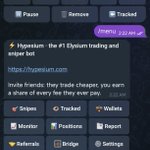
The image highlights five of them:
➜ Montra
➜ Ascend
➜ Volta
➜ Rebate Pad
➜ ElysPump
The other 14 include Kleos, BOXA, Stockium, aka.fun , Stands.social, RONS, Wormpad, Merklewood, LiquidFi, Mesa, Quoted, PerpMe, Obol and Eleos.
With so many launchpad integrations, having a way to check the bot's operational condition becomes especially useful.
That's where the "/status" command comes in.
It displays four key details:
- Connected chain
- Current block
- Network gas information
- Bot connection health
These signals help users understand the environment their trading instructions are going through.
For example, if a snipe doesn't execute as expected, checking the connection and current block can provide useful context before blaming the token or launchpad.
Of course, a healthy connection doesn't guarantee transaction inclusion, favorable ordering or a successful trade.
And supporting 19 launchpads doesn't automatically mean every launch behaves the same way.
I see two useful parts of the product here: broad launchpad discovery and basic operational visibility.
More integrations can expand access, but clear system feedback helps users understand what is happening behind the scenes.
In trading, knowing where you can act matters. Knowing whether your tools are properly connected matters too.
We believe @Hypesium
We love @Hypesium

Faro.eth retweeted
In Web3, having access to a wallet is one thing. Being able to recover it independently is another.
That distinction becomes especially important when a trading service connects wallet access to a Telegram account.
Looking at @Hypesium 's Terms of Service, one detail caught my attention: users are advised to export their wallet private keys before closing their account.
This is not just an account-management step. It is part of protecting access to your assets.
Consider the situation: if someone loses access to their Telegram account before exporting their keys, they may also lose the ability to access the wallet through the service.
The policy also allows users to request account closure and data deletion through official channels, but securing the wallet keys comes first.
I think users should separate two responsibilities:
Wallet control: Keep an independent backup of your private keys so access does not depend entirely on one application.
Data control: Know what information remains with the platform and how to request its deletion.
This is a useful reminder that onboarding is only half of the user experience. The exit process matters just as much.
Before relying on any wallet integrated trading tool, understand how to leave it safely.
Convenience should never replace independent control of your assets.