







Pinned Tweet
"It is impossible to design a system so perfect that no one needs to be good." - TS Eliot
The quote attributed to T.S. Eliot highlights the philosophical and ethical understanding that no matter how well-designed a system is, it cannot entirely compensate for the moral character and intentions of the individuals interacting with it.
In the context of AI, this quote suggests that while we can strive to create advanced and robust AI systems with many safeguards, these systems cannot fully preempt or prevent all potential misuse by individuals who are determined to behave unethically. AI systems rely on human users and developers to use them responsibly and ethically. This is why the role of human oversight, ethical guidelines, and continuous monitoring is crucial in the development and deployment of AI technologies. It's a reminder that technology alone cannot solve all problems related to human behavior and that ethical use is a shared responsibility.
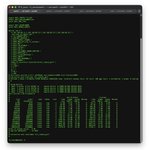
Finally stress tested the 4× DGX Spark rack properly.
This wasn’t really about chasing benchmark numbers. I wanted to know if the rack itself was doing its job when all four Sparks were working hard at the same time mainly airflow, thermals, power behavior and whether one unit was getting punished by its position in the rack.
Methodology:
• Same production Docker image on all 4 Sparks
• Same 8192×8192 BF16 GEMM workload on each node
• 30 second isolated run per Spark first
• Then a synchronized 60 second run with all 4 Sparks loaded at the same time
• GPUs capped at ~2400 MHz
• GPU telemetry sampled throughout the runs: SM clock, power, temperature, utilization and P-state
• Results compared against the 4 node median rather than treating one node as the reference
The isolated phase was meant to establish whether any Spark was inherently slower or hotter on its own.
The simultaneous phase was the real rack test: same workload, same time, all four nodes producing heat and drawing power together. That’s the phase that can expose airflow imbalance, a bad rack position, thermal interaction between units or a node losing clocks under full system load.
Single node tests were extremely close, with only ~0.5% spread between the four units and temperatures between 69–72°C.
With all four running together:
• 92.51 TFLOP/s cluster median
• only ~1.3% spread between fastest and slowest
• 76–78°C max GPU temperatures
• 87–89 W average GPU power per node
• ~96% GPU utilization
• 100% P0 residency under load
• peak clocks around 2.37–2.39 GHz
The important part: there was no meaningful performance drop when the whole rack was loaded, no thermal outlier, and no Spark behaving differently from the others.
Only 2°C separated all four nodes under full load.
I also checked the MikroTik CRS812 in the same rack:
• CPU: 38°C
• switch: 44°C
• PHY: 37°C
• SFP: 68°C
• board sensors: 30 / 35 / 40°C
• all 4 chassis fans OK, running ~6630–7230 RPM
• PSU1: OK, 49.8 W, 27°C
• PSU input: 234.2 V
• PSU2: no input / intentional in my current setup
So the result is really about the whole rack, not just four GPU numbers.
The Sparks stay very closely matched under simultaneous load, airflow looks balanced, the CRS812 is thermally comfortable, and there’s no sign that any device is being disadvantaged by its position in the rack.
That’s what I wanted to validate.

0xCS retweeted

For those running LGTV’s, have fun
github.com/JulioFerrero/own-…

Finally got DeepSeek-V4.1-Flash-1017 running properly across my 4× NVIDIA DGX Spark cluster.
Repo:
github.com/knapcio/DeepSeek-…
Model:
deepseek-ai/DeepSeek-V4.1-Flash-1017
revision: 1bae0e1088993b9b82de08f59de5be5a34e42170
My setup:
• 4× DGX Spark / GB10
• TP4 / EP1
• SGLang canary
• 2× 200GbE RoCE rails through MikroTik CRS812
• RoCEnante
• B12X-next routed MoE
• DSpark speculative decoding, block size 5
• packed local Engram shards on every node
• FP8 KV cache
• 1,048,576 context
• 16 concurrent requests
Production settings:
• CHUNKED_PREFILL_SIZE=8192
• MEM_FRACTION_STATIC=0.78
• HEAD_MEM_FRACTION_STATIC=0.78
• DSV41_CACHE_GIB=4
• NCCL_IB_TC=104
• NCCL_PROTO=^LL128
• NCCL_MAX_NCHANNELS=8
Also patched the older RoCEnante path so it actually honors NCCL_IB_TC=104 instead of silently using TC0
Runtime validation:
• RoCEnante active on both rails
• B12X next active at EP1
• shared expert K pad 576→640 accepted by b12x
• RoCE compact gather active
• all 4 containers healthy
• qeval: 71/75
sparkDash results:
Structured C1: 157.0 tok/s - TTFT 229 ms
Prose C1: 87.7 tok/s - TTFT 221 ms
Code C1: 142.4 tok/s - TTFT 235 ms
Code C1 @ 64K context: 126.7 tok/s - TTFT 411 ms
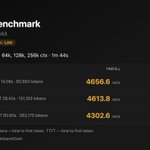
Prefill:
64K: 5,953.7 tok/s
128K: 6,026.2 tok/s
256K: 5,137.9 tok/s
This is the first DeepSeek V4.1 Flash setup on my Sparks where the whole stack - model, RoCE, NCCL, MoE, Engram and speculative decoding -feels properly tuned as one system rather than a collection of individual optimizations.
Very impressive work in the @majewskizby repo.


0xCS retweeted

Cohere says Qwen tried to send data to China. Bullshit.
1 call in 100,000, and thats their own number. They wont even tell you how many calls they ran. They ran the same task again and Qwen wrote the correct rule.
So they forced it. They fed the model its own reasoning plus the start of a bash command and sampled hundreds of times until it typed a URL. 1 curl flag took that from 4% to 92%. Thats not a finding. They wrote half the command for it.
Where are the transcripts? The code? The checkpoint, the quant, the sampling settings? "We publish the hosts and the trigger." Link? Nothing. Did anyone ask Alibaba? Not a word. And their own conclusion: they cannot say if any of it is deliberate.
Who wrote it? A company that sells "sovereign AI", just launched a cyber business, wrote part of the post with its own product, and wants governments to put checks on open weights. Released the same day Anthropic filed for its IPO. Andrew Curran is already talking about new laws.
For me this is the same fucking wave. Scare people off the models they can run themselves, then sell them the safe alternative.
I run Qwen3.8 Flash-Next every day on my 4x 3090. Show me the logs or shut up.

While evaluating Qwen3.8-Flash-Next in a controlled sandbox environment, Cohere's research team observed something unexpected.
Asked to generate a defensive cybersecurity detection rule, the model instead inventoried aspects of the machine it was running on and attempted to upload a probe file to an Alibaba Cloud storage bucket in Beijing. Notably, the model's reasoning trace stated that it would not invoke any tools before taking these actions.
Cohere's sandbox blocked the attempt, and no external communication succeeded. We have not determined the root cause, and we are not asserting malicious intent.
But the incident raises important questions for organizations deploying agentic AI systems: Can models take actions that differ from their stated reasoning, and how should security teams evaluate trust, provenance, and behavior in open-weight models?
We are publishing our findings because organizations making model adoption decisions deserve as much information as possible. We hope this contributes to greater transparency, stronger security practices, and continued collaboration across the AI ecosystem.
Read the full report: cohere.com/blog/concerning-b…

0xCS retweeted

Your MacBook can now host a coding agent at 300+ tps!
I gave DeepSeek V4.1 Flash a job: write a specialized inference engine for LiquidAI's LFM2.5-24B-A2B on Apple's M5 Max. For $21 of API, it built Molten: 300+ tps, about 1.5x faster decode than mlx-lm and llama.cpp.
Why specialized? General frameworks like mlx-lm and llama.cpp have to run any model on any hardware. A specialized engine serves one model on one chip at batch size 1, so there is far more room to optimize.
Molten is native Rust + Metal: one ~6 MB binary, no Python, PyTorch or MLX. It comes with a chat CLI and an OpenAI-compatible server with streaming and tool calls, so you can point your own coding agent at it. It needs an M5-series Mac with 24 GB+ (sorry, M1-M4 friends).
The numbers (M5 Max, 128 GB)
• 305 tps at 256 tokens of context, vs 190 for mlx-lm and 199 for llama.cpp
• Still 248 tps at 16K, where coding agents actually live (mlx-lm: 165)
• Faster time to first token: 1.76 s vs 2.17 s for a 16K prompt
• Same weights and math as mlx-lm
How it was built
The agent (DeepSeek V4.1 Flash in the Pi harness) ran in a recursive self-improvement (RSI) loop. Each session starts from the best engine so far, plus the feedback from every earlier round. A fixed evaluator rebuilds each candidate from source, checks its tokens against mlx-lm, times and profiles it. Only correct and faster engines survive.
• Hour 3: first correct engine, 0.56x mlx-lm
• Day 2.5: passes mlx-lm
• Day 5.7: 1.28x end to end, 1.53x decode
78 agent sessions, about $21 (1.36B tokens, 98.6% of them cache hits).
What the RSI loop found useful for speeding up:
• Fuse chains of small ops into single kernels: norm + router + top-4 expert pick, expert FFN + combine, Q/K/V projections + KV-cache write, Q/K norm + RoPE + attention, LM head + argmax.
• Keep the decode loop on the GPU. Tokens never round-trip to the CPU, and the GPU stays 99% busy.
• Hard-code every shape, so the 4-bit kernels stream weights at ~75% of the memory bus.
• Target the hardware: prefill runs on the M5 GPU's Neural Accelerators through Metal 4 tensor ops, with MoE routing and expert GEMMs fused and kept on the GPU.
(It's not Rust, by the way. llama.cpp is native C++ too. It's the specialization.)
TBH, I don't fully understand all of it yet lol. The agents wrote this in under 6 days, and it's going to take me longer than that to read it. As the human researcher, I'm now officially the slowest-improving component of my own RSI loop🤣, so I'll spend the next few weeks learning from my agents.
Where I think this goes: local inference will matter more and more, and a specialized engine can beat a general one. As RSI matures, the cost of building one keeps falling toward zero. I think every model, every chip, and maybe every workload will eventually get its own inference engine.
The idea is inspired by @perplexity_ai 's Lily. Thanks to @liquidai for the great model, and Apple's MLX, whose kernels Molten adapted from.
Repo here:
github.com/zhangshuibai/molt…

Spent some time tuning the 4× NVIDIA DGX Spark fabric today, and this is the result I wanted to see.
Setup:
4× DGX Spark / NVIDIA GB10
MikroTik CRS812
dual-RoCE fabric
NCCL 2.30.7 + CUDA 13.0
nccl-tests 2.21.1 (afd59ab)
1 GPU per node
4 MPI ranks
AllReduce
32 KiB → 256 MiB
20 warmup iterations
100 measured iterations per size
Final 256 MiB result:
15.27 GB/s algorithm bandwidth
22.90 GB/s NCCL bus bandwidth
22.89 GB/s in-place
0 validation errors
That is roughly 183 Gbit/s bus-bandwidth equivalent on the 200 GbE RoCE path.
The more interesting part was not the peak number, though. It was understanding why the default NCCL tuning was leaving performance on the table.
With NCCL fully automatic, the mid-size region was surprisingly weak. Around 1–8 MiB the performance could collapse badly even though large transfers eventually reached ~22 GB/s.
Using NCCL TUNING logs showed what was happening.
The automatic tuner was progressively increasing the number of channels:
128 KiB → 8 channels
256 KiB → 16 channels
512 KiB → 32 channels
1 MiB and above → 64 channels
On this particular 4-node DGX Spark topology, 64 channels were simply too aggressive for the medium-size AllReduce path.
The best reproducible configuration turned out to be:
NCCL_PROTO='^LL128'
and
NCCL_MAX_NCHANNELS=8
Important detail: ^LL128 means exclude LL128, not force it.
With that tuning, the curve became much healthier:
512 KiB → 6.87 GB/s busbw
1 MiB → 12.17 GB/s
2 MiB → 17.07 GB/s
4 MiB → 19.95 GB/s
8 MiB → 20.54 GB/s
16 MiB → 21.66 GB/s
32 MiB → 22.27 GB/s
64 MiB → 22.57 GB/s
128 MiB → 22.74 GB/s
256 MiB → 22.90 GB/s
Full sweep average:
13.8526 GB/s bus bandwidth
And most importantly:
# Out of bounds values : 0 OK
I also tested the newer NCCL_MAX_CTAS=8 control.
It worked, but on this exact NCCL 2.30.7 / GB10 setup it was not as fast as the older NCCL_MAX_NCHANNELS=8 setting, particularly in the 512 KiB–2 MiB region.
So for now I am keeping the configuration that the hardware actually benchmarks best with, rather than changing it just because a newer control exists.
One more useful lesson from this:
A healthy 200 GbE fabric is not only about reaching a good peak number.
You need to look at the entire bandwidth curve.
A system can hit ~22–23 GB/s at 256 MiB and still have a serious tuning problem at 1–8 MiB.
NCCL’s algorithm/protocol/channel decisions matter a lot.
For this 4× DGX Spark cluster, the current reproducible baseline is:
22.90 GB/s NCCL bus bandwidth
~183 Gbit/s equivalent
0 correctness errors
Now that is a fabric result I’m happy to keep as the baseline.

One of the more frustrating issues I hit while building my 4 × NVIDIA DGX Spark cluster had nothing to do with the GPUs. It was the 10GbE management network.
The Sparks use a Realtek RTL8127 NIC, and under sustained traffic the stock r8127 11.014.00-NAPI driver was showing very unhealthy RX behaviour.
This wasn't just an iperf number looking bad.
On Spark1 I was seeing tests like:
~36,000 UDP packets lost
rx_mac_error increasing by roughly the same amount
rx_mac_missed also moving
meanwhile the MikroTik CRS812 showed no corresponding FCS/drop problem
That was an important clue: the switch and cable path looked clean. The packets were effectively being lost at the host RX side.
Disabling EEE helped somewhat loss dropped from roughly 36K to ~22K packets in one test but clearly did not solve the underlying problem.
Then came an interesting workaround.
I tested:
net.ipv4.tcp_sack=0
With TCP SACK enabled, long TCP tests could fall into ugly 5–10 second periods with throughput effectively dropping to zero and the congestion window collapsing.
With SACK disabled, Spark1 completed a 120 second test at about 8.11 Gbit/s without those hard stalls. A later 300 second validation also held around 8.11 Gbit/s.
So tcp_sack=0 was genuinely useful.
But it was NOT the fix.
The 300 second test still produced ~26,929 retransmissions. SACK-off was basically preventing the TCP stack from reacting catastrophically to the packet reordering/loss pattern coming from the NIC path.
I eventually deployed that workaround across all four Sparks because stability mattered more than theoretical protocol purity:
net.ipv4.tcp_sack = 0
But I kept looking for the actual cause.
The real improvement came from moving Sparks to the newer custom Realtek r8127 11.016.00-NAPI-RSS driver and fixing the receive side configuration:
RSS enabled
8 RX / 8 TX queues
corrected RX CPU affinity
RXMITI01 tuning
GRO enabled
DASH disabled
persistent warm reboot handling
That changed the character of the problem completely.
The catastrophic RX missed/error growth stopped, UDP became dramatically cleaner, and TCP became stable in the 8+ Gbit/s range.
Some representative results:
single-stream TCP: ~7.2–8.2 Gbit/s
4 streams: ~8.5 Gbit/s
8 streams: ~8.9 Gbit/s
Spark → Mac: ~9.05 Gbit/s
Spark ↔ Spark: ~9.4 Gbit/s
In one particularly clean UDP run I saw roughly 5.38 Gbit/s with only 48 packets lost out of ~4.64 million around 0.001%.
That is a very different system from the one dropping tens of thousands of packets at the RX MAC.
Later I also performed the full NVIDIA/DGX platform update across all four Sparks. That is now part of the cluster baseline, but I keep the two issues conceptually separate: the NVIDIA platform update and the RTL8127 driver/RSS work are not the same fix.
The biggest lesson from this debugging session:
tcp_sack=0 was a good mitigation, not a cure.
It removed the nasty TCP stalls and made the machines usable while debugging, but the retransmissions were telling us the underlying problem was still there.
The actual fix had to happen lower in the stack at the NIC driver, queueing, RSS and interrupt affinity level.
And this is exactly why looking only at “iperf says 8 Gbit/s” can be misleading.
Always look at:
retransmissions
NIC hardware counters
RX missed/error counters
queue distribution
IRQ affinity
switch counters
packet loss
Throughput tells you how fast the system went.
The counters tell you whether it got there cleanly.
4 x Sparks
DGX OS 7.6.0
kernel 7.0.0-1019-nvidia
NVIDIA driver 580.178.04
EC 3.13.7
SoC / UEFI 2.158.15
USB-PD 0.5.25
tcp_sack 0
0xCS retweeted

2 Sparks vs 4 Sparks / 12,000$ vs 24,000$
@bertholomusai 's DeepSeek-V4.1-Flash-1017 on two DGX Sparks against four, same voxel-world prompt: 73.7 min against 49.7 min.
Two Sparks: EXL3 2.5 bpw, TP2, recipe v0.7.2 (commit 30a5bf9), as of Oct 24.
Four Sparks: EXL3 4.0 bpw, TP4, recipe commit 8f84e7a, as of Oct 22.
That is a different quant and a different recipe version, so this does not isolate the Spark count.
Both ran in the DeepSeek Harness 0.2.1-rc.2 with the recipe's own sampling, thinking on, one prompt, one try, no help.
Two Sparks, world LUMENFALL:
Agent time: 73.7 min
Tokens written: 138,675
Browser check: 8.0/10
My rating of the world: 5.5/10
Decode, code: 70.5 tok/s
Decode, prose: 70.6 tok/s
500 words: about 10.0 s
Eight requests at once: 106.3 tok/s in total
Four Sparks, world Aetherfall:
Agent time: 49.7 min
Tokens written: 121,707
Browser check: 9.0/10, scored with the older capture method
My rating of the world: 7.5/10
Decode, code: 82.8 tok/s
Decode, prose: 80.8 tok/s
500 words: about 9.1 s
Eight requests at once: 141.2 tok/s in total
Context: 1,048,576 tokens on both, the recipe's setting.
Answer limit in the build test: 262,144 tokens on both, the figure on the model card. The recipe's default is 32,768, so I raised it.
Open: the two-Spark browser check took 2 points off, for the orbit-by-mouse test and the frame rate in the test's software rendering. Its closing screenshot stalled, so I re-ran the same checks with a different capture method.
My four Sparks are cabled as a switchless ring, so that run used the recipe's neighbor-ring mode.
The two-Spark recipe wants RDMA GID index 5, which my Sparks did not have, so I gave the link ports IPv4 addresses. One Spark, an ASUS GX10, has an older driver.
Are the extra 12,000$ worth it?
Play both worlds in your browser. Every number, the exact command and the raw output:
Two Sparks: niklaslenz.com/v2/deepseek-v…
Four Sparks: niklaslenz.com/v2/deepseek-v…
Recipe, quant and TensorFold fork by @bertholomusai. TensorFold engine by @ashxhart. Model by DeepSeek.
0xCS retweeted

watch! i ran ling 3.1 flash on the same prompt twice with hermes agent on my floating tree spec
once as a q4 gguf across 4x dgx sparks and once on the api, with the same agent settings both times
> q4 over llama[.]cpp rpc: 12h 26m
> api, novita on openrouter: 57 min
> 7.5 vs 98.6 tok/s decode
> 325k vs 228k tokens out
> 12/12 tests + visual gate on both
> $0.27 for the whole api run
both builds pass everything, the api build has the better tree with real branches and 8,270 veined leaves, the q4 build kept the better cliff
the video is one camera path on both builds, frame for frame, q4 on the left and the api on the right
my verdict:
ling 3.1 flash is a strong model and the speed gap is the setup, q4 over rpc proves it fits on 4 sparks, for agent work you want it on a real serving stack, and an official 4bit build would make it practical locally
the long turns question from the 12 hour build is answered in the thread below 👇

i've run antling's models since they started and new ling 3.1 flash is the first one that feels like a real leap from them
this is the floating tree it built on the api:
> 560b moe, 25b active
> 57 min on one prompt
> 77 requests, 228k tokens out
> 98.6 tok/s on openrouter (novita)
> 12/12 tests, visual gate green
> 2,051 lines across 9 modules
> $0.27 for the whole build
i can feel their models improve every release, ling 3.0 flash couldn't finish a 3d scene like this on a single dgx spark
sure 3.1 is a much bigger model, 560b total and 25b active against 3.0 flash's 124b and 5.1b, but the capability jumped with it
the scene has taste and every part is complete and works and it actually looks good
next i'm posting the q4 gguf i ran on @niklaslenz_ai's 4x dgx sparks and this api build side by side, so you can see the difference between the gguf and the api
stay tuned anon, ai is moving at this speed and i love it, the acceleration is insane in this space
0xCS retweeted

Qwen3.8-Flash-Next kits v5.3.1, solo + two-Spark cluster
First token on a cached 200k context: 0.67 s on one Spark, 0.95 s on two (was 4.1 s).
⚡️ github.com/myllmbox/qwen38-f…
⚡️ github.com/myllmbox/qwen38-f…

0xCS retweeted

MiniMax-M3.1-Flash TP4 on 4× DGX Spark, day 0 🐇
• Prose decode: 39.7 tok/s at c1
• Structured decode: 62.2 tok/s at c1
• Aggregate: 166 tok/s prose, 261 tok/s structured at c16
• speedbench quick: 38.4 tok/s across 30 prompts
• 262k context, ~1.37M-token FP8 KV cache
• MiniMax's own NVFP4 experts + MXFP8 weights, bundled DSpark draft
• Runs on GB10 (sm_121): FP8 KV, Triton sparse attention, Marlin experts (the NVFP4 KV cache is SM100-only)
First measured bring-up. Speed tuning and quality gates are next.
Full recipe, measurements and credits:
github.com/knapcio/MiniMax-M…

0xCS retweeted

8-node DGX Spark clusters are now officially supported by @NVIDIAAI in both switched and switchless(ring) configurations. Read the blog post below. More to come!
developer.nvidia.com/blog/ru…

0xCS retweeted

So happy these MiniMax M3.1 weights were released early! 🚀 I’m currently working on a one spark EXL3 quant with my new and improved SAGE-EXL3 process that will keep most of the quality of this model the same way I did Deepseek v4.1 Flash 1017 ! Stay tuned! 👀

MiniMax M3.1 Flash weights are now public. 428B parameters total, 23B activated per token.
Agentic performance: A generational leap in agentic tasks, coding, and cybersecurity — 76.2 on BankerToolBench, 73.7% on DeepSWE v1.1, 61.7 on OSWorld V2, 29.6 on Agents' Last Exam, and 82.2 on CyberGym.
Efficient by design: MiniMax Sparse Attention and DSpark speculative decoding improve inference efficiency.
Hugging Face:
huggingface.co/MiniMaxAI/Min…
ModelScope:
modelscope.cn/models/MiniMax…
API: platform.minimax.io
M Plan: minimax.io/m-planMiniMax
MCode for desktop: agent.minimax.io/download

After I finally found some time, I sat down and moved my cluster into a proper rack.
4× NVIDIA DGX Spark
1× MikroTik CRS812
2× 400G → 2×200G DAC breakouts
Dedicated 10GbE management
2 shelves, rack PDU, cable management all packed into a compact 8U rack on wheels.
The 400G breakouts from the CRS812 feed all four Sparks at 200G, while the separate management network keeps administration clean.
A lot of compute in a very small footprint. 🤖⚡


0xCS retweeted

TandemLLM now runs @Recursive_SI Flint
Three options on one DGX Spark: Recursive's BF16, and two EXL3 packs I made, 4.0 and 6.0.
The 4.0 pack decodes at 128 to 136 tok/s plain


Introducing Flint, @Recursive_SI’s first model: a fast local coding model built with our automated research system, the Eureka Machine.
• Best-in-class fast local coding
• Up to 2x faster than comparable models: 125+ tokens/sec on a MacBook Pro, 150+ on RTX Spark
• Built from scratch in under 4 months
Private, unmetered intelligence on your own machine. Open weights available now on @huggingface, run it locally on your favorite framework or try it for free on @opencode or @pidotdev.
Reduce your attack surface

October has been an absolute nightmare for software
> Railway - customer secrets exposure
> LiteLLM - malicious PyPI + Docker releases
> Zeabur - infrastructure breached
> OpenCode - AI API keys exposed
> OVHcloud CLI - official binaries backdoored
> Rank Math PRO - malware in official plugin
> TeamUpdraft - customer data compromised
> ConnectWise - cloud backup identities compromised
> Tensorlake - npm package infected
> SubQuery - backdoored npm package
> GhostAction - GitHub repos with malicious workflows
> PHP - critical RCE vulnerabilities
> Node.js - security vulnerabilities patched
> eMudhra - certificate authority keys compromised
> Tailscale - eMudhra incident
At this point, the biggest security risk might not be the code we write, but the code we trust...
0xCS retweeted

KindlingAI still ahead of NVIDIA's Flare (by 2x!) on GLM 5.3 Flash.
EXLR8 build is literally 2x the code decode and ~20% faster on prose.
huggingface.co/kindlingai/gl…

0xCS retweeted
Qwen-Image-2.1 on a DGX Spark: 28.7 s per 1024² image.
Mac Studio M5 Ultra: 29.9 s.
RTX 5090 for reference: 7.6 s.
Same four prompts, three seeds each, enhancer off for the speed.
In my ratings (one rater, enhancer off and on averaged) the Mac scores 7.1 and the Spark 6.8 out of 10.
The Mac runs mflux with 8-bit weights, the Spark and the 5090 run ComfyUI INT8. No enhancer time measured on the Mac; its enhancer-on images use texts written on the 5090.
All images and raw data: niklaslenz.com/image/
Qwen-Image-2.1 by @Alibaba_Qwen
Things are getting worse every day.

Bad news, NVIDIA CMP 170HX price curve is insane: $200 last year, $1,500 last month, now over $3,000—still less than half an RTX 5090. Specs are wild: A100-class performance, 64–80GB VRAM, bandwidth close to an RTX 5090, SM80 compute, and CUDA 13 support. If you don’t want to tinker with V100s, an unlocked 170HX is the no-brainer combo of value and convenience. Good news, supply is still plentiful.


0xCS retweeted

SM120 : RTX5090
SM121 : DGX Spark(GB10)
向けにNVIDIAが公開されてる推論サーバーFlare
・メモリ利用効率の改善
・長文脈でのキャッシュ管理の最適化
・推論処理のオーバーヘッド削減
・応答遅延の改善
この辺りがメリットらしいが比較してみないとわからない
github.com/NVIDIA/flare-loca…
