

FPA_ISA is the official Twitter account of the Foreign Policy Analysis Section of the International Studies Association.
- Tweets584
- Following535
- Followers882
- Likes215





ALT Title: Strategic Trade Controls as Trade-Enabling Institutions Abstract: Do Strategic Trade Controls (STCs) restrict trade, or can they help countries participate in the trade of sensitive goods? Despite obligations under UN Security Council Resolution 1540, more than one hundred countries have not adopted comprehensive systems for controlling dual-use exports. Concerns that these regulations may impede trade and economic growth help explain this gap. We develop a new dataset recording STC enactment and adoption across all 193 UN member states and combine it with CEPII-BACI bilateral trade data for 170 countries from 1995 to 2023. We find no evidence that adopting an STC system systematically reduces strategic trade values. Instead, the clearest positive pattern appears when both trading partners maintain STC systems. The results for countries acting without a similarly regulated trading partner are less consistent, particularly after accounting for their existing trade relationships.

ALT Title: US Hierarchy, Chinese Development Finance, and Great Power Competition Abstract: How do great powers compete for influence? A common assumption in research on aid competition posits that rival donors provide similar goods when outbidding each other for international support. Yet, political relationships like hierarchies between dominant and subordinate partners grant the former some legitimate authority over the latter in exchange for various forms of side payment—political, economic, and security. We re-visit donor competition by examining dissimilar goods provision in the US-China context. Whereas the United States maintains hierarchies with multiple forms of patronage, China challenges those relationships with a single form of inducement: development finance. The effectiveness of this revisionist financing depends on expected recipient concessions, which are inversely related to costs of realignment.


ALT Title: The Quiet Influence: Are Germany’s High-Level Visits for Democratic Durability? Abstract: While great powers often use diplomacy to ensure incumbent survival, this article asks whether democratic middle powers instead deploy high-level visits to foster democratic durability during times of internal turbulence. Analyzing a novel dataset of German Chancellor visits (1991–2023), we find that domestic instability acts as a strategic filter for engagement. Probit estimates demonstrate that instability significantly increases the likelihood of a visit when the host is a democracy, whereas instability in autocracies deters engagement. This indicates Germany strategically deploys “symbolic capital” to validate democratic resilience during turbulence. The analysis further reveals a partisan asymmetry: this responsiveness is driven primarily by Christian Democratic Union (CDU) governments and amplified following Germany’s post-2013 shift toward assertiveness.


ALT BISA logo, Manchester skyline, Conference 2027 Manchester, UK Fragmenting orders, shared futures: Global politics in turbulent times Call for papers out now Website: conference.bisa.ac.uk Submissions open: 28 September 16-18 June

ALT Title: Bridging the Gap: Intelligence Agencies in Foreign Policy. A Three-Dimensional Framework for Analyzing International Intelligence Relations Abstract: Intelligence agencies operate in complex international relations alongside official foreign policy, yet the interactions between these concealed and official layers remain underexplored in Foreign Policy Analysis. This article addresses this gap by theorizing intelligence agencies’ international relations as distinct yet embedded processes within foreign policy. It proposes a comparative framework to explain how and to what extent these relations are integrated into foreign-policy processes, what interaction effects they generate over time, and what roles they assume.


ALT Title: Driving Engagement: Issue Salience in Brazil’s Climate, Forest, and Biodiversity Diplomacy Abstract: From a democratic perspective, the size and composition of national delegations to multilateral negotiations should reflect the salience of the issues being addressed within the domestic agenda. This study examines whether variations in issue salience are reflected in participation patterns across negotiation arenas, using Brazil—a key actor in climate, biodiversity, and forest governance—as a case study. Employing a mixed-methods design, we combine Google Trends data (2004–2024), official records on delegation size and composition, and expert interviews. Findings show that Brazil consistently sends large and diverse delegations, including high-level political actors, to UNFCCC COPs despite relatively low issue salience over time.


ALT Title: Important Topics: Variation in Leadership Trait Analysis Scores by Topic Abstract: Margaret Hermann’s Leadership Trait Analysis (LTA) is a popular approach within Foreign Policy Analysis for assessing a leader’s public persona and their corresponding behavior. The most common approach is to create a summary profile consisting of scores for seven individual differences. Unfortunately, summary profiles often fail to explain the difference in policy behaviors on different topics, such as trade versus immigration, or toward different actors. For example, it is difficult for a summary profile of President Trump to account for both his October 2025 financial support for Argentina and his initiation of armed conflict with purported agents of Venezuela in September 2025.

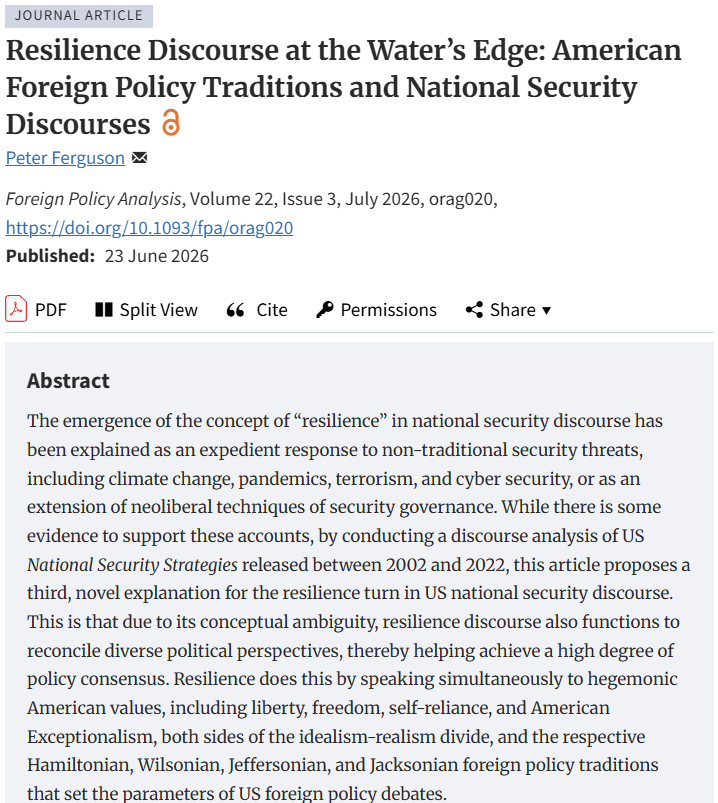
ALT Title: Resilience Discourse at the Water’s Edge: American Foreign Policy Traditions and National Security Discourses Abstract: The emergence of the concept of “resilience” in national security discourse has been explained as an expedient response to non-traditional security threats, including climate change, pandemics, terrorism, and cyber security, or as an extension of neoliberal techniques of security governance. While there is some evidence to support these accounts, by conducting a discourse analysis of US National Security Strategies released between 2002 and 2022, this article proposes a third, novel explanation for the resilience turn in US national security discourse. This is that due to its conceptual ambiguity, resilience discourse also functions to reconcile diverse political perspectives, thereby helping achieve a high degree of policy consensus.