
Return to sell-side pending
Joined January 2018
- Tweets97
- Following1.3K
- Followers780
- Likes984



Commodity Adjusted EBITDA retweeted
Signed on for a new role in institutional equities based in NY. Will be moving in the next month or so. If you're based in NY and like talking stocks (particularly Canadian cyclicals) would love to connect. DM's open
Sharing what I think could be a useful tool for investors especially if you are across both public and private assets.
A free quarterly PE performance report with some interesting data transparency compiled by a secondaries firm in Canada. They were (relatively) early to the secondaries game so cover a wide swath of AUM. No affiliation, just found it interesting and helpful. Link in comments.

Signed on for a new role in institutional equities based in NY. Will be moving in the next month or so. If you're based in NY and like talking stocks (particularly Canadian cyclicals) would love to connect. DM's open
I like a good bear thesis (see previous posts) but, I find the current bearish discourse around the private equity-backed insurance companies either alarmist or disingenuous.
We must acknowledge that the PE-backed insurer portfolios are:
1. opaque
2. used by sponsors for value transfer to the AM and PE businesses
3. liabilities carry surrender risk in a sharp rate move
4. funding sources are not truly "permenant"
But, to say that opacity by its nature leads to systemtic risk is alarmist. The issuers are deliberately taking on asset variance as opposed to underwriting variance compared to say P&C insurers. The real magic in the business model is that they are able to convince ppl to buy annuities at a 3.5-4.0% cost of capital.
On surrender (redemption) risk in the face of rising rates. Annuities are not demand deposits. Policies are subject to both a surrender charge (up to year 10) and a MVA charge. The latter passes part of the interest-rate mark-to-market loss to the departing policyholder. This is all before accounting for the friction that would occur in the sales channel given the incentives provided.
Let's use a worked example on the asset side. $APO's Athene is run-rating ~3-3.5B of SRE. Let's assume that ~20% or ~$63B of its book is private credit. At a 50% recovery rate, 10% of that entire bucket would need to default to consume one year of spread earnings.
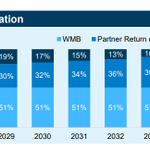
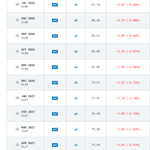
Recent deals also seem to have built in additional cushion. Both the $BX / $WMB and $APO / $OKE deals allow for cash flow outperformance above cost of capital to serve as a return of capital which would serve to cushion the book during volatility (BX schedule below).


Commodity Adjusted EBITDA retweeted
No position in the stock, but $CRWV flagged an A100 recontracting out to 2029. I've been noodling on who the counterparty could be, and my theory is it's $NVDA. A couple of reasons why I think this makes the most sense.
It's clear the hyperscalers are trending away from GPUs as they scale their TPU ecosystems. That creates both urgency (see NVDA's $500B deal with the mega-cap PE firms) and incentive for NVDA to help the neoclouds scaling inside the NVDA ecosystem to defend its moat. Recontracting A100s out to 2029 can dramatically improve the neoclouds' cost of capital (equity and debt) especially when CRWV management is light on the details.
On IR callbacks, CRWV said the A100s are "inferencing for a customer." That could just be NVDA running internal research workloads. Who else could be so certain they'll still want an A100 in 2029? How about the guys best placed to optimize for it. It would make sense that NVDA keep building more efficient versions of Nemotron that can best leverage older-vintage GPUs, and point them at the internal coding workflow.
If NVDA does turn out to be the counterparty, the market shouldn't read this recontracting as a broader uplift in GPU terminal values because NVDA has a clear incentive to prop up the neoclouds to defend against the $AMZN and $GOOG TPU ecosystems.
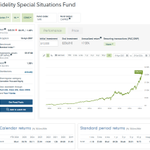
Kinda funny that this came up today amid the SALP unwind. Come get you some 18 years of 17% compounding, leverage-free! This fund is closed but you can buy $FINN.NE


Commodity Adjusted EBITDA retweeted


Around a month ago, a couple of hedge fund friends pitched me on $SNDK, $MU, $SKHY , and the rest of the memory names as their best ideas. The thesis was compelling, and the guys are very smart. Their main argument was simple: these companies were incredibly cheap. P/E of 10. P/E of 8. Some even lower.
The interesting part is that not a lot has changed fundamentally since then, yet many of these stocks are down around 50%.
We can extrapolate that, since nothing fundamentally changed and the stocks have been cut in half, sentiment is more important than multiples, and you never want to buy at peak sentiment, no matter how cheap the deal looks.
Read more about it in my post below, “The Myth of P/E Ratios.”

This is the classic analysis people love to do on E&P’s at $100+ oil…. Guess how many privatized via buybacks?

Commodity Adjusted EBITDA retweeted
I’m long some these AI stocks like the rest of you degens but my feed is currently flooded with people rationalizing that a 30-50% drawdown in some AI supply chain names make no sense because jevons paradox etc etc. I’ll make two market structure observations.
1. In cyclical industries like memory just like in commodities the stocks cannot simply be viewed as conventionally “cheap”. Stocks can lead the commodity price on the downside of the cycle. This happened in energy in 2018 when the $XOP peaked in mid-May while oil prices didn’t peak until early October but then promptly declined 40%+ by Christmas. All to say, stock prices are forward looking into perpetuity and will not always peak with/after underlying commodity prices (looking at you DRAM bulls)
2. People claiming a 30-50% drawdown is too severe are implicitly suggesting that pre-decline share prices were the efficient prices. This is hard to assert in isolation because as we’ve observed, a lot of the recent price action was driven by leveraged trading out of Korean retail. This was not fundamentals driven buying going in and an unwinding of the trade does not then necessarily represent a stock “decoupling” from its fundamentals. Retail’s ability to re-lever and buy back in will be a big part of determining if and when we can take out the previous highs.

The $GFL / $SES.TO merger getting this contentious wasn't on my bingo card.
My position is unchanged: this isn't the optimal outcome for either party. That said, $SES.TO shareholders are getting a good price today. At 11x forward (announced price) or ~10.5x using current $GFL price, investors should take their ball and go home. For continued energy beta via OFS, I'd point you to $CEU.TO, a best-in-class specialty chemicals biz trading at 9.5x that's tied to production (vs. drilling activity), much like $SES.TO's base biz.
My comment below on preferring $SES.TO standalone is b/c a combo with $GFL is sub-optimal for both sides.
$GFL shareholders want truly non-cyclical CFs. Adding OFS pressures the multiple by muddying the story and weakens $GFL's ability to do accretive SW M&A, especially opportunistic M&A in economic downcycles.
For $SES.TO shareholders, the standalone growth profile gets watered down by the broader $GFL. That's not to say $SES.TO is a "waste" biz whose chart will grind up and to the right, as many suggest. When the next energy downcycle hits (and it will), the multiple will compress dramatically. But $SES.TO holders should be given the chance to trade around that growth profile and energy cycle volatility.
My near-term view on $SES.TO is positive: the Iran situation should inject a geopolitical risk premium into oil that we haven't seen in a decade+. Layer on renewed focus on security of supply, which will point major crude and products buyers to NAM. $SES.TO's core business will benefit because it supports Canada's long-life resource base and an oil price anywhere close to US$80 is great for basin-wide profitability and will support healthy activity levels.
If $SES.TO's multiple keeps grinding higher as generalists conflate commodity CFs in a constructive oil price environment with business quality, this opens the door to accretive M&A of actual waste assets and a longer-term pivot. That's the additional optionality in the $SES.TO thesis, but it requires that the oil price remains high enough for long enough. Once again, this highlights $SES.TO's exposure to energy beta.
