

Building persistent agent infrastructure for infinite self-evolving intelligence. More at: https://xitter.cf/t.co/o8pZbNgDPI
Joined April 2026
- Tweets141
- Following95
- Followers520
- Likes83


Pinned Tweet
🤯 Evolvent's Self-Evolving Agentic System
What if one agent’s failure could make the whole organization smarter?
💡 That’s the collective intelligence layer we’re building with Evolvent.
🧩 Across 5 AutoResearch-style tasks, individual attempts, failures, fixes, and breakthroughs are transformed into shared experience for the entire agent organization.
Full write-up 👇
pre.evolvent.co/en/research/…
First leaderboard is live: across 6 research agents × 5 benchmarks, Opus 5 leads at 0.4809. RSI-Index is the first score measuring joint improvement of model weights AND harness. The RSI race now has a scoreboard. 🏁
The full codebase and per-agent experiment configs are on GitHub.Need to evaluate your agent or improvement method? DMs are open — we'll help you run the eval. 📩👇

💡Our view: RSI is a systems engineering problem, not just a model problem.
Progress depends on the environment a research agent works in: what resources it can call, what it can change, and how it runs experiments. That environment should reflect real production workflows and be easy for agents to use.
At @Evolvent_AI, we built RSIGym around Everything as a Service. Agents can call established research services and iterate on data, training settings, and harness code.
We also introduce RSI-Index to measure how well frontier agents jointly improve a target model’s weights and harness. Across 6 research agents and 5 benchmarks, Opus 5 leads at 0.4809. 🧵
We’re releasing the code, experiment configurations, research trajectories, and evaluation logs. Try your own improvement methods with RSIGym.
🌐 Website: rsi-index.ai/
💻 GitHub: github.com/evolvent-ai/RSIGy…
📄 arXiv: arxiv.org/abs/2610.10310
Three weeks. Two personal life agents.🤖
Sept 8 — @Meta's Muse: 3.4M+ downloads, #1️⃣ on the US App Store. Sept 28 — @ManusAI 's Cue: agents with their own phone number, wallet, and computer.
The era of "AI that runs your life" is officially here.
Now the uncomfortable question: can they actually run it?
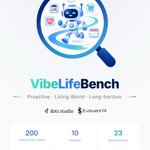
We built VibeLifeBench (with dots studio) to find out — 200 long-horizon life tasks: family trips, lawsuits, renovations, rentals, exam prep. Each one runs for simulated weeks while the world silently changes behind the agent's back.
Best frontier agent so far: 32.5%.
Fluent in chat. Fragile in life. That gap is exactly what we measure.
Run it in one command 👇
github.com/evolvent-ai/VibeL…


VibeLifeBench Update: More Stable, One Command to Run
📌 VibeLifeBench has drawn wide attention across the industry since launch. We've just upgraded it again — steadier, and easier to work with:
🔧 A batch of stability fixes. It runs more reliably now.
⚡ Every task now uses one unified task format (standard structure + automatic execution and scoring). One command and it runs — no more manual setup.
What VibeLifeBench is
🤖 AI can already write code, pass exams and do research — all of which have mature leaderboards to measure them. Real life is the one blank spot. And life happens to be the hardest kind of problem: it spans weeks, it never stops, and nobody reminds it. Stretch the timeline, and it falls apart.
So we built VibeLifeBench with dots studio — an agent benchmark dedicated to long-horizon life management 🎯
Task design
▸ 200 long-horizon tasks — 20 in each of 10 life domains
▸ 20–30 stages per task, spanning several simulated weeks
▸ 23 mock services · 18,000+ atomic checks, each graded against real backend state
▸ 10 life domains: travel, finance, litigation, renovation, rental, shopping, exam prep, career, fitness, and team building
▸ All environments are offline synthetic data, so no answer can be retrieved
What makes our tasks hard
① Late stages depend on what the agent understood in the early ones — with no human hints in between ⏳
② The world changes behind its back: aircraft get swapped, policies update, prices move — most of it is never announced 🌪️
③ Only backend state counts. Saying you booked it earns nothing — if it isn't in the system, it's a 0 ✅
④ There are authorization boundaries: payments, orders and cancellations need permission first. Acting on your own loses points — and so does asking about everything 🔐
Getting started is cheap ⚡
Docker + Python 3.12+ + uv. One command per task. Works with Anthropic / OpenAI / Moonshot / DeepSeek and any OpenAI-compatible gateway.
Repo below👇
github.com/evolvent-ai/VibeL…

"Expert-annotated data and vibe coding are fundamentally the same" — sounds like a hot take, but it's really a flattening: once the agent is the system's executor, human contributions compress to a single difference — the ability to define what counts as right, and own what counts as wrong.
Which is the real point: execution is inflating, judgment is appreciating. The scarcest resource in the RSI era isn't agents that run experiments; it's humans who can supply the fitness function. OpenRSI-Index turning that into a public good is exactly why it deserves your attention.
RSI-Anything is currently the framework that best aligns with my understanding of expert-annotated data.
To some extent, there is no fundamental difference between expert-annotated data and CS students' vibe coding. What everyone sees is the result translated by the agent, and when the agent deems a decision necessary, it makes a choice-based decision. The entire system is agent-driven, with humans existing as tools.
AA's 95% confidence interval tells you how confident we are in the model — not in the evaluation. The moment an industry accepts "leaderboard = truth", eval stops being a tool and becomes power. And history is clear: nobody wants to live inside someone else's scoreboard. Labs publishing their own boards, OSWorld v2 / ALE / TB4 going crowdsourced — that's the quiet exodus.
One of the most important shifts in AI is psychological: researchers are beginning to imagine systems that may soon exceed their own abilities in parts of the work they do.
That should produce humility, not surrender.
The right response is to make the tools more open, the processes more transparent, and the benefits more widely distributed. If AI can accelerate research, it should expand the number of people who can participate in discovery, not narrow it to a few institutions.
We’re excited about self-improving agents because the future of intelligence should be something more people can contribute to, not something fewer people are allowed to access.


VibeLifeBench Update: More Stable, One Command to Run
📌 VibeLifeBench has drawn wide attention across the industry since launch. We've just upgraded it again — steadier, and easier to work with:
🔧 A batch of stability fixes. It runs more reliably now.
⚡ Every task now uses one unified task format (standard structure + automatic execution and scoring). One command and it runs — no more manual setup.
What VibeLifeBench is
🤖 AI can already write code, pass exams and do research — all of which have mature leaderboards to measure them. Real life is the one blank spot. And life happens to be the hardest kind of problem: it spans weeks, it never stops, and nobody reminds it. Stretch the timeline, and it falls apart.
So we built VibeLifeBench with dots studio — an agent benchmark dedicated to long-horizon life management 🎯
Task design
▸ 200 long-horizon tasks — 20 in each of 10 life domains
▸ 20–30 stages per task, spanning several simulated weeks
▸ 23 mock services · 18,000+ atomic checks, each graded against real backend state
▸ 10 life domains: travel, finance, litigation, renovation, rental, shopping, exam prep, career, fitness, and team building
▸ All environments are offline synthetic data, so no answer can be retrieved
What makes our tasks hard
① Late stages depend on what the agent understood in the early ones — with no human hints in between ⏳
② The world changes behind its back: aircraft get swapped, policies update, prices move — most of it is never announced 🌪️
③ Only backend state counts. Saying you booked it earns nothing — if it isn't in the system, it's a 0 ✅
④ There are authorization boundaries: payments, orders and cancellations need permission first. Acting on your own loses points — and so does asking about everything 🔐
Getting started is cheap ⚡
Docker + Python 3.12+ + uv. One command per task. Works with Anthropic / OpenAI / Moonshot / DeepSeek and any OpenAI-compatible gateway.
Repo below👇
github.com/evolvent-ai/VibeL…
Excited to see Evolvent AI included in this new survey on genuine recursive self-improvement.
One idea we especially appreciate is the survey’s autonomy-centered framing: self-improvement is not a binary label. It is a progression—from executing prescribed changes, to choosing improvement strategies, to acquiring the right experience for the next learning cycle, adapting through deployment, and eventually improving the improvement process itself.
The survey places Evolvent AI’s work on organizationally self-evolving agents in the L2–L3 landscape, connecting skills, memory, code, and environments with task feedback, refactoring, and skill updates. It also references our AI Scientist work on self-editing agents for AI research among the L5 candidate systems discussed in the appendix.
We see these as complementary directions: building the infrastructure for organizational learning, while exploring how research agents can revise parts of their own pipeline.
We see this as a useful description of the direction we are building toward: agents that do not merely complete tasks, but learn from work, turn feedback into reusable improvements, and help organizations compound capability over time.
There is still a long road from experience-driven adaptation to genuine recursive self-improvement. Making each stage explicit—and measuring what is actually automated—is exactly how the field moves forward.
A thoughtful survey and a valuable map of the next frontier.

Self-improving agents are a top research topic right now.
This new survey is a good map of the area.
(bookmark it)
It splits recursive self-improvement into stages of autonomy.
An agent first executes improvements someone else designed. Then it chooses its own improvement strategy, collects its own experience, adapts to new environments, and finally improves the process of improvement itself.
That staging makes claims easier to check. When a paper says its agent is self-improving, you can ask which of these stages it actually automates.
The survey also uses a Headroom-Closed Index to show where current LLMs fall short, and compares requirements across scientific discovery, embodied agents and software engineering.
Paper: academy.dair.ai/papers/the-l…

1/6
Introducing VibeLifeBench, a benchmark for evaluating AI agents in long-horizon, evolving life environments.
It includes:
200 tasks across 10 life domains
22 mock services and 288 tools
12,261 fine-grained checks
A median task duration of ~29 days


5/6
We reviewed trajectories from 7 frontier models.
Not one detected the passport issue at the right time.
Not one reselected seats after the aircraft change.
The strongest model scored only 0.325 on average, and repeated runs remained highly unstable.

6/6
VibeLifeBench shows that long-horizon assistance requires more than tool use:
Proactivity: noticing changes without being prompted
Persistence: maintaining state across weeks
Coherence: preserving budgets, deadlines, health and privacy constraints
A real assistant must operate in a world that refuses to stand still.
Totally agree. This is exactly the gap we’ve been focused on. In April, Evolvent AI launched ClawMark, the first real-world benchmark for coworker agents. VibeLifeBench, co-built with Xiaohongshu, takes this into real-life scenarios: ultra-long-horizon tasks spanning weeks, months—even years.

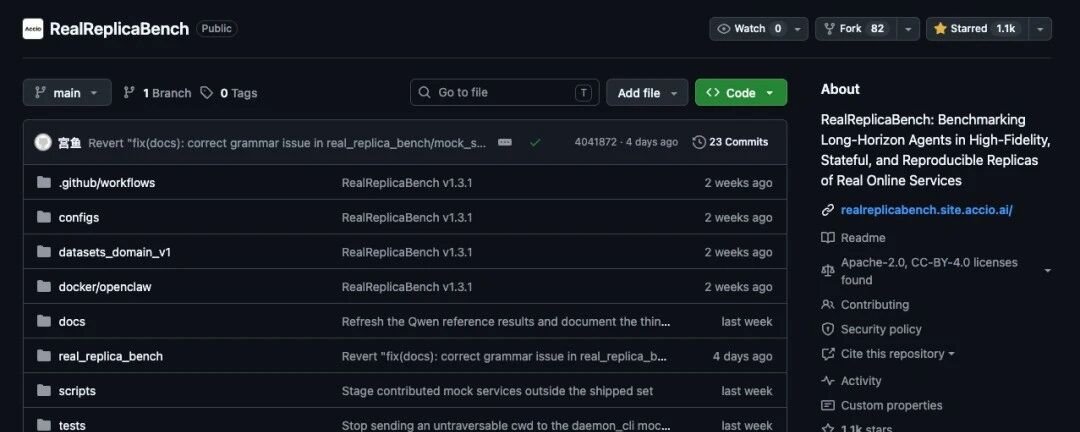

ClawMark is the coworker benchmark: 100 tasks across 13 professional domains, including clinical work, law, HR, PM, journalism, investment analysis, real estate, and e-commerce.
Each task spans 1-3 simulated working days. The agent works, then time advances.
Across all three projects, narration earns nothing.
Rubrics inspect backend DB state and workspace files. If an agent says it booked a flight but did not, it scores zero.
Over-action is penalized too: paying or cancelling without approval is a failure mode.
All three are public:
Terrarium: github.com/evolvent-ai/Terra…
ClawMark: github.com/evolvent-ai/ClawM…
VibeLifeBench: github.com/evolvent-ai/VibeL…
Living environments are becoming standard for training. They should become standard for evaluation as well.
