

TRUSTED BY WATCH ENTHUSIASTS SINCE 1993
Boston, MA
Joined January 2012
- Tweets18.2K
- Following4.2K
- Followers9.2K
- Likes1.9K
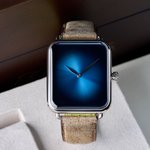


It’s the same shape and size as an Apple Watch but it’s cased in 18k white gold and you wind it by hand.
It’s the Swiss Alp Brrrr. Moser released it alongside a companion called the Zzzz, limited to 20 pieces each and zero vowels between them.
The case is 38.2mm by 44mm, with straps attached to wire lugs rather than clipped in the way Apple’s do. That difference is the whole argument the watch is making.
The dial is a blue fumé, bright through the middle and darkening as it runs toward the edge.
Inside is the HMC 324, made in house by Moser, hand wound, 27 jewels, running at 18,000 beats an hour and holding four full days of reserve.
From the front this thing tells you nothing but the time. No text notifications, no health updates, no apps. Get ready for people to be REAL confused by this one!
Available now on our website!


Taylor with Laurent Ferrier on the new Sport Traveller at NYC WatchTime.
42mm cushion case in grade 5 titanium, so it wears far lighter than the size suggests. Dual time, with two pushers on the left that move the local hour hand without ever stopping the movement.
And the micro rotor is 950 platinum, set off centre so you can still see the calibre working around it.
She told Taylor the whole thing comes out of motor racing, which Mr Ferrier has loved his whole life.
Stay tuned for more content from NYC WatchTime!
The whole month sits on the dial. A fixed ring of dates with a gold crescent sliding around to mark today, and the weekends picked out in a different colour so the week reads at a glance.
Count the positions though. There are 35, not 31. The last four preview the opening days of next month, so you’re always looking at five full weeks. That’s what makes it an agenda rather than a date window.
Calibre C032, hand wound, 378 parts, 46 jewels, 72 hours. Every month is treated as 31 days, so you correct it five times a year and that’s it.
39mm of white gold, and the white gold version is capped at 45 a year.
There are 80 baguette diamonds on this watch, and 22 of them sit on the clasp where nobody will ever see them.
The other 58 run across the bezel and down the lugs, channel set so tightly there’s no metal showing between them. Roughly 4.84 carats altogether, and all of it done by Patek rather than added by someone afterwards.
Look closely at 12 o’clock and you’ll notice that the marker is a baguette diamond too. And there’s one more that doesn’t appear in any count, a brilliant cut set into the case at 6, which is how Patek marks a platinum watch without shouting it.
Everything underneath the stones is standard 5270. Black lacquer built up in 12 separate layers, sub dials sunk below the surface rather than printed onto it, and a tachymeter running around the edge.
The movement is the calibre CH 29-535 PS Q which was the first perpetual calendar chronograph Patek ever built entirely in house. Six of its innovations are patented.
It also comes with a second case back. A solid platinum one, so the owner can close the movement away on the days they’d rather not show it.
Available now.


That’s a square dial, rotated 45 degrees, sitting inside a perfectly round case.
Cartier London built the original in 1972, and research suggests only six of the large size were ever made. One of the originals sold at Phillips a few years ago for 403,200 francs, roughly eight times its estimate.
Those originals were built in a Clerkenwell workshop and carried across London by an apprentice on the number 38 bus, in a briefcase with that week’s straps and buckles. The thinking was that nobody would ever suspect a scruffy kid on public transport.
This is the reissue Pebble Cartier brought back for the 50th anniversary, limited to 150 individually numbered pieces.
Inside is the calibre 430 MC, hand wound and only 2.1mm thick, which is the entire reason the finished watch comes in at 6.3mm.
Three things separate it from a 1972 example. The crystal is sapphire rather than plexiglass, it measures 36mm instead of roughly 35.5mm, and Cartier hid its secret signature inside the VII.
Available now.


The winding rotor on this watch looks exactly the same from the front as it does from the back.
Most micro rotors hang off one side on ball bearings. This one is sandwiched between two bridges, each with its own ruby bearing, and the main plate is cut away in a circle around it so you see the same solid gold weight from either side.
The dial is Grand Feu enamel on a white gold base, fired in house between 780 and 840 degrees, then polished until it reads like a mirror.
There are two mainspring barrels and they run in series rather than in parallel. That isn’t really about the 80 hours it buys. It’s so the rate holds steady whatever the state of wind.
The screw heads carry an S shaped slot. Romain Gauthier cuts them in house, and the shape isn’t decoration. It lets a watchmaker put more torque through the screw during assembly.
He called it the Insight because the dial side was laid out to be read as mechanics rather than just as time. In rose gold with this blue enamel dial, it runs to 10 pieces.
Available on our website now.


EP 17 of ranking EVERY watch brand...
Grönefeld.
Rob opened at A tier. His case was the work. Bart and Tim trained at WOSTEP and then at Renaud & Papi building minute repeaters and tourbillons, and all of it shows up in the finishing. The engraving on those steel bridges is as good as anything anybody is making.
Justin’s counter was history. Vacheron goes back to 1755. Patek to 1839. The first watch with Grönefeld on the dial came out in 2008. His argument was that A tier is something you earn over a century, not over 18 years, no matter how good the watches are.
One thing in Grönefeld’s favour though. The brothers are third generation. Their family has been doing this in Oldenzaal since 1912, and their best known watch is called the 1941 because that’s the year their father was born. The name on the dial is new. The hands aren’t.
This dial isn’t enamel. It’s porcelain, made from clay and fired at 1,400 degrees.
There’s a real difference. Grand feu enamel is built up in fired layers of powdered glass on a metal base. This is clay fired solid into porcelain, then given one transparent coat of enamel for the sheen.
The Breguet numerals sit in anthracite with the 12 in scarlet red, and the minute track is gold circles with diamond shaped markers at 3, 6, 9 and 12.
The movement is the Calibre FBN 229.01, a self winding micro rotor made up of 186 components and 35 jewels, with 72 hours of reserve.
The escapement is silicon and runs double direct impulse, which means two escape wheels push the balance twice every oscillation rather than just once.
Limited to just ten pieces in total, it’s 41mm of white gold with that porcelain dial doing most of the talking.
Coming to our website soon...


Found a very small independent doing interesting work. A brand called Rolex.
Keep an eye on these guys. We think they MIGHT be going somewhere.
Voutilainen works mostly in gold and platinum. This one is steel.
Steel was never a catalogue option on the Vingt-8. The ones that exist were made by special request for people close to the workshop, which is why you almost never see one.
Underneath is the direct impulse escapement. Two escape wheels feed the balance without a pallet fork in between them, so the escapement runs with no lubrication at all. It beats at 18,000 VPH, which is slow, on a balance that is 13.5mm across, which is enormous, and it holds 65 hours of reserve from one barrel.
The dial was engine turned at Comblemine, Voutilainen’s own dial workshop, which is why the guilloche looks the way it does.
And the calibre 28 is finished. Voutilainen closed orders on it at the end of 2025, so what exists is all there is, and this one has never been worn.
Coming to our website soon...


Every American 1921 has a tilted dial…except for this one.
On a watch whose whole identity is the rotated dial, this limited edition perpetual calendar version straightens it, so that every indication stays readable.
The original is rarer than the reputation suggests. Vacheron built the American 1921 for the US market, and by the brand’s own count only 36 were made.
Inside is the calibre 1120, in house, first built in 1968 and still one of the thinnest automatic movements ever made, here carrying a perpetual calendar and a moonphase.
20 pieces in platinum, sold only through four Vacheron boutiques, in Geneva, Moscow, Hong Kong and Shanghai, all with the edition number engraved into the caseback.
40mm of platinum, 9.3mm thick, guilloche subdials, and a moonphase display with a lapis lazuli background. It doesn’t get much more special than this!
Coming to our website soon!


Franck Muller made 50 of these back in 1996, and it looks nothing like almost any other Franck Muller.
No tonneau case, no Cintree Curvex curve, no exploding numerals anywhere. The Sport Chronograph from 1996 sports a simple round three piece case and a black dial.
Franck Muller built his entire name on shaped cases. This is what happened the one time he went round.
The movement is a Lemania 1874 reworked in house, with chamfering and Geneva striping added over the base.
Every watch in the run was individually numbered and used two distinct dial layouts, the three register seen here and an even rarer two register.
The brand released a tribute model a few years ago, but the original just can’t be beat!
Available now.


Nothing is printed on this dial at all.
Every star on this De Bethune is a white gold pin, set into the surface of the titanium one at a time by hand.
The colour isn’t paint either. The dial is grade 5 titanium polished to a mirror and then heated, and the temperature alone decides what shade it turns. This one was taken all the way to burgundy.
Even the Milky Way running across it was cut in, micro milled into the titanium by laser and then gilded with 24k gold leaf.
The calibre is the DB2005, hand wound, 160 parts, and it runs for six days off a self regulating twin barrel. The escape wheel is silicon and the balance is titanium with white gold inserts.
Underneath that sits a triple pare chute shock absorber, and the lugs are hollowed out and built into the case rather than attached to it. 40.6mm of titanium, 8.8mm thick.
Recently sold.


This watch shows you the whole month at once, and even tells you which days are the weekend.
The ring around the outside of the dial on the Krayon Anyday has the numbers 1 to 31 cut out of it, with a second ring that turns underneath, colouring the weekend days differently from the working ones.
A crescent moon pointer sits over today’s date and jumps to the next at midnight, so the whole calendar reads at a glance rather than through a window.
Four dots at 6 o’clock preview the first days of next month, so you can even see over the edge of the month you’re currently standing in.
Remi Maillat spent six years at Cartier designing complications before he started Krayon. His first watch tracked sunrise and sunset for anywhere on earth. This is the third model, and the one built for actual everyday use.
The calibre C032 is his own and uses 378 components and 46 jewels. It is hand wound with 72 hours of reserve and a stop seconds complication. 39mm of white gold, 9.5mm thick, with a team of just 12 watchmakers behind it.
Available now.


The rotor in this Richard Mille gets adjusted to how much you move your arm.
It’s called a variable geometry rotor. Two weights sit on the winding mass and a watchmaker repositions them with spline screws, speeding the winding up or slowing it down to suit how active the owner actually is.
The rotor is a ring of 5N red gold with a heavy metal segment, turning on ceramic ball bearings and winding in both directions. The point of it all is to fit the watch to the person rather than the other way round.
Underneath, the baseplate and the bridges are grade 5 titanium, skeletonised, microblasted and electroplasma treated, then tested for rigidity on their own before anything gets assembled onto them.
The case is built using three parts and is held together by twelve grade 5 titanium spline screws, with stainless steel washers and two nitrile O rings. That’s what gets a case this shape to 50 meters of water resistance.
The dial is a solid slice of onyx set into a skeletonised gold surround, so you get a black stone centre with the movement visible around it. Calibre CRMA2, 25 jewels, roughly 50 hours of reserve in a 45.6mm by 31.4mm rose gold and carbon fiber case.
Available now.


In the early 1980s Jean-Claude Biver bought a dead watch brand for 22,000 francs. He sold it in 1992 for 60 million.
The brand was Blancpain, and he rebuilt it on one sentence. Since 1735 there has never been a quartz Blancpain watch, and there never will be. At the time the whole industry was going the other way.
Then he turned Omega around, took over Hublot and launched the Big Bang inside a year, and ended up running the watch division at LVMH. He stepped back in 2018, after 43 years of building other people’s brands.
This is the one with his own name on it, started with his son Pierre. 26 people, and somewhere around 150 watches across 2025. After half a century in the industry, he said there was only one place he wanted to start, which was the top.
Which is where the finishing comes in. Most of the bridges in this movement take about nine hours to finish by hand, with metal files and boxwood. The hardest one, which straddles the winding click, takes up to 16.
The part that gives it away is underneath. Biver finishes the components hidden below the dial to the same standard as the ones you can see, and the lugs are soldered on by hand, shaped after a Patek Philippe reference 1579 he owns one of only three known platinum examples of.
Available now on our website!


Every colored section that you see on this dial is held together by a tiny gold wire.
That’s cloisonne. The enameller bends flat gold wire into the outline of the picture, fixes it down, and then fills each little cell it creates with a different colored enamel.
Patek calls the dial “Iris and Night Fireflies”.
The dial goes into the kiln roughly nine times and every firing is another chance for the enamel to crack or the colours to shift. If that happens, there’s no saving the dial and the process has to be started over again.
The movement is the calibre 240 with a 22k gold micro rotor, which is how Patek keeps a self winding watch this thin. It carries the Geneva Seal and you can see all of it through the back.
38mm of platinum, 8.3mm thick, with a single Top Wesselton diamond set into the case between the lugs at 6 o’clock, which is how Patek marks a platinum watch.
Available now on our website!


Two seconds hands on the same dial, turning in opposite directions, and nothing physically connects them.
The Lederer Central Impulse Chronometer runs two complete gear trains. Two barrels, two escape wheels, no gearing between them anywhere. The only thing holding them in step is the single balance that both of them feed.
George Daniels worked out the escapement that makes this possible, then concluded the tolerances made it close to impossible to shrink into a wristwatch. Charles Frodsham got there in 2018. Bernhard Lederer followed in 2021, and added something Daniels never had, a constant force remontoir in each of the two trains, offset so the impulses alternate instead of landing together.
What that buys you is a balance that never feels the mainspring winding down. Nearly empty or fully wound, it gets the same push.
212 components, 36 jewels, 38 hours of reserve, with the escapement cut from titanium. 39mm of white gold.
Two seconds hands, turning in opposite directions, and nothing connects them.
The Central Impulse Chronometer runs two complete gear trains, each with its own barrel and its own escape wheel, with zero geared connection to one another anywhere.
What keeps them together is the balance. Both trains feed the same one, and that single shared component is the only thing holding two independent movements in step.
The idea belongs to George Daniels. He developed the double wheel escapement to run without oil on the escapement, then concluded the tolerances made it next to impossible to shrink down to fit in a wristwatch.
Charles Frodsham got one onto a wrist in 2018. Lederer followed in 2021, and Bernhard Lederer added a constant force remontoir to each of the two trains in his watch, offset so the impulses alternate rather than arrive together.
212 components, 36 jewels, 21,600 beats an hour and 38 hours of reserve, with the escapement parts cut from titanium, all housed in a 39mm white gold case.
Available now.


