





Pinned Tweet
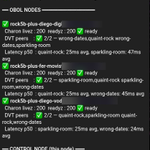
This is our @LidoFinance Community Staking Module HOME cluster protected by the @Obol_Collective DVT stack.
Don't get fooled by the devices' fragile appearance. These are very powerful and rock-solid machines capable of running hundreds of validators flawlessly with a local #Ethereum node using just 10W of power.
3 different locations | 3 different ISPs | client diversity | HA | monitoring
Decentralization at its best.
⚙️ Setup consists of:
✅ 3 Obol nodes (@RadxaComputer 3x Rock 5B+, 24GB RAM)
✅ 2 Control nodes (1 Rock 5B 32 GB RAM + 1 NanoPC T6 )
✅ 3 different locations (ISPs)
✅ Tailscale VPN connection
Obol nodes run different Consensus and Execution clients locally to provide client diversity:
@go_ethereum + @lodestar_eth
@Nethermind + @grandineio
@ethrex_client + @ethnimbus
The Obol cluster is monitored by an in-house solution installed on all nodes (including the 2 control nodes in active/passive mode). It reports to a Telegram channel in case any issue/event arises:
🔴 Missed attestations/blocks by each validator or a massive missed alert
🟢 A block is proposed by one of our validators
📊 Obol cluster status: Charon state, network latency, validator clients...
🖥️ Obol nodes status: Running services, CPU load, memory, disk usage...
🔄 Client updates availability
Control nodes fulfill additional tasks to contribute to cluster health, HA, and monitoring:
🔁 Backup nodes: If the cluster goes down, a control node is ready to take over all validators through a synced local node, as it has all configs and keys available
🔗 Obol relay: Both control nodes run a local Obol relay that allows the nodes to get a direct connection between them and minimize latency
🚨 Charon beacon fallback: All Charon nodes are configured with the Control nodes' beacon as fallback in case a local Obol node goes down
Performance
We are hitting 98.5-99.5% on the beaconcha.in score with client diversity. Best results come with Nimbus and Grandine as Consensus Clients, with a consistent ≥99.5%.
Total cost (estimation)🔲 Boards (5 × $270): $1,350
SSDs (5 × $270): $1,350
MicroSD (5 × $9): $45
Cases + cooling (5 × $38): $190
Ethernet cables (5 × $5): $25
Power supplies (5 × $16): $80
➡️ Grand total: ~$3,040
Documentation
We released all the code and documentation for anyone to replicate the cluster. If you are a home staker and want to try a reliable solution to harden your setup, this is your chance:
🔗 ethereum-on-arm-documentatio…
Source Code
github.com/EOA-Blockchain-La…


Ethereum on ARM (and RISC-V) 🦇🔊🐼👉👈🐼 retweeted

Over the past few months, the @Nethermind Client team has been focusing on almost everything BUT performance - authoring, supporting and reviewing EIPs for Glamsterdam, championing Hegota headliner - Frame Transactions, researching state bloat, and much more.
That's not changing - we are still being heavily involved in Ethereum roadmap. But AI has unlocked a whole new level of productivity for us, and we're now pushing hard on several fronts:
1. zk guest program - coming soon to @eth_proofs. Very promising, very performant.
2. RPC refresh - Geth compatibility, major performance improvements, and more. Few projects already got a feeling of what we are shipping - and it is looking very good.
3. Client hardening with AI - Node MCP for users and our custom CoreMCP for developers, helping us ship faster and build a much more stable client.
4. Innovative node optimizations and advanced plugins - unlocking capabilities that could be extremely useful for many projects across the ecosystem, including support for new chains.
And that's just the beginning.
As a "side effect," we've also significantly improved the node's performance at the tip of the chain - before even getting into the Glamsterdam hard fork, which should unlock a whole new level of throughput.
Nethermind is the fastest #Ethereum execution client, and the only one pushing beyond 1.5 GGas/s in p50 block throughput at the tip of the chain.
With the next fork, we expect that ceiling to go even higher - based on Sepolia data, potentially around 3x higher.
And we're definitely not done.
We want to change the rules of the game. The AI-powered tools we've built in-house are giving us enormous leverage, and we're confident this advantage will only grow over time.
Performance is good. 🚀

Ethereum on ARM (and RISC-V) 🦇🔊🐼👉👈🐼 retweeted

Margaret Hamilton, who led the team that wrote the code that put humans on the moon, has died at 90 🕊️


Ethereum on ARM (and RISC-V) 🦇🔊🐼👉👈🐼 retweeted

bunker.supplies
Quick POC of a post-quantum Ethereum wallet.
- Retains the same address*
- Rotates key every transaction*
- Uses Safe + Bip39 as rotation system
- Works with any HD derived ECDSA wallets
- No new cryptography
xitter.cf/drakefjustin/status/21…

Today I call upon the blockchain industry to calmly begin planning for "bunker mode". My personal recommendation is to set in motion a controlled mass migration of assets to fresh addresses, i.e. addresses whose pubkeys remain hidden behind a hash.
Holders, starting with large and sophisticated ones, should consider moving the bulk of their funds to addresses that have never signed a transaction. And when they do sign one, they should also move remaining funds to a new address (possibly generated from the same seed phrase).
Don't rush. While I believe there is cause for action a rushed migration would do more harm than good. Don't panic either. Moving assets to protected addresses is a simple, preventative step which does not require new cryptography or new wallets.
IMO it is now reasonable to brace for the possibility that ECDSA breaks before qday, in the worst case in months not years. By "break" I mean fast private key recovery (e.g. in one week) on available hardware (e.g. a large GPU cluster).
Recent days have been humbling for human mathematical intuition. Long-held, unquestioned hypotheses have fallen. This includes the n log(n) bound for integer multiplication and the 3SUM conjecture. In hindsight, May's unexpected disproof of the Erdős unit distance conjecture was our warning shot.
Yesterday's OpenAI drop made it clear that mathematical superintelligence is upon us. They say there are weeks where decades happen. We are about to live through weeks where centuries of mathematical progress happen. Could our magic 64-byte ECDSA signatures be too good to be true? Was it just security through obscurity all this time?
Elliptic curves feel especially vulnerable to superintelligence. Curves carry rich structure, with room for fancy tricks like Schoof, Frobenius, pairings. (By contrast, hashes are designed to minimise algebraic structure.)
Separately, as Ewin Tang can attest, an efficient quantum algorithm sometimes foreshadows an efficient classical one. We should be open to the possibility of a classical counterpart to Shor that breaks elliptic curves and RSA at once.
Also noteworthy is the striking under-representation of cryptographic breakthroughs among the 722 mathematical results OpenAI published. I've witnessed first-hand the US government censoring academic quantum cryptanalysis results. Backroom interventionism is my base case.
I urge large, sophisticated actors to lead by example. Project11's "risq list" (bitcoin-risq-list.projecteleven[.]com) is a great tracker of exposed BTC pubkeys. Binance, Bitbank, Robinhood, Bitfinex, and Tether have an opportunity to harden their cold storage. Next month I'll address institutions in London in a live Q&A (forum.ethereuminstitutional[.]org/london-2026).
Again, please do not rush. Wallets holding under 50 BTC enjoy partial cover from "Satoshi's shield", i.e. his 20K exposed addresses that hold 50 BTC each. Load-bearing signers like oracles and L2 security councils should consider rotating ECDSA pubkeys with every signed message and/or multi-signing with a hash-based schemes like SPHINCS.
Exiting bunker mode safely will require post-AI cryptography. My inclination is to go all-in on hash-based cryptography and avoid structured mathematical assumptions entirely, whether from curves, lattices, or isogenies. A single battle-tested hash (e.g. from the SHA or BLAKE families) yields plausible post-AI security.
The Ethereum roadmap on strawmap[.]org fully embraces hash-based cryptography with end-to-end formal verification as a response to the quantum threat. Those timelines must now be revisited and accelerated in light of mathematical superintelligence. I'll be pushing for maximum defensive acceleration.
Upgrading our @Obol_Collective #Ethereum staking cluster nodes from Noble to Resolute one by one.
No downtime, no rush, no issues.
If you are staking from home, build a DVT cluster.
Ethereum on ARM (and RISC-V) 🦇🔊🐼👉👈🐼 retweeted

Atomic synchronous composability is no longer a promise. History made on mainnet: the first atomic cross-chain L1->L2 transaction ever 🔥 And this is only the beginning for EEZ ... 🚀 @etheconomiczone


Ethereum on ARM (and RISC-V) 🦇🔊🐼👉👈🐼 retweeted

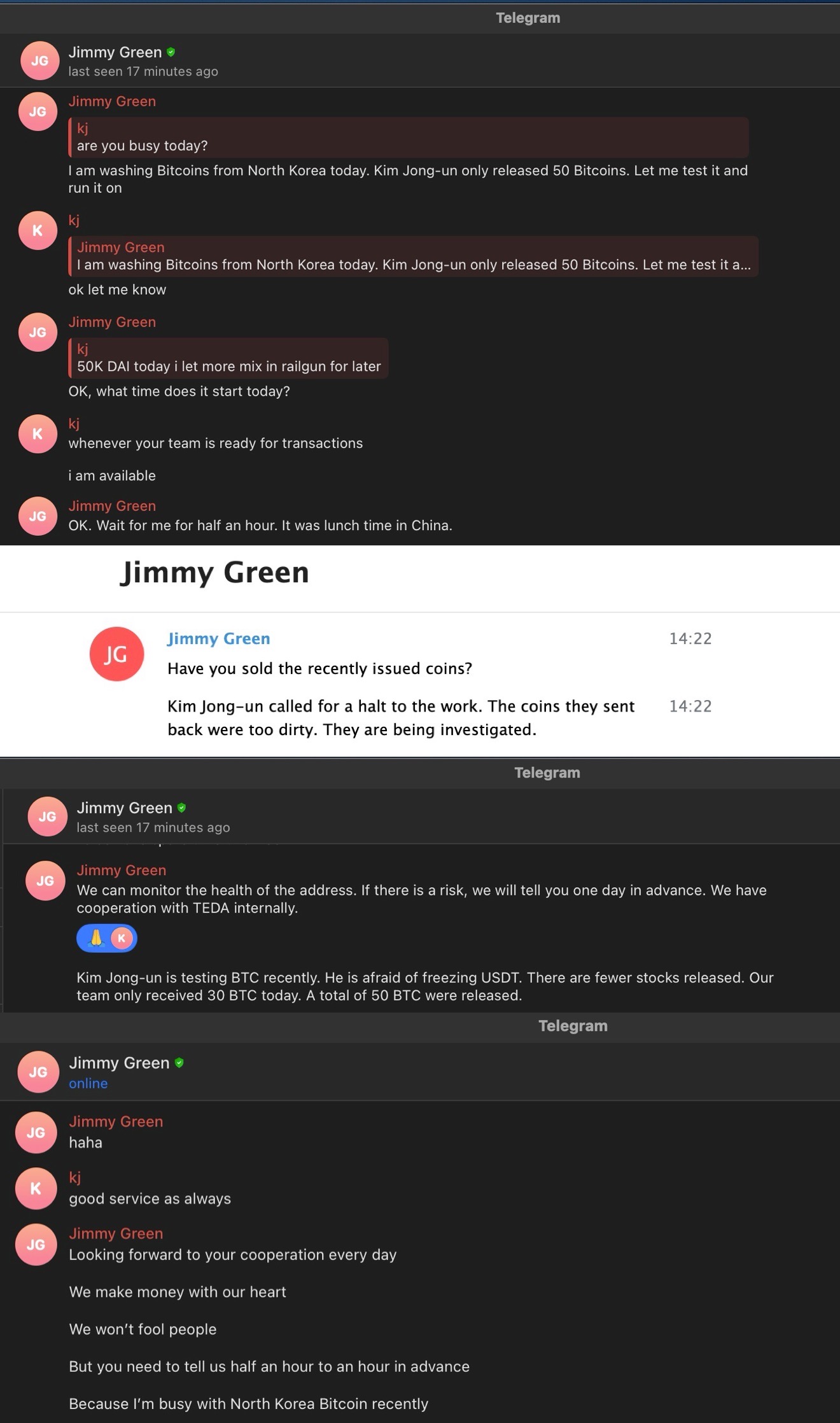
1/ How I infiltrated a Chinese organized crime syndicate that has laundered $1B+ across multiple exploits for Lazarus Group.
Posing as a client, I gathered intel that helped action freezes for the Feb 2025 Bybit exploit and attribute illicit activity onchain.

Ethereum on ARM (and RISC-V) 🦇🔊🐼👉👈🐼 retweeted

Thank you for engaging in good faith with a smile on your face through a long onslaught, it’s not easy :)
If I take the moment to tl;dr some of the key places the proposal fell down imo, (that more or less fit your categories)
- protecting ETH’s security and resistance to capture is more dictated by the Nakamoto (and withdrawal cred gini) than the ratio. The strawman to exemplify that is a validator set with a Nakamoto of 20, good gini, and staking ratio of 80% is more secure and capture resistant than one with a 47% ratio and Nakamoto of 3. We need to start measuring these numbers, and building rough consensus on where they should be, to enable agreed upon change. Would love your help here, what’s your minimum tolerable Nakamoto for eth?
- we need to take a zk-L1 seriously, and model the economics of it, and how we reach the social consensus (👆) builder diversity numbers. We don’t get many changes of economics while retaining moneyness (your second objective), so let’s make sure proving and aggregating make economic sense and are not winner takes all.
- I don’t think any curve that goes to zero at a reachable point is wise, it allows for a lowest cost wins game. This proposal in particular meant that weak validators in high ratio environments would be extra screwed in reward nvm economies of scale, it would have been ruinous for the indie stakers. Tails at 0.5% ->1.5% issuance are fine imo.
- we need community alignment on if CROPS > hard money or not. IMO Ethereum is not bitcoin and shouldn’t try to be. Hard money/increasing the burn is in contention with extra marginal scaling, we should pick it. Tbh a 1% dilution on eth makes it a better normal money, versus a store of value asset (hard/ultrasound). You can avoid this dilution by taking a risk and staking your eth.
- let’s fix the tax treatment on solo staking in proactive jurisdictions
- we can make Ethereum staking more decentralised (and likely impede higher staking ratios) with other EIPs such as 7716, or by making a price to exit stake. Would love your support on that one for Hegota as a compromise win. :)
- lastly, a good cost model for staking would help understand what a marginal change to economics would do to the chain health metrics, including whether they’re likely to surpass our social consensus decentralisation thresholds
Many things here, some you already mentioned, some not, but you have my continued support and engagement in trying to get Ethereum into a more healthy secure and decentralised state. Bonne chance. :)
Ethereum on ARM (and RISC-V) 🦇🔊🐼👉👈🐼 retweeted

📋Withdrawing EIP-8363 from consideration for Hegotá.
EIP-8363 rapidly became one of the most commented-on EIPs in the history of the Ethereum-Magicians forum, with 200+ comments in a few weeks. As we progressed through the Hegotà CFI (Consideration For Inclusion) process, several parties in the industry as well as core protocol and client contributors voiced that a fork scoping exercise was not the right venue to settle an issuance policy change.
We agree and we'd rather acknowledge this now than carry on towards Hegotà in this context. The topic is too important and raised too many concerns that it deserves its own process. We commit to giving issuance its own process and we thank the entities such as @LidoFinance who offered to help steer such an initiative.
We stand by the motivation of this EIP, in particular: “a very high staking ratio is undesirable for two distinct reasons (...), preserving Ethereum’s security, neutrality and resistance to capture, and protecting ETH’s role as money.” Not everybody immediately relates to both reasons and for others recognizing just one of these reasons is enough to justify a change. Nevertheless, we will all benefit from improving our understanding of the issue and what is at stake. The questions we have faced since we published EIP-8363 can be boiled down to 5 categories:
➡️Security: What does a lower ratio actually secure versus a higher ratio?
➡️Industry impact: What else is built on the yield and what will be the impact ?
➡️Curve specs and alternate tools: Is this curve even the right instrument?
➡️Composition: Who is left staking (the effect on the composition of the validator set) ?
➡️Decentralization: How will solo stakers be impacted by the reduction?
We already argued a lot, conceded some and adjusted a few points in the very long Ethereum-Magicians thread mentioned supra. For a broader consensus to emerge and a better issuance policy for Ethereum to be designed and adopted, we need a dedicated process. We call for all willing hands to help and contribute to this, please do reach out. Here’s our start at what a multi-node process would look like (table attached).
Onward and forward, let’s improve Ethereum.


🚨 New EIP: Tapered Issuance Burn
We just submitted an EIP to ethereum/EIPs: a minimal, market-driven fix to Ethereum's issuance policy removing the incentive for stake growth beyond 50% of ETH supply.
EIP-8361 by @pintail_xyz, @jdetychey, @dapplion, @pa7x1, @ladislaus0x & @drakefjustin 🧵
Ethereum on ARM (and RISC-V) 🦇🔊🐼👉👈🐼 retweeted

I've been working in Ethereum for nearly 10 years and it still feels great to send a transaction to your own self-hosted node.
Reading and writing from the chain without any intermediary. No other chain comes close to how easy it is with Ethereum.
Ethereum on ARM (and RISC-V) 🦇🔊🐼👉👈🐼 retweeted

Ethereum should be anti-fragile; failures should strengthen it.
A correlated downtime should hurt more than an uncorrelated one. EIP-7716 would encourage more client diversity, and would make Ethereum resilient to black swan failures.
Short term pain, long term gain.

Ethereum is considering correlated downtime penalties for stakers, an idea by @VitalikButerin. The aim is to disincentivise centralised points of failure before they cause a mass slashing event
I made a website to understand the EIP and why we should adopt it
🔗 below, tl;dr👇

ALT validatordowntime.obol.org header photo. "Ethereum punishes correlated slashing. In 2027, it will punish correlated downtime too. Fail alone and you pay exactly today’s rates. Fail alongside 10% of the network and the first hours are charged at ~78×. Short-term pain, for long-term gain: that outage costs ~0.024 ETH per validator, while a correlated slashing of the same 10% would take ~9.66 ETH. The penalty pays you to leave a crowded client before a critical bug does it for you"
Ethereum on ARM (and RISC-V) 🦇🔊🐼👉👈🐼 retweeted

Syncing an Ethereum node is the first step towards freedom.

Ethereum on ARM (and RISC-V) 🦇🔊🐼👉👈🐼 retweeted

HABEMUS TESTNET — DAISUGI v0.1
A post-quantum Ethereum testnet using hash-based SPHINCS signatures with non-native account abstraction.
Big thanks to @riva_labs and @GiulioRebuffo.
Coming next:
• Frame Transactions
• Signature aggregation via LeanSPHINCS
Believe in somETHing. Link ⬇️


Ethereum on ARM (and RISC-V) 🦇🔊🐼👉👈🐼 retweeted

We paved the way for client diversity, and then showed that Ethereum doesn’t have to be stuck at a 30M gas limit.
Our mission is not complete yet. Next priorities:
1. Help bring post-quantum cryptography to Ethereum
2. Support Gnosis @etheconomiczone - the future of the L2 space
3. Participate in the ZK-Guests program
4. Leverage our top-tier formal verification and client teams under one company to build a formally verified client
5. Accelerate Ethereum strawmap and node development with AI and adapt to all challenges related to the new speed of development
6. Make the RPC layer more trustless, performant, and robust
7. Keep pushing Ethereum toward a stronger performance culture.

Nethermind Client 2.0.0 is out. It changes how the node stores Ethereum's state: archive nodes drop from ~30 TB to ~2 TB, you choose the history you keep, and blocks process 2–3× faster than the previous release on a fresh node.
Nine years since the first commit. The fastest execution software we've ever built.
Breaking changes; read the notes before upgrading. Release: github.com/NethermindEth/net…
What an incredible work, congrats to all team and thank you for this amazing client.
Updated. Run:
sudo apt update && sudo apt install nethermind
Nethermind Client 2.0.0 is out. It changes how the node stores Ethereum's state: archive nodes drop from ~30 TB to ~2 TB, you choose the history you keep, and blocks process 2–3× faster than the previous release on a fresh node.
Nine years since the first commit. The fastest execution software we've ever built.
Breaking changes; read the notes before upgrading. Release: github.com/NethermindEth/net…
Ethereum on ARM (and RISC-V) 🦇🔊🐼👉👈🐼 retweeted

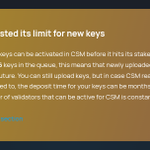
We’re introducing new visualizations for the CSM module.
You can now compare the module’s overall performance against the broader network, while also tracking validator decentralization within Lido’s Community Staking Module.
We’re also introducing the Gini coefficient, a metric that helps quantify how concentrated stake is across validators; making it easier to monitor and understand the level of decentralization within the module.
Take a look and let us know what you think.
Which other metrics or insights would you like to see?

Ethereum on ARM (and RISC-V) 🦇🔊🐼👉👈🐼 retweeted

1. Nethermind 2.0 will have ~ 2TB mainnet archive with super fast eth_call. And if you want historical proofs it goes to 4.3 TB currently. The best part - you can really configure it based on your needs!

🎉 10 years ago today, we released our first image for running an #Ethereum node on a Raspberry Pi 3.
10 years later, the principles remain the same.
We're living proof that decentralization doesn't need expensive hardware, just a $200 ARM board.
Here's to 10 more years. 🥂

Ethereum on ARM (and RISC-V) 🦇🔊🐼👉👈🐼 retweeted
I would say I'm surprised, but really I'm just disappointed with the EF Protocol's continued presumption of decentralisation as a given. Let me be clear:
FOCIL doesn't work if the attester set doesn't want it to.
The protocol priorities post focuses on post-quantum as a goal, fine, and pays lip service to CROPS; "FOCIL is Hegotá's consensus-layer centerpiece. Our appetite beyond it is close to zero unless an addition directly supports post-quantum readiness."
The elephant in the room the EF continues to ignore is that the chain is centralising at a rapid pace, and there is a lack of interest in either acknowledging the problems, or prioritising fixing any of them. For example, correlation penalties (7716) they describe as: "Adds slashing-logic surface for validator correlation with no CROPS or PQ contribution. Not a priority in a fork, we are trying to keep the CL scope light."
This is inaccurate to start, 7716 has no slashing logic, and its misguided at best to assert that it doesn't contribute to CROPS. 7716 is the best EIP on the table to improve client diversity and penalise centralisation. It's not a panacea, but its what we have, it should not be DFI'd.
Spending a year on H-star to ship FOCIL without addressing the validator set's underlying issues risks the big few centralised staking entities saying 'actually nah' and refusing to attest to slots with ILs they don't like. This costs them no rewards, thinking we'll socially slash them for it is wishful thinking, and now Ethereum is compromised and you need permission to use the chain.
Preventing this outcome is not a matter of one EIP on the margin, it needs a cultural shift within the EF to realise they don't have a divine right from God to a decentralised chain, and that they can't just focus on academic challenges like PQ while ignoring real challenges like the ongoing acceleration in chain centralisation.
We need quarterly reporting on the state of the chain, to make it harder for people to keep their head in the sand as to the severity of the situation. We need at least one EIP per fork focused on improving the nakamoto, staking gini, or other aspect of the validator set, and we need pragmatic, action-oriented leadership who care about Ethereum being CROPS beyond just a purity test. (I'm hoping that's @pcaversaccio).
There are some people in the EF that care about the chain being CROPS for real, but unless we the community are outspoken and steadfast in our demands, they won't be listened to. Please show them why we're supporters of Ethereum and not any another centralised chain, please advocate for decentralisation and CROPS in H-star and beyond. Thank you.

The Protocol Cluster has published two new posts:
Hegotá EIP Opinion Post and Tier List evaluates and grades all 62 EIPs proposed for Hegotá, providing the cluster’s first unified tier list for a network upgrade
Current and Emerging Priorities covers commitments and research arcs, anchored on a quantum-resistant Ethereum L1 by Dec. 2029
Offered as one input to Hegotá scoping, roughly 60 researchers, engineers, and individual domain experts across all 9 teams in the Protocol Cluster contributed to the Hegotá tier list, providing 397 tier grades before discussing contested items live.
The plan, commitments, and shared set of cluster-wide priorities covered in the companion post provide the context behind the final tier grades.
The Protocol cluster will host a Reddit AMA on r/ethereum on September 16 at 2pm UTC to talk through these priorities, the Hegotá tier list, and anything else on your mind.
→ Submit questions ahead of time here: pad.ethereum.org/form/#/2/fo…
Read the articles here:
→ EF Protocol - Current and Emerging Priorities: blog.ethereum.org/2026/09/07…
→ EF Protocol - The Hegotá EIP Opinion Post and Tier List: blog.ethereum.org/2026/09/07…

Updated. Run:
sudo apt update && sudo apt install nimbus

📢 Nimbus consensus client `v26.3.0` is out now.
The Nimbus consensus client `v26.3.0` is a `low-urgency` release which improves blob and column-handling performance.
github.com/status-im/nimbus-…
