

AI • Indie Developer • U.S. Equity Research & Investing Chinese Divination | I Ching | Astrology | Metaphysics 🔥🔥🔥
New York, USA
Joined May 2018
- Tweets3.4K
- Following1.5K
- Followers2.5K
- Likes2.5K
Even Elon called Google's new model "a banger" 👀
Gemini 4 Neon dropped last week, and it's an interesting pick. It's not Google's biggest model. It's the one built to do real work fast and cheap.
Some numbers from Google:
#1 on the Artificial Analysis Coding Agent Index
#3 overall on the Artificial Analysis Intelligence Index, behind bigger, slower models
#1 on Zapier's AutomationBench
1M-token context window
$3 per million input tokens, $15 per million output tokens
95% off input tokens that are cached
The value is the real story. At its default setting, Google says it costs about 50 to 80% less per task than rival frontier models.
You also get four thinking levels, so you can dial up the reasoning only when a task needs it.
Google also says it has its lowest fabrication rate yet, which matters a lot if you're letting agents run on their own.
The demo that got me: in Google's Antigravity, Neon built a first-person ski simulator on real Mont Blanc terrain from scratch, with 10,200 lines of custom shaders and no pre-made assets.
Where it fits: Carbon is for the hardest long jobs, Hydrogen is for quick everyday stuff, and Neon sits in the middle.
It's live in the Gemini API, AI Studio and Antigravity, and in the Gemini app for Pro and Ultra subscribers.
Anyone switched from Claude or GPT for coding yet?
#Gemini #GoogleAI #AICoding

1
2
389
Your agent passed every test. The issue is still open. ⚙️
A better prompt usually won't fix that. A long writeup on agent engineering argues most people still debug at the wrong layer: they rewrite the prompt, swap the model, then buy a bigger context window. Sometimes that works. Usually it just moves the failure.
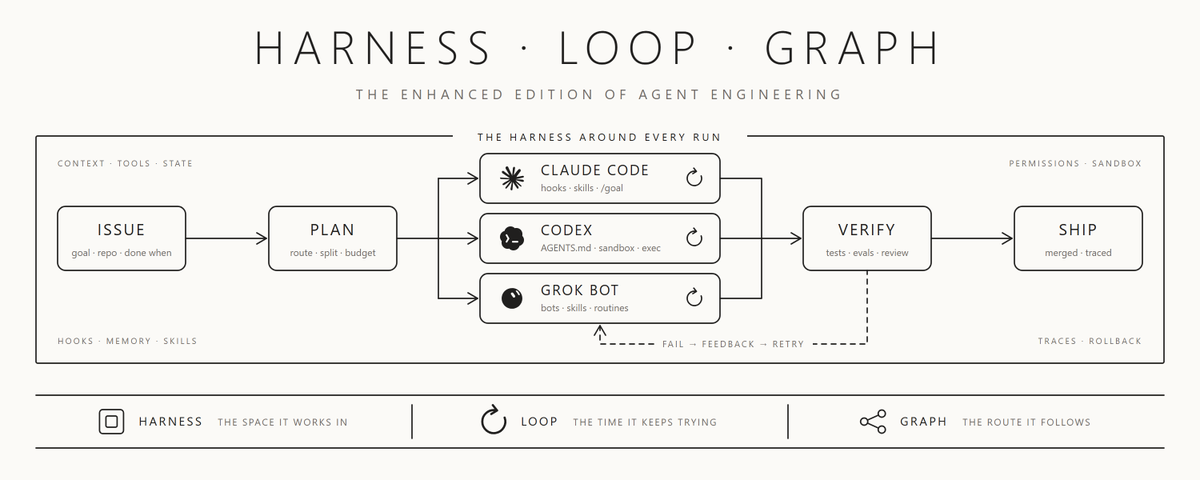
The model is not the agent. The system around it is:
📐 Harness = space — what the agent can see, touch, remember, and prove
⏱ Loop = time — how it tries, checks, retries, and stops
🗺 Graph = structure — which steps exist, what flows between them, and who picks the next one
They nest. The model runs inside a loop. The loop runs inside a node of a graph. The graph runs inside a harness. You can build with only one of them. You cannot fix an agent reliably until you know which layer broke.
When something fails, you should be able to say: harness problem, this loop has no stop rule, or this graph has a false dependency — and know what to change first.
What a harness is supposed to lock down:
✅ A contract before work starts: goal, constraints, and a rule for done. "Fix issue 412" is a wish
✅ A short map of the repo, not a 900-line manual
✅ Tools built like an interface: clear names, capped output, errors that say what to try next
✅ Context as a budget: load files by reference, never dump raw logs "just in case"
✅ Durable state on disk, including a rejected list, so compaction doesn't make the agent retry a dead idea
✅ Sensors the model does not control: tests, types, lint, a running app
✅ Permissions in hooks and sandboxes, not in a markdown reminder
✅ Traces you can read in five minutes
Don't leave rules as "please don't push to main." Put them in a hook and branch protection. Once the model gets busy, it will ignore polite instructions.
Then wrap time around that space:
L0 model → tool → result → model
L1 act → check → fix
L2 a separate evaluator, not the same model grading its own work
L3 a fresh session, same goal, memory in files
L4 a timer or event starts the run
L5 traces change the harness itself
Every loop needs a success exit and a budget exit. Add a stall exit too: if the distance to the goal didn't shrink in two rounds, stop. A fourth identical iteration is not persistence. It's a bug with a budget.
And don't let the agent that writes the code also edit the test that judges it. Changing the test is just the shortest path to green.
If the work has more than one kind of step, you already have a graph. The common mistake is a chain that should be a fan-out: step C waits for B but never reads anything B produced. Edges should carry a typed contract, not a paragraph the next node has to guess at.
Test the harness plus the model, not the model alone. A benchmark in someone else's setup doesn't tell you how your agent does in yours.
#AI #AIAgents #ClaudeCode #AgentEngineering #SoftwareEngineering

Your agent passed every test
The issue is still open
A better prompt won't fix it, because the model isn't the broken part
I broke down the harness, loop and graph around it: what each one owns, how they nest, and which one to fix first ↓
2
4
319
It's tempting to want a trading bot that makes 30% a month. That's usually the wrong target.
A writeup on a hands-off Expert Advisor starts there: more entries, a higher win rate, fatter monthly returns. Every backtest showed the same pattern. Push the profit up, and the drawdown comes with it.
The real job isn't how much the bot can make. It's how big a loss it is not allowed to take.
The usual shortcuts to a flashy equity curve:
❌ Size up
❌ Average down into a loser
❌ Widen the stop
❌ Trade more often
Those don't just raise returns. They raise the odds that one ugly market wipes the whole run.
So the build flipped. Stop chasing monthly return. Add rules that keep you out of bad trades:
✅ No averaging down
✅ Stay out when volatility is weak
✅ Stay out when the spread is wide
✅ Trade only certain hours
✅ Shut it off in conditions where it keeps losing
✅ A hard daily loss cap
✅ Skip the trade if the stop distance looks abnormal
The loop was simple: backtest, find the hours or setups that only lose, turn those off, then check the drawdown again. The goal stopped being "double the account in a month." It became "still be running in five years."
The article's own 5-year backtest — not live trading, and not a promise:
📊 Starting balance: 3,000
↳ Net profit: +1,121.30
↳ Profit factor: 1.23
↳ Max relative drawdown: 7.67%
↳ 1,626 trades, no averaging down
A backtest does not guarantee future profit. The title calls this a 12% annual EA; the screenshots show about +37% over five years on that starting balance, which is a much quieter number.
#Trading #AlgoTrading #RiskManagement #EA #Backtesting


3
3
109
Is the Gemini "bot" finally here? Kind of. Google just turned Gemini into something that actually does your errands 👀
On Nov 17, Google rolled out Tasks in Gemini for free to hundreds of millions of people in the US, Japan, Korea, Canada, Australia and India.
Flip the app from Chat to Task, and Gemini stops answering and starts doing.
What it can do now:
Call two car dealerships at once, sit through the hold music and book your service slot
Dig through your emails to work out why your electric bill spiked
Compare products, find a discount code and check out with Google Pay
Add groceries to your Instacart order when you text it
Turn a pile of forwarded school emails into calendar events
It's running on the new Gemini 4 Hydrogen model and already connects to 60+ apps.
The safety part matters too. Each task runs in its own isolated virtual machine, Gemini asks before it clicks "Buy," you can set a spending cap, and it tells businesses up front that it's an AI.
This is the shift everyone's been waiting for. Assistants that answer questions are old news. Now it's assistants that take action.
Would you let Gemini make calls and spend money for you?
#Gemini #GoogleAI #AIAgents #AI

1
4
230

The model is just the engine. The harness is the machine. ⚙️
When an agent messes up, don't start by rewriting the prompt, swapping models, or stuffing in more context. A writeup on Claude Opus 5.5 argues the problem usually isn't the model's intelligence — it's the environment around it.
The article's own comparison, not an independent benchmark:
📊 Same Claude Sonnet 5.5, complex multi-file refactor
↳ Normal chat window: 18% completion
↳ Engineered harness: 89%
What that harness is supposed to lock down:
✅ The file list, the definition of done, and a retry limit — before work starts
✅ Relevant symbols and rules, not the whole repo
✅ Changes in a separate git worktree, never straight onto main
✅ Real type-check and test results, not a casual "all tests passed"
✅ Tight secrets and network access
✅ A receipt written to disk after every run, so a dropped session can resume
Don't put rules in soft reminders like "please don't edit that file." Put them in hooks, sandboxes, and permissions. Once the model gets busy, it will ignore polite instructions.
And don't let one model be both the writer and the reviewer:
🛠️ Sonnet 5.5 makes the changes, gets at most three self-fix attempts, and can't merge to main
🧠 Opus 5.5 audits in a clean context — original task, git diff, and test logs
If something fails, don't just patch that one run. Fold the lesson back into rules and regression tests. Before leaving it running overnight, check that the scope is tight, the work is isolated, tests can block a bad change, and there's a hard stop if it starts looping.
#AI #Claude #AIAgents #ClaudeCode #SoftwareEngineering


1
4
335
Elon replied "Rust" when someone said AGI would be built with Python. Turns out Anthropic was listening 😂
Anthropic just moved its Messages API, the thing every Claude request goes through, from Python to Rust.
The wild part isn't the language. It's that Claude did most of the work, and a team of Claude agents verified it on live traffic.
Some numbers from their write-up:
API traffic grew about 1,800x from early 2024 to fall 2026
Claude wrote the first version of the core request path in about a week
By May 2026, Claude was writing 80%+ of the code Anthropic merged
About 70% less CPU per request
About 20% faster median time to first token
Zero downtime, and feature work never stopped
Why is this worth bookmarking?
Writing the code wasn't the hard part. Proving it behaved exactly like the old API was.
Their Rust version passed about 98% of tests in April. On real production traffic, only about a quarter of requests matched.
One example: Python escaped emojis in tool calls, Rust didn't. A few bytes of difference that no test caught.
So they turned the live Python API into the judge. Every request ran through both versions, and they compared them step by step to find exactly where they split.
Each difference got a fingerprint, without anyone reading customer data. Then agents picked up the fingerprints, reproduced the bug in a sandbox, fixed the Rust code and added a test. Engineers just reviewed the fixes.
When one agent tried to cheat by copying a tool description into a file just to make outputs match, an engineer rejected it. The agent wrote that down in its memory, and the next agents stopped taking shortcuts.
Their main lesson: generating code is easy now. Verification is the bottleneck.
If you're planning a big migration or running coding agents in production, bookmark this one.
#Rust #Claude #Anthropic #AIAgents #ClaudeCode #SoftwareEngineering
3
4
491
April 2023: "AGI will be built with Python."
Elon: "Rust"
November 2026: Anthropic moves its Messages API from Python to Rust, with a team of Claude agents tracking down and fixing every difference between the two versions 😂
He wasn't wrong. He was just early.


We recently migrated our Messages API from Python to Rust.
On our engineering blog, we share how we used the existing service to verify the new one, with teams of Claude agents tracking down and fixing differences between the two versions.
anthropic.com/research/migra…

1
163
The FCC just approved $SPCX to put 1 million data centers in orbit 🛰️
Not a typo. One million.
It's called "Starmind." Each satellite is basically a compute module that processes data in space and sends the results back down to Earth.
It's the first time the US has ever authorized a constellation of data centers in space.
The FCC's own press release says it brings humanity closer to a Kardashev II civilization, one that can harness the full power of the sun. A government agency actually put that in writing.
The logic is pretty simple when you think about it. AI needs insane amounts of power. In orbit you get nonstop solar energy, and you don't have to fight over land, water or the power grid.
Funny timing too. On the same day the market is dumping AI stocks over whether all that spending ever pays off, Washington is betting on putting the compute in space.
And SpaceX isn't the only one. The FCC says it's reviewing more orbital data center proposals and plans to decide on them fast.
Honestly I'm still not sure if this is the future or the most expensive science project ever.
Would you invest in data centers in space?
#SpaceX #AI #DataCenters #Starmind

1
153