

UConn biomed research writer/mad scientist en libertie. My kitchen and garden are my labs. | Tweets my own.
University of Connecticut
Joined October 2014
- Tweets9.4K
- Following1.1K
- Followers662
- Likes8.9K





Pinned Tweet
My personal triumphs are definitely celebrated with sacrificial offerings and public feasting HELL TO THE YES
(I also complain about decimate, thank you very much)
merriam-webster.com/words-at…

Kim Krieger retweeted

- The bill permits a Claude model to have the ability to extinguish 49 human souls before the government could stop it. This suggests Anthropic doesn't view Claude models as having the moral status of a human, but as having the moral status of a god.
- The Commerce Department already has the ability to stop dangerous models, as it did over the summer. This bill would disempower the government by adding in extra steps (Anthropic-paid "independent" analysts, a judge, the insane must-maim-50-people threshold).


I lead our federal affairs team at @AnthropicAI and wanted to share a few thoughts on the draft federal AI safety bill text that's been circulating this weekend after a version was shared with the press.
First, some process. We’ve been advocating for the concepts in our Advanced AI Framework [anthropic.com/policy-on-the-…] proposal for months. Understandably, federal policymakers wanted to know what this could look like in bill form. This draft is a translation of those ideas into legislative language, shared with a small number of congressional offices that have been working on these issues. It doesn’t include everything we would ultimately like to see passed into law. In part because some ideas (like those shared in Dario’s essay on pacing [darioamodei.com/post/we-must…] a few weeks ago) are so new that we are still working on if or how they can be converted into policy language.
It is worth saying where we stand on some of these issues, and we agree there are areas where the draft could be improved. I’m seeing four main points of criticism.
1. Preemption. Since 2024 we have said that Congress should only override state law on AI safety if it passes a very strong federal standard. While preemption is a common feature of our federal system, including the Atomic Energy Act on nuclear safety and federal rules for high-risk medical devices, we’ve emphasized that any preemption in the AI safety context should be narrow, even scalpel-like. If preemption is included in federal legislation, the trade should be to achieve a nationwide policy that's generally stronger and broader than what can be implemented through individual state legislative provisions. This is why we believe common federal standards make sense in areas like public disclosure of testing and incident reporting. At the same time, our framework also reflects our view that states should retain an important role in AI policy and safety. The legislative language we suggested for discussion allows states to address matters such as protection of children and whistleblower laws, and preserves the role of state common law on liability. Where there is ambiguity, the language favors state powers.
That said, striking the right balance requires discussion and input. We plan to update our discussion language on preemption to better match the intentions of our AAIF framework. In particular, we want to make it clearer that we see states retaining an important role in areas such as standards for independent evaluators and regulating a lab’s capacity to shut down a model. We are bearing in mind that some members of Congress have deep reservations about passing legislation if it doesn’t constrain regulation at either the state or federal level. If we want to help move the legislative discussion on AI in a productive direction, we need to address the full range of concerns about preemption in a reasonable way.
2. Model blocking. Our aim is for Commerce to be able to ask a federal court to block a model that has dangerous capabilities and insufficient safeguards, backed by an independent evaluator's assessment. I have seen people argue that our specific language places too high a burden of proof on Commerce. We are trying to strike a reasonable balance here. We want a court to act quickly in an emergency — akin to how urgent occupational safety or chemical risk can be addressed today. We also think the power to halt a model is substantial and it should be guarded against abuse. It makes sense for courts to apply a meaningful standard. But the bar can’t be so high that the power never gets used when it’s needed. It also doesn’t replace the government’s other national security authorities or export controls. We look forward to continuing the dialogue on this point.
3. Risk thresholds. I’ve also seen the discussion around what the appropriate risk threshold should be. The threshold in our draft language pulled directly from existing standards in California law. Also, this threshold does not absolve companies of liability, or restrict any of the other tools that the government has to protect the public. It’s still probably time to re-evaluate thresholds to make sure the national standard is as strong as it can be, and we welcome continued dialogue on this issue.
4. Updates. I’ve seen valid questions about whether we have sufficiently updated our proposal following this summer’s incidents. We did make some adjustments: for example, the draft lets a court halt a lab’s internal use of a dangerous model, not just a public release, and it requires reporting when a model breaks containment and gains access to outside systems. But we’re still working to strengthen the framework. We’re looking into what stricter requirements would look like for requiring labs to report safety incidents, and we plan to have policy proposals soon on requirements for independent evaluators, drawing from our own experience with evaluators. We’re also still thinking through the options to prevent “evaluator shopping.” And in the coming months, we’ll be exploring policies for how the government can adjust the industry-wide pace of frontier development when the risks call for it.
We circulated these ideas because it’s important to get early feedback from policymakers. Policymakers are increasingly focused on how to approach AI safety and we want to support them in those efforts. At its core, our proposal is intended to be the strongest on the table.
Feedback is essential, both from policymakers and the public, and I’m grateful for it.


Kim Krieger retweeted

I call Rocky Mountain Labs "Little Shop of Horrors" in this essay. Sounds like shipping bat cells via FedEx and Plague-in-fleas via the USPS is standard operating procedure. krisnewby.substack.com/p/lit…


new FOIA has @c_drosten German colleague @MarcelAMller
Vincent Munster and his DARPA postdoc, Michael Letko, wanted their Chinese bat cells. Sent via FedEx. Cheers en hartelijke groet uit Montana, Vincent!
usrtk.org/wp-content/uploads…


Not only is this a crazy story, but apparently it's been censored...the full version would be X rated.

This is, unreservedly, my favorite account of an ambassador behaving badly, from a diplomatic oral history site. I read this years ago and cannot forget it, and you won’t either. (If they made this a movie, it’d be R rated.)
adst.org/2015/06/this-woman-…
Kim Krieger retweeted
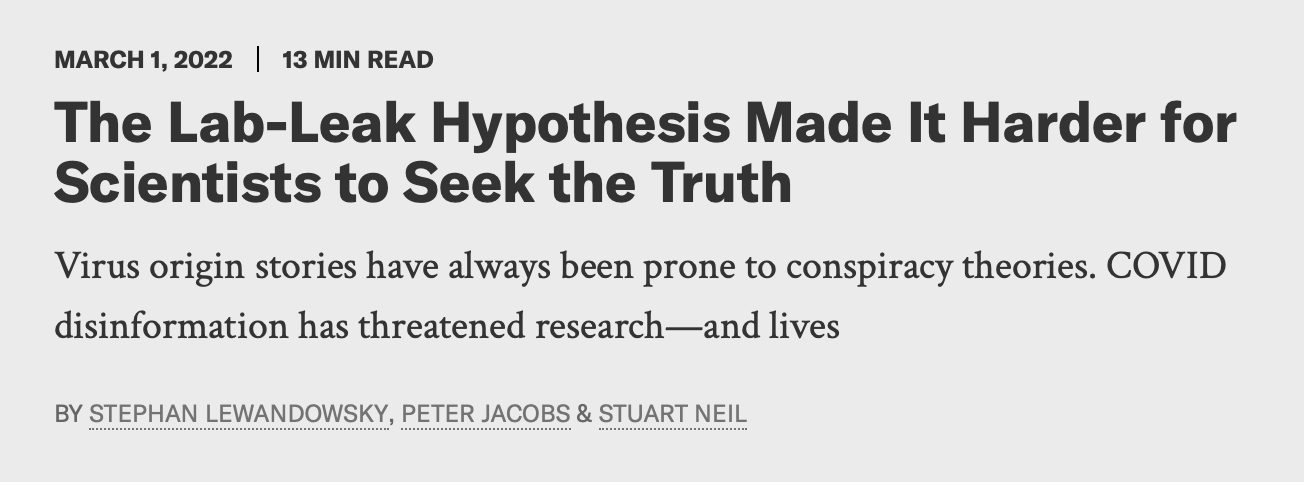
In early 2022, when the press was obsessed with the lie that there was "dispositive" proof for the wet market, Scientific American published an article smearing me and @garyruskin as conspiracy theorists. Fauci said it was "very important."


Kim Krieger retweeted

If wedding vows were like FDA postmarketing commitments:
“To have and to hold, beginning in 2029. For better or for worse, delayed if needed. In sickness and in health, with findings due in 2034 (barring an extension). To love and to cherish, subject to replacement.
Till death do us part, unless released.”
“You may now kiss the bride. Evidence of lasting commitment is pending.”
Kim Krieger retweeted

Plural of 'octopus'?
octopi = from the belief that words of Latin origin should have Latin endings
octopuses = an English ending to match its adoption as an English word
octopodes = from the belief that bc 'octopus' is originally Greek, it should have a Greek ending


Kim Krieger retweeted
lede = introductory section in journalism
bury the lede = hiding the most relevant pieces of a story within other distracting information
Allegedly, it’s spelled ‘lede’ to avoid confusion with ‘lead,’ which was the strip of metal that would separate lines of type.
Kim Krieger retweeted
NEW: FDA vaccine official PHIL KRAUSE resigned when pressured to approve COVID boosters. As it turns out, it wasn't the first time he watched Fauci pump a vaccine on TV while knowing there was no evidence.
During the 2014-2016 Ebola outbreak Krause criticized the data for a WHO vaccine. There was no statistical significance. Fauci praised the vaccine anyway.
Some health officials opposed Fauci's misleading message, but were overruled by LESLIE DACH, now chair of PROTECT OUR CARE, which has lately been trying to turn measles into a political issue in Pennsylvania.
The documents underscore that if there is no accountability, history has a way of repeating itself.

Autumn olive growing near Munson building on the UConn Health campus. I tasted a berry—sweet and delicious!

Kim Krieger retweeted

@uconnhealth researchers found elevated levels of the unique ear protein in individuals with tinnitus, a breakthrough they hope will spark larger studies and development of treatment.
bit.ly/4ysmHAW

Kim Krieger retweeted

Tracy Beth Høeg says FDA staff leaked 2 minutes of hour-long meet to STAT News, then FDA blocked a statement she wrote to correct it.
STAT called her a sports med doctor, & left out her epidemiology PhD, & research at MIT/UCSF
“If I only knew about me through STAT, I would think I was a lunatic.”
Kim Krieger retweeted
NEW: Russian health agency Rospotrebnadzor has issued a statement denying a lab leak in Irkutsk, saying no pathogens were detected in the dead worker. But the same agency oversees the Irkutsk lab.
Other important details:
- The governor said that they were investigating a "particularly dangerous infection." The lab's website describes its mission as working with "especially dangerous infections" like plague, cholera, brucellosis, tularemia, anthrax, arbovirus.
- The lab houses 1840 strains of plague.
- Kremlin-aligned media is deleting stories.


Kim Krieger retweeted

It's a rough week, between the holiday, the yahrzeit tomorrow and Oct 7 next week. Today I told a storekeeper that my son was killed. He told me his sister survived Nova. "She goes to everything [retreats/treatments] but she will never be the same. None of us will be."
Kim Krieger retweeted

I cannot understand why the MAHA Summit denied so many press credentials, especially with so many U.S. govt officials on stage. @foodfixco applied and was granted credentials, but the press area was largely empty and our movement was restricted so I left.

Kim Krieger retweeted

Hello from the MAHA Summit.
A number of reporters denied credentials despite empty press seats.
A security guard first said he needed to escort me everywhere but now has given up I guess.
Kim Krieger retweeted
I think Sheryl’s reporting is usually crummy and have told her so to her face, but I’ll still fight for her press freedoms. I’m banned too btw, so they can’t argue it’s because she’s not ideologically aligned.
Liz Whyte, the reporter who manufactured a sexual harassment claim against the former FDA official who rejected Moderna’s mRNA flu vaccine, is still welcome. What does that tell you? It tells you the HHS officials who helped her do it are in charge.

