



The way this was show was pretty elegant: if you expose naive animals to local virtual looming blobs, then they learn to be cool with crowded situations later on. However, if you expose them to blobs that rotate around them (without changing size) they don't adjust.
Nice!!
And he showed that the way fish measure and quantify the local population density is by integrating specifically over looming events - rather than just motion clutter.
That makes sense, because loom are a very particular signature of approaching siblings - but anything can move.
Yet another cool story just came out of the ever so capable hands of Roy Harpaz (@RoyHarpaz).
rdcu.be/ftQKm
Roy showed that larval zebrafish will adapt and get used to crowded conditions, and that they are then, later on, less sensitive about their personal space.
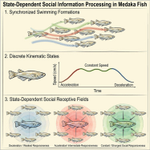
It's a really cool demonstration of how behavioral states can influence and modulate sensory receptivity, and it allows one to speculate why it might be an advantage to extract socially relevant features while swimming at a smore stable constant velocity.
Specifically, Roy could show that adult medaka respond much more reliably to neighbors when they swim at constant speed, that they are less responsive during accelerations, and that they care very little during decelerations.
Here is the link to a paper that just came out on "Social interactions in medaka".
sciencedirect.com/science/ar…
It's a story that was spearheaded by Roy Harpaz, where he looked into the fish's sensitivity to social cues, and how this sensitivity depends on the current swim state.

Florian Engert retweeted

How much do we *really* learn?
In @NatRevNeurosci with @EngertLab and @AFerreiraCastro, we address why most of you humans firmly believe that patterned activity plays a necessary and instructive role in shaping neural circuits.
nature.com/articles/s41583-0…

This mechanistic reductionist approach allows us now to make explicit predictions about the underlying neural circuits in the visuomotor processing stream, and thereby guide future whole-brain imaging and neural recording experiments to get at the underlying neural circuits.
This modeling framework accurately captures our behavior findings, and allows us to make novel behavioral predictions that we confirm in subsequent experiments.
Based on these experimental findings we generate a time-varying state space model that links the history of visual stimulation to the strength of inter-individual interactions, thereby providing a quantitative, predictive, framework for the modulation of collective behavior.
Remarkably, it is not translational motion, as reflected by other fish passing by, but it is - very specifically - looming stimuli, as induced by neighbors approaching, that is critical for changing the internal state of the animals.
We precisely measure the time dynamics of these modulations and find that they develop slowly over tens of minutes and remain stable for many hours.
Notably, we have isolated the specific visual features of neighbors swimming in the vicinity that induce the modulation.
We find that already at a very young age (7 days post fertilization), previously experienced social densities strongly modify the current collective behavior of the larvae: experience with high social densities decreases the vigor of inter-individual responses and vice versa.
In the new project we used, in a very similar fashion, naturalistic and virtual reality experiments and computational analysis to study how the history of experienced social environments modifies these individual-level computations and changes the resulting collective behaviors.
It is an extension of a previous story where we have described the precise visuomotor transformations that underlie collective behaviors in these small and amazing animals (Harpaz et al,. 2021 Nat Comm).
The story is entitled
Experience-dependent modulation of collective behavior in larval zebrafish
biorxiv.org/content/10.1101/…

Check out the latest project that came out of the phenomenally productive collaboration that Roy Harpaz (@RoyHarpaz) has initiated a few years ago by bridging the joint expertises of @engertlab and the team of Mark Fishman (also here at Harvard).
Florian Engert retweeted

Nature Over Nurture: Functional Neuronal Circuits Emerge in the Absence of Developmental Activity [Engert Lab] @EngertLab @GregorFPS @bdanubius mcb.harvard.edu/department/n…

Florian Engert retweeted
Now out in @NatureComms, our paper on activity- and experience- independent maturation of sensorimotor behaviors in zebrafish. @GregorFPS @EngertLab
Since the preprint, we added new experiments confirming the effect and washout of anesthesia 👇
nature.com/articles/s41467-0…

Nature over Nurture: with @GregorFPS and @EngertLab, we find that functional neuronal circuits emerge in the absence of developmental activity. Essentially, complex visuo-motor pathways mature even without activity-dependent refinement 🧵
biorxiv.org/content/10.1101/…
Florian Engert retweeted

This has become one of my favorite papers.
We're very VERY far away from understanding how the brain works.
thelancet.com/journals/lance…
