Joined November 2024
In 1930, Dransy drew a tipsy man in a grapevine crown, riding a blue donkey. The crown belongs to Dionysus, god of wine; the donkey to his revels. The joke has a point: you don't need to be a god to feel like one. You just need a glass: "Drink Mon Vin and live joyfully."
1
4
264
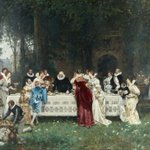
Give me a long table under the trees and a reason to raise a glass Le Centenaire, Adrien Moreau, 1880
1
2
15
Painted in 1880 and exhibited at the Paris Salon that May. Moreau was known for historical scenes of the French upper classes, looking back to earlier centuries rather than depicting the life of his own day
34
The goal is to have time to watch my wife enjoy the ocean in a picturesque setting. The South Ledges, Appledore, Childe Hassam, 1913
1
3
51
Hassam spent many summers on Appledore Island, off the coast of Maine, among artists, writers and musicians gathered around the poet Celia Thaxter. The Smithsonian reads the woman's pose as if she's listening to a sandpiper, a nod to Thaxter's poem
1
20
The first champagne cork ever painted, mid-flight, at Louis XV's post-hunt oyster lunch. De Troy, 1735.
1
2
88
Le Déjeuner d'huîtres hung where the king dined after the hunt. On the left, heads tilt back to follow the cork. Champagne was still new, and de Troy caught it in flight. Every friend group dreams of a lunch like this.
52
A French Michelin bicycle tyre poster, circa 1936.
1
3
48
Why a bicycle? Michelin developed its removable bicycle tyre in 1891, before moving into car tyres in 1895. By circa 1936, when this poster appeared, it was still advertising bicycle tyres. A bright little piece of that two-wheel history.
22
A Saddled White Horse in a Stable, Emil Volkers, 1903.
1
2
37
A dapple grey, saddled and waiting, a red blanket folded on the straw. Nothing happens, and it still feels immaculate. The small details do it: the white sock, the stitched tack, the warm brown wall behind him.
23
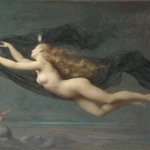
La Nuit, painted by Auguste Raynaud in 1887.
1
3
34
Raynaud showed La Nuit at the Paris Salon of 1887. Night isn't something to fear here, she's a gentle presence, a veil of stars drifting like her hair, an owl keeping watch below. A quiet painting worth discovering.
22
Less about the hunt than the idea of England itself: frost on the marsh, spaniels working the reeds, a mill by the water. Country sport as a way of life, sold to the world as one. Snipe Shooting, after Samuel Howitt, 1807.
1
3
57
This is from Orme's Collection of British Field Sports, 20 hand-colored aquatints published in London by Edward Orme in 1807-08, each captioned in English and French. This one's French title, La Chasse aux Grives, actually means thrush hunting.
31
Rosa Bonheur painted this dapple grey like it was a portrait commission. The red shirt of the handler, the golden sky, the camp below. A working horse given the weight of marble. She called The Horse Fair her own Parthenon frieze. She meant it.
1
2
57
To make The Horse Fair (1853, now in the Met), Bonheur sketched the Paris horse market twice a week for eighteen months. She needed police permission to wear trousers while doing it. The most famous animal painter of her century did her best work in borrowed clothes.
1
45
I’m at peace looking at the Sorgue river flowing through L’Isle-sur-la-Sorgue…. mesmerizing
2
51
Animals and scroll-work swirling around a central jug. These weren't art for display. They were pattern books for goldsmiths and embroiderers, showing the exact shapes to replicate in silver and thread. The high contrast was functional. The beauty was incidental.
1
3
66
Schweifwerk means "tail-work," a blend of scroll-work, strap-work, and arabesque. Von Hulsen published these as templates for artisans in Middelburg. Four centuries later, the tools survived. Everything they were used to build is gone. The instructions outlasted the creations.
62
Bespoke boots, a Purdey passed down through generations, and dogs that know the ground better than you do. Two hundred years later, the correct way to spend a morning hasn't changed.
3
50