

Education change-makers. #PBL curriculum that empowers young people to take charge of their learning. Powerful tools for teachers.
Seattle, WA
Joined December 2011
- Tweets2.3K
- Following1.9K
- Followers3.6K
- Likes717


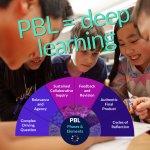
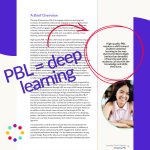
Ongoing, low-stakes assessments allow teachers to adjust instruction, provide targeted support, and ensure students are progressing toward learning goals while empowering them to reflect on and revise their thinking and work.
PBL incorporates both assessment for learning (formative feedback that guides instruction) and assessment as learning (student self-monitoring and metacognitive reflection). When students engage in self-assessment and peer feedback throughout the project, they develop agency over their learning process.
See how the PBL Design Framework might help instruction and assessment in your classroom. bit.ly/4cGkeux

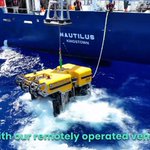
ALT A sunny deck on a ship overlooks the ocean. Text overlays the image reading, "A common misconception about PBL is that assessment occurs only at the end of a unit through the final product. In fact, PBL offers abundant formative assessment opportunities." An arrow points to a book titled "Designing PBL" by NCEE.
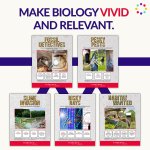
Our Life Science course brings biology off the page and into students’ hands. Through engaging investigations, learners explore evolution, ecosystems, genetics, and cellular processes while solving real-world problems.
From analyzing fossils and designing species habitats to examining DNA damage and tackling algal blooms, students think and work like scientists. Three-dimensional assessments capture their growing ability to model, argue from evidence, and design meaningful solutions.
Take a closer look: ncee.org/project-based-learn…

Middle schoolers act as anthropologists in The Next Renaissance, a unit that explores how ideas and innovations from the Renaissance have transformed people’s lives around the world.
They research a field of interest, create a mini photo essay, and refine their ideas through debate, peer feedback, and reflection culminating in a compelling photo essay that answers the question: What will spark the next Renaissance?
Real-world connections are an integral part of project-based learning. ➡️ ncee.org/project-based-learn…
The technologies we rely on require metals. But what happens when getting them means mining the deep ocean?
Depths of Discovery puts students in the role of scientists and explorers, connecting classroom learning to real-world challenges, experts, and careers. ncee.org/project-based-learn…
We talk a lot about this curriculum, with good reason. This partnership with @EVNautilus is bringing exciting opportunities for teachers and students—see the mission in action.
Contact us about Depths of Discovery curriculum: ncee.org/contact-us/
Sustained attention, deep reading, interpretation, and the ability to make sense of multiple and sometimes competing sources—Eric Jones (NCEE) reflected on the importance of these skills while digging into the PISA 2025 findings with Andreas Schleicher from the OECD and other panelists.
We immediately thought of project-based learning, where students build these skills through sustained, meaningful inquiry.
Read the PBL Design Framework and watch the OECD discussion for a deeper look at PISA results, beyond the headlines.
ncee.org/project-based-learn…
ncee.org/thriving-in-a-compl…
@OECDEduSkills @CtrEdEcon

A major investment in Idaho is reshaping the state’s workforce and creating an opportunity to think differently about how students prepare for what comes next.
We are happy to support the Idaho Workforce Development Council, school leaders, community leaders, and teachers who are imagining how project-based learning intersects with career-readiness and gives students pathways into the opportunities growing around them. stem.idaho.gov/project-based…
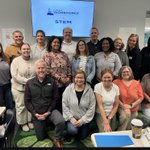
These photos are from the Future Pathways Leader Cohort—looking forward to being back in Idaho soon for the Teacher Design Intensive!


The ocean floor is largely unexplored. What might your students discover?
Depths of Discovery puts students in the role of scientists and explorers, connecting classroom learning to real-world challenges, experts, and careers. ncee.org/project-based-learn…
We talk a lot about this curriculum, with good reason. This partnership with @EVNautilus is bringing exciting opportunities for teachers and students—see the mission in action.
Contact us about Depths of Discovery curriculum: ncee.org/contact-us/
The latest results from the OECD’s Programme for International Student Assessment (PISA), the world’s largest education survey of 15-year-old students, have been all over the headlines.
One takeaway that stands out to us is favoring "depth over breadth," a principle at the heart of project-based learning. We invite you to:
➡️ Take a look at the PBL Design Framework and see what comes to mind for you and your students, particularly in this moment of thinking about how education systems and deeper learning can support future-ready learners. ncee.org/project-based-learn…
➡️ Hear directly from Andreas Schleicher (OECD) and other panelists about what these PISA results mean for U.S. students. ncee.org/thriving-in-a-compl…
@CtrEdEcon @OECDEduSkills #PISA2025

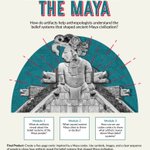
In this middle school social studies PBL unit, students think like anthropologists.
Their challenge: How do artifacts help us understand the belief systems that shaped ancient Maya civilization?
➡️ They analyze artifacts, art, and legends for clues about Maya beliefs and values.
➡️ They explore the rise and fall of Maya cities and the culture’s lasting legacy, building skills in observation and evidence-based storytelling.
➡️ Then they put the evidence together, creating a comic inspired by a Maya codex to show what artifacts reveal about Maya belief systems.
Along the way, students practice observing closely, interpreting evidence, and using what they discover to tell a story about the past.
Take a closer look at the learning experience with a free sample unit.
ncee.org/project-based-learn…


Educurious retweeted

Legendary ocean explorer Dr. Robert Ballard was featured on @CBSSunday reflecting on the discovery of the Titanic and the continuing mission of the EV Nautilus to explore and map the largely unknown world beneath the sea.
Kids ask him what his next great discovery will be. His response: "I don't know. I'm just gonna bump into it."
I love that answer. It's a good description of how discovery often works and captures habits of mind we should cultivate in young people: the curiosity to go looking before you know what you’ll find, and the determination to keep going long enough to find it.
My colleagues are developing a three-part graphic novel series on Ballard's life and work. Walking on the Ocean Floor takes young readers beneath the surface, following Ballard's groundbreaking discoveries, the science and technology that made them possible, and the persistence behind it all.
I love the idea of Ballard’s story inspiring a new generation to stay curious, keep exploring, and see what they might bump into.
cbsnews.com/video/shipwrecks… @Educurious @EVNautilus

In the Medieval and Modern Eras units, students explore questions like:
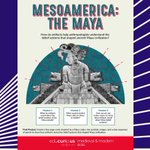
➡️ How do artifacts help anthropologists understand the belief systems that shaped ancient Maya civilization?
➡️ How can multiple perspectives help us expand the fairy-tale view of life in medieval Europe?
➡️ How would anthropologists document the significance of knowledge created and preserved during the Islamic Golden Age?
➡️ How have ideas and innovations from the Renaissance transformed people’s lives around the world?
➡️ What can anthropologists learn about the preservation of knowledge by studying the Mali Empire?
Students take on the role of anthropologists as they explore civilizations from Mesoamerica to the Renaissance. Through hands-on inquiry and analysis of artifacts, texts, and primary sources, they examine how knowledge, culture, and innovation shaped societies across time.
Take a closer look: ncee.org/project-based-learn…
In A Layered History of the American West, middle school students investigate westward migration by analyzing maps, sources, and key events like the Lewis and Clark Expedition, the Oregon Trail, and the Mexican-American War. They examine perspectives from Indigenous nations, settlers, immigrants, Black pioneers, railroad workers, and vaqueros to understand both the opportunities and consequences of expansion.
The unit concludes with an illustrated graphic story (like these real examples!) that captures a historically grounded moment in the history of the American West. bit.ly/46Bt88m

Our team was in Federal Way, WA, supporting a professional learning opportunity for teachers to learn more about PBL and civics teaching. Team member Naomi Tsai came back with some interesting conversational threads:
“We talked a lot about how PBL design supports the College, Career, and Civic Life (C3) Framework for Social Studies State Standards Instructional Shifts—it was cool how well they mapped to our PBL Design Framework! Some highlights from this activity included:
💡 A group of teachers describing the project launch as “winning the battle of why” with students.
💡 Another group used a waterfall metaphor to describe how inquiry works across a unit. The unit driving question sits at the top and everything below it cascades—the module supporting questions, then the questions the students generate themselves. Each level feeds the next and it all runs in one direction: toward the final product.
Our big question of the day was, what is PBL and how does it turn civic knowledge into civic action? We talked about depth versus breadth and what makes civic knowledge actually stick→ students have to use it for something, e.g. civic action.
We dug into Unit 1: Foundations of U.S. Government, ending day two with a taste of the student experience: creating our own proposals for a 28th Amendment.”
Wonderful to have this experience with you @FWPS210 and we hope your school year is off to a great start!

We spoke candidly with teachers Leo, Tyler, and Ashley about what it has taken to implement project-based learning in their classrooms. Their reflections share a common thread: PBL is challenging, but it is also deeply energizing, adaptable, and worth the effort.
For educators thinking about what this might look like in your classroom, keep reading.
bit.ly/4gQ3TUB

Real-world connections are an integral part of project-based learning. In Storm Watch, middle school students explore how the uneven heating of Earth creates air masses, winds, and the conditions that generate storms.
Acting as meteorologists, they analyze weather data, model storm formation, and practice real meteorological forecasting. Students work in meteorologist teams to create and present two Weather Channel video broadcasts: one that forecasts a storm approaching a region and another that provides live storm coverage.
Explore the units on our website. ➡️ bit.ly/4gpoOiU
Dive deeper into why career-connected learning matters and download the Thinking Differently About Career-Connected Learning brief. ➡️ bit.ly/3SzMhnR

We know teachers are busy in the classroom (to put it mildly).
But if you’re curious about new insights from 760,000 students across 91 countries about things like use of #AI for schoolwork and mindsets such as curiosity and perseverance, register for this webinar and we can send the recording to you to watch on your own time. We’ll translate the research and share learnings for schools here in the U.S. bit.ly/4qSodcz
@OECDEduSkills

We’re excited to kick off our work with Coakley Middle School in Harlingen, Texas, where teachers are designing three new career-connected PBL science units rooted in relevant and authentic opportunities in their community.
Over the course of this year, we’ll continue meeting with Coakley educators to co-design the units, build connections with local community and industry partners, and ultimately bring these projects to life with students.
Here’s a quick preview of what’s taking shape: Students will explore wind energy and sustainable wind farm design, local water quality and protecting community water resources, and the science behind peptides and health claims that teens encounter online.
These projects are just getting started, and we’re excited to see where the teachers take them. More to come as the work continues!

Wishing everyone a wonderful school year, either already started or to come.
Also, we love seeing student work! 😁 Tag us in any creative PBL from your classrooms this year, we’d love to see it.

Teachers, principals, district leaders: As a new school year kicks off, consider how project-based learning could work in your classroom, school, or district.
Dive into the why and the how, and download the PBL Design Framework 👉 bit.ly/4tkRDj8
@CtrEdEcon

Educators at Elevate Northeast Middle School in Denver, CO, are using Educurious project-based learning middle school social studies curriculum as their tier 1 instructional materials, or high-quality instructional materials. Our team had the opportunity to visit and share some interesting classroom observations.
Take a look: bit.ly/4bxEw8t
@DSSTPubSchools
