

Research Fellow @HooverInst; quantifying and studying regulation and deregulation. Better regulatory management leads to more abundance.
Washington, DC
Joined January 2009
- Tweets933
- Following567
- Followers1.1K
- Likes462





Pinned Tweet
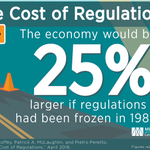
Ten years ago, I made this video to help folks visualize overregulation. The wall of books of regulations that I piled up almost crushed me! And it has only gotten worse since then. @elonmusk @VivekGRamaswamy
Who wants to help make an updated video that shows regulatory accumulation through 2024? Probably need safety equipment, though, in case the pile of books actually falls on me this time.
Patrick McLaughlin retweeted

An extraordinarily insightful day at @PepperdineSPP for the "What’s the Matter with California?" conference.
Experts shared their experience across key sectors, including housing, the economy, the energy industry, and political dynamics.
Thank you to all of our speakers and panelists for sharing your research and insights with us!
@StevenGreenhut, @EconPatrick, @edring, @MikeUmbro, James Enstrom, Jennifer Hernandez, Chad Hathaway, Steven Hayward, Cyrus Mojibi, Lee Ohanian, Frank Wolak


Patrick McLaughlin retweeted

More evidence reducing #regulation increases growth "a 25% reduction in state regulatory restrictions is associated w/ 4.4% higher employment growth. For the average state, our estimates imply cutting red tape by 25% would create roughly 10,000 additional jobs over the study period" via @EconPatrick thirdorder.substack.com/p/st…
Patrick McLaughlin retweeted

A BC success story to emulate? "There is also evidence that reversing the accumulation can help. For example, the Canadian province of British Columbia reduced its regulatory requirements by roughly 36% after launching reforms in 2001. Research I conducted with Mr. Coffey estimated that those reductions increased annual economic growth by about one percentage point.
While those estimates don’t guarantee an identical result if the U.S. cuts regulations by 36%, they do make a strong case for the regulatory budgeting approach that British Columbia pioneered.
The approach involves three initial steps and then a feedback loop. First, inventory existing requirements, set reduction targets and require agencies to identify rules whose costs exceed their benefits. Then continually measure success against economic performance and the health, safety and environmental outcomes regulation is supposed to improve." @EconPatrick @HooverInst

I was recently asked what keeps me up at night. My answer: the trend towards wealth taxes that we're seeing in America right now. I can think of no better way to stifle innovation than to punish successful innovators with a wealth tax.

Important facts and considerations I discuss with @realjonslavet here
- Prop 40 CA wealth tax will on net lose revenue for the state when you consider lost income taxes of departed billionaires
- Entrepreneurs like @parkerconrad have advised founders to leave CA because of the possible wealth tax
- Investors like @mcuban are requiring founding teams not to be located in CA if they want capital
- State will spend billions litigating. Example: Zuckerberg left CA in Feb 2026, late relative to 1/1/2026 cutoff date, but no way he is simply forking over $12B without a contest
- You have to consider well-being of Californians if jobs or future jobs are destroyed for a little revenue today. If you raise $1 and kill 100,000 jobs, that's bad for people.
- Stated reason for Prop 40 is need for emergency revenues due to federal gvt cuts to Medi-Cal in OBBBA. But Medi-Cal spending has more than doubled since 2019 (up 2.2x). Federal gvt contributions to Medi-Cal have also more than doubled (2.1x) and will continue to grow but their rate of growth will slow. Not a fiscal emergency, more like a health worker union money grab.
Whole video link ⬇️
Patrick McLaughlin retweeted

Chairman @RepDavid led a roundtable with @HooverInst to examine how regulatory sandbox pilot programs can reduce barriers to innovation, facilitate responsible experimentation & inform more effective regulatory policy. “We are approaching a fundamental choice: cut or innovate. Too often, cutting or capping what already exists is easier than pursuing disruptive technologies that can lower costs, improve outcomes, and challenge entrenched business models.” Thanks to the Hoover Institution at Stanford University for hosting JEC.
@StanfordDeptMed @SUBiodesign @BusinessUtah @EconPatrick @StanfordEng @RachelSlaybaugh

Patrick McLaughlin retweeted

Hoover Research Fellow @EconPatrick argues that America's regulatory system is designed to expand, imposing costs that impact prices, innovation, wages, and economic growth. Restoring accountability requires eliminating ineffective rules, sending the costliest mandates to Congress for approval, and making rigorous cost-benefit analysis permanent.
Watch a new installment of Intellections based on McLaughlin's research:
Patrick McLaughlin retweeted

a tale of 2 adjoining counties and data centers. One embraced data centers. The other rejected them.
Take a guess how this story ends. It's not hard to figure out...


Patrick McLaughlin retweeted

“The United States has a preposterous amount of regulations in the book and we will know we are successful when there are less.” 🔥 @JamesBroughel
@reevebull, @JamesBroughel, @EconPatrick, and Caleb Taylor went through how AI technologies can streamline regulatory processes!

What you pay for groceries includes the price of refrigeration, transportation, warehousing, energy, labor, packaging, and compliance. If government regulations raises the cost of any of those links, some of that cost eventually reaches the shelf.
Some on the hill might benefit from learning how regulating a transportation network will increase the cost of consumer goods. @RepSamGraves has it right: more regulations --> higher prices. Especially true for freight transportation.

Why does everything cost more today?
It’s not just inflation. Regulation quietly acts like a hidden tax across the economy.
Every extra freight mandate, permitting delay, compliance burden, and transportation bottleneck raises costs for:
food
energy
housing
consumer goods
In Episode 169 of the Let People Prosper Show, I talk with @EconPatrick of the @HooverInst to break down how excessive regulation slows growth, weakens productivity, and raises prices for everyday Americans.
Good policy should focus on measurable outcomes—not symbolic rulemaking. 1/

Patrick McLaughlin retweeted

I also talk with @EconPatrick of @HooverInst about:
✅ Why freight costs affect most products
✅ How regulatory accumulation hurts small businesses most
✅ Why Washington often confuses headlines with reform
✅ The hidden economic costs of transportation barriers
✅ What smarter, evidence-based regulation should look like
Watch/Listen/Show Notes here: vanceginn.substack.com/p/hid… 2/2

I recently had the pleasure of chatting with Vance Ginn on his podcast, Let People Prosper. It's a rare treat to be able to get into the weeds on how to measure regulation and how that affects regulatory reform efforts--but we did! Check it out: open.substack.com/pub/vanceg…
Patrick McLaughlin retweeted

How the Railway Safety Act Could Make Railroads Less Safe - excellent piece by @EconPatrick citing multiple studies that the RSA not only hurts rail through costly regulations, but unleashes a contagion of costs that slow the entire economy.
thedailyeconomy.org/article/…
Patrick McLaughlin retweeted

Gains in safety historically came from innovation and operational flexibility on the ground.
Three new studies suggest Congress is approaching rail safety backward.
cc: @EconPatrick
thedailyeconomy.org/article/…
Patrick McLaughlin retweeted

How and why should the Administrative Procedure Act be changed? Hear from Patrick McLaughlin @EconPatrick, Research Fellow at the @HooverInst, with host @Andrew_Langer.
Patrick McLaughlin retweeted

I am particularly proud of this interview with @EconPatrick from @HooverInst. We talk regulatory costs, CMMI, etc.
youtu.be/Kh0HrRM54fo?si=S9-l… – at Virginia, USA
Patrick McLaughlin retweeted

Learn something new every day.
@FERC has the highest count of general/broad delegations of authority in @PacificLegal's Nondelegation Project data.

Rail safety needs follow-through, not symbolism. As Congress writes the surface transport bill, don't revive prescriptive mandates that freeze innovation. Judge policy by measurable safety outcomes and let proven tech deploy. washingtonexaminer.com/resto…
