





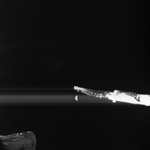


ALT Image taken by BepiColombo during its sixth Mercury flyby. Planet Mercury is visible in the background with its grey, cratered, pock-marked surface. In the foreground are some spacecraft parts.

ALT Image taken by BepiColombo during its sixth Mercury flyby. Planet Mercury is visible in the background with its grey, cratered, pock-marked surface. In the foreground are some spacecraft parts.

ALT Image taken by BepiColombo during its sixth Mercury flyby. Planet Mercury is visible in the background with its grey, cratered, pock-marked surface. In the foreground are some spacecraft parts.

ALT Cartoon representation of the three elements of the BepiColombo mission: ESA’s Mercury Planetary Orbiter (shown in blue, middle), JAXA’s Mercury Magnetospheric Orbiter (red, top) and the ESA-built Mercury Transfer Module (grey, bottom), respectively. The Mercury Magnetospheric Orbiter holds a clipboard with all the six flyby dates marked as checked. Left unchecked is the arrival date on 21 November 2026. In the background, planet Mercury greets them with a yellow balloon shaped as number six.


ALT A cartoon-style image with a blue background. On the left, a small grey planet (Mercury) with a happy face raises two black arms, one waving and the other holding a flag with the number 5 on it. On the right, in the foreground, is a spacecraft made of three parts. The bottom, grey part has two solar panels sticking left and right, a darker grey rod sticking up and towards the viewer, and a screen with some emojis on it. On top of that is a blue spacecraft with a surprised face, pointing an infrared camera at Mercury and with a solar panel sticking up behind it. On top is a smaller red spacecraft with a happy face, holding up a clipboard with dates on it, the first five of which are checked off.


ALT Infographic explaining BepiColombo’s fifth flyby of Mercury. In the centre of the infographic we see the spacecraft flying past the planet. On the left we see the inner Solar System in perspective, with the positions of Mercury, Venus and Earth indicated. On the right we see which of BepiColombo’s instruments will be activated during the flyby.


ALT The launch of Ariane 5 flight v245 into the night sky, carrying the Bepi Colombo spacecraft.

ALT A textured sphere representing Mercury is shown with magnetic field lines compressed on the sunward side and streaming out into a tail on the nightside. The BepiColombo spacecraft’s trajectory is drawn passing through the magnetosphere from dawn to dusk, close to the planet’s surface. Various features in the magnetosphere are depicted and labelled with text. Following the order in which they were detected by the spacecraft, this includes the bow shock, magnetopause, low-latitude boundary layer, cold ion cloud, plasma sheet horn and ring current.

