

Duy Dat Tong retweeted

UniMetric: Universal Metric Scale Recovery for Visual Geometry Foundation Models
Lei Yang, Yuner Zhang, Ziyang Liu, Ziying Song, Kai WU, Yiyang Gao, Jiangtao Su, Yiming Li
tl;dr: uncertain object-size priors from VLM + GFM reconstruction->scale
arxiv.org/abs/2610.16945


Duy Dat Tong retweeted

KronLSTM is out!! | Candidate to replace TRANSFORMER in LLMs
KronLSTM is built on the Kronecker Delta Rule: instead of correcting the vector stored at a key, it corrects a single scalar, how strongly this key is bound to this value.
P: arxiv.org/abs/2610.26834


Duy Dat Tong retweeted

发现一个牛逼的DSH插件,可以让AI破防。不仅仅可以破Deepseek,基本能破的都能破。
github.com/YuJunZhiXue/dsh-p…

Duy Dat Tong retweeted

GroundAnything
Why locate objects one token at a time? This 4B diffusion model generates grounding predictions in parallel, delivering a 4.51× speedup while setting a new SOTA across 30 benchmarks.
Duy Dat Tong retweeted
Graph3R: Unifying View Graph Initialization with Feed-Forward Reconstruction
Jingwen Yu, Hengli Wang, Jianhao Jiao, Zhonghang Liu, Ping Tan, Hong Zhang
tl;dr: π3->verification head->pairwise covisibility->view graph->graph-conditioned reconstruction
arxiv.org/abs/2610.16272


Duy Dat Tong retweeted
TartanMatch: Towards Universal Dense Correspondence Across Modalities
Hyeokjoon Kwon, Jiting Cai, Ruogu Li, Kritan Bhandari, Geethika Hemkumar, Parv Maheshwari, @QiuYuhengQiu, @YuchenZhan54250, @smash0190, Wenshan Wang
tl;dr: multi-modal UFM
arxiv.org/abs/2610.14513


Duy Dat Tong retweeted

Looped Transformers are a hot topic these days
And these 10 new papers are really worth your attention.
▪️ Recurrent Looped Transformer
▪️ Looped Prediction Transformer (LPT)
▪️ Recursive Multi-Agent Systems (based on looped transformer)
▪️ Loop Flow Transformers (LiFT)
▪️ Looped Diffusion Transformer
▪️ LAST: Looped Audio Spectrogram Transformer
▪️ LoopCD
▪️ Hyperloop Transformer
▪️ OperLoop
▪️ LoopQuant
Here is our quick guide to what they are, how they work and when to use each.: turingpost.com/p/10-looped-t…

Duy Dat Tong retweeted

We plugged Google Research’s Harness² into JEV 1.14.
Zero weights touched, yet driving massive gains on vision benchmarks round after round.
Under the hood, the system:
⚡️ Rewrites its own prompts
🛠️ Builds its own tools
🧠 Distills its own experience
JEV-Harness² repo drops soon. Stay tuned.

Google just open-sourced Harness².
(turn any harness into a self-improving system)
a harness is everything wrapped around the model, like the system prompt, tools, memory, skills, and subagents. today a person designs it once, and the agent runs every new task with that same fixed setup.
Harness² lets the agent refine that setup for each new task on its own, with the model weights left untouched.
on every task, the agent proposes edits to its harness, runs a few candidate versions, and composes a better harness by comparing how those runs behaved.
because it learns from the differences between runs, it needs no correct answer or grader for the task.
that covers a single task. Harness² also carries what it learns from one task into the next.
after each task, it saves the harness it settled on along with the lessons that held up across the runs. the next time it refines a harness, it starts from those notes instead of from scratch.
this means every finished task makes the next round of edits more informed.
Google tested this with Gemini 3.5 Flash and GLM-5 on legal, office, and professional work benchmarks. one round of edits was enough to beat their original harnesses, and giving the agent more rounds pushed scores higher.
those extra rounds can go wide or deep. the agent either tries several candidate harnesses at once or keeps refining a single one step by step, using OpenCode or Codex to carry out the work.
you can find the Harness² repo here: github.com/google-research/h…
I wrote about a similar idea for agents already running in production, where the harness should repair itself after a failure instead of waiting for someone to debug the trace by hand.
that piece walks through how @Cometml's Opik (open-source) closes this loop, going from a failing trace to a proposed fix to a regression test that stops the same failure from coming back. it's quoted below.

Duy Dat Tong retweeted

🎓 Google AI Pro 学生优惠:3年领取教程
按步骤操作,争取用 $8.99 解锁 3年 Gemini AI Pro + 3年 YouTube 会员,预计可用 2029 年 10 月。
第一步:领取学生优惠
🔗 gemini.google/students/?utm_…
第二步:选择 AI Pro
显示 Google AI Pro 就直接操作;如果显示 AI Plus,点击「查看所有学生优惠」,再选择 AI Pro。
第三步:确认扣费时间
⚠️ 重点检查下次扣费日期,确认符合优惠条件再继续,别盲目订阅!
第四步:领取额外2年
🔗 one.google.com/ai-student?g1…
按页面提示操作,支付 $8.99。确认页面明确显示优惠期限后再付款。
第五步:取消自动续费
🔗 play.google.com/store/accoun…
找到 Google AI Pro,取消自动续费,避免后续扣款。
✅ 重点:先确认资格、优惠期限和扣费日期,再操作! 实际优惠以账号页面显示为准。
找到对应的 Google AI Pro 订阅,点击取消订阅,并按照提示完成操作。


Duy Dat Tong retweeted

GET 6 MONTHS OF FREE CHATGPT PRO + CODEX 🤯
OpenAI is recruiting Codex Ambassadors with perks including API credits
how to apply
1. go to developers.openai.com/commun…
2. record a 30 second intro video
3. share public links to projects you've built with Codex
4. submit before November 1
important
• not for students, almost for everyone
• you must publish content or organize an event every month
if you're already building with Codex, worth applying

Duy Dat Tong retweeted

Brilliant paper by NVIDIA.
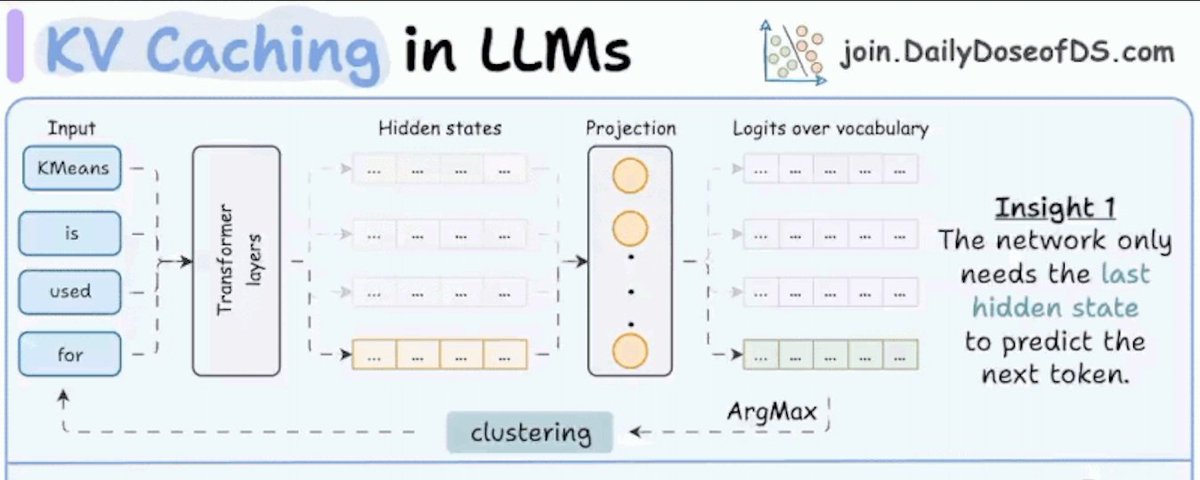
they found a way to make KV cache transferable between models.
the target model skips prefill entirely, and the conversion runs 2.7 to 25x faster than processing the context again.
let's understand why this is so important today.
LLM APIs are stateless, so every turn sends the entire conversation back to the model. the model reads it again before generating a new token, and all of it is billed as input.
prompt caching lets providers hold the KV cache for a stable prefix and bill cache hits at roughly 10% of the base input rate because that compute was already done.
this 90% reduction is one of the biggest levers in LLM serving.
but the cache only works on the model that produced it. since keys and values depend on that model's weights, another model cannot directly reuse them.
this becomes a problem with LLM routing.
if traffic moves to another model for cost or capability reasons, the accumulated KV cache becomes invalid.
the entire context must be processed again and billed at full rate.
NVIDIA's recent paper treats this as a representation problem.
prefill's main output is the KV cache, so transferring it means converting one model's cache into the representation another model expects.
they first checked whether this conversion had enough structure to exploit.
for Qwen3 14B → 32B, a linear regression from a single source layer reconstructed 56% of the variance in the target model's keys.
because models can have different layer counts, there is no natural one-to-one layer mapping.
so, for every target layer, they rank the source layers by predictive power and use the top eight together.
that pushes reconstruction to 79%.
the mapper has three parts:
> each target layer and head gets its own linear map, solved in closed form instead of with gradient descent.
> cross-layer selection chooses the source layers that best predict each target layer. their ablation shows this contributes the most.
> RoPE adds a position-dependent rotation to keys. they remove it, fit the mapping in position-free space, then apply the target model's rotation again at inference.
across six model pairs from Qwen3, Llama 3.1, and Ministral 3, four retain 73 to 98% of the receiving model's standalone accuracy.
conversion is also 3 to 25x faster than processing the context again.
prior cross-model KV reuse methods either train a neural adapter for every pair or require architecturally identical models.
this approach is closed-form and training-free, but there are still important limitations.
every tested pair belongs to the same model family, such as Qwen → Qwen or Llama → Llama.
cross-family transfer is still future work.
the tested pairs also share KV head count and per-head dimension. mismatched configurations remain untested.
and the work currently covers dense full-attention models only, not sliding-window or attention-recurrent hybrids.
link to the paper: arxiv.org/abs/2608.03893
we wrote a first-principles breakdown of how KV caching works
the article is quoted below.
Duy Dat Tong retweeted

system_fingerprint for deepseek-flash just changed.
aeb56401ca74e127821c4f9126dcb669 to
e72d3c7f663d3e1383b00b3884cb4501
I think DeepSeek V4.1-Flash-1017 is here.
it does feel smarter. Probably terser.


Duy Dat Tong retweeted
All-St3R SLAM: Real-time RGB Dynamic SLAM with Pixel-wise Motion Masking
Yewon Kim, Paul Hongsuck Seo, Sang Chul Ahn
tl;dr: DUSt3R + All-Tracker
arxiv.org/abs/2610.16143


Duy Dat Tong retweeted

🎉 Jev 1.14 终于能看图了!!!
我让它在一幅包含上百个小人的画里找一个人,看看效果如何。
尼德兰箴言里藏了上百人物和动物,这里把找人拆成三个步骤:
1. 选块:把画切成 16 块,出一道 choice,16 个选项本身就是 16 张图。它选第 12 块,概率为 0.95
2. 框:在这一块上问一道 box,返回一个框,置信度 0.77
3. 验边:四条边各问一道 noul,询问人有没有被这条边截断。上边 0.86、右边 0.80,框把头截掉了
于是把超过 0.5 的边往外推 12%,再问一遍,反复两次终于头进到框里了。
5 次请求,实际 46.4 秒(换成并发可压缩到 6-8 秒),总共消耗 $0.0014。
想必用来自动玩小程序里找不同的无脑游戏挺不错的😁

Jev 发布才 8 天,开源替身已经一堆了,今天诺基亚也来蹭热闹了😅
我在 MacBook 上,让官方 Jev 和 3 个开源方案同跑 20 张中文工单🫱
Laya 25ms,比 Jev 快 50 倍
djev 509ms
官方 Jev 1.3 秒
AnyJev 将近 4 秒
仓库都在这:
Laya(Mac 版)github.com/mizorewww/laya-ml…
djev(Mac 版)github.com/jamescorbett/mlx-…
AnyJev github.com/nokia-applied-res…
但快的,不一定对 👇
Duy Dat Tong retweeted

Introducing Quotient Recurrent Reasoners (QRR) 🚀
Looped reasoning models (e.g., TRM, FPRM) spend a large amount of loops on oscillatory dynamics that don't contribute to reasoning, wasting a lot of computation before converging. Turns out gauge equivariance helps tremendously by defining convergence in a quotient space instead of state-space, where these oscillations are part of the same equivalence class.
Super strong performance on reasoning benchmarks: Sudoku-extreme: 97.9% 🤯
Incredibly work done by my student Sumin Park @psmiziz
Check out the fascinating thread below. Also such a cool visualization! 🧵👇
@ELLISInst_Tue @MPI_IS @liquidai


Duy Dat Tong retweeted

VideoJev
System One Model for Video Understanding and Interaction
paper: huggingface.co/papers/2610.1…
Duy Dat Tong retweeted

Introducing Next-Concept Models (NCMs), a new paradigm for language generation that is significantly faster and more data efficient than diffusion models.
How it works:
1) First we learn a series of compressed representations of text from coarse to fine-grained, aka ‘concepts’. This step is done once, similar to training a tokenizer.
2) At inference, we generate text going from a coarse to fine hierarchy via these ‘concepts’. A transformer predicts each level of the hierarchy sequentially, but the codes within each level are generated in parallel.
Compared to strong diffusion language models, NCM achieves:
Up to 31× faster generation on downstream tasks like summarization and machine translation.
10-21× faster generation across TinyStories, LM1B, and OpenWebText, using 3-5× fewer training data.
On reasoning tasks like Sudoku, NCM outperforms both autoregressive and diffusion baselines with fewer sampling steps.
Lead authors: @KumbongHermann & @ishanskhare, together with a great team!


🚀 Introducing Next-Concept Modeling (NCM): our new paradigm for fast, parallel, coarse-to-fine text generation.
Compared to strong diffusion language models (DLMs) at similar parameter size, NCM achieves:
⚡ Up to 31× faster generation on downstream tasks like summarization and machine translation with comparable or better quality.
🏎️ 10–21× faster unconditional generation across TinyStories, LM1B, and OpenWebText, with comparable or better generative perplexity and using 3–5× fewer training tokens.
🧩 Better performance on reasoning tasks like Sudoku, outperforming both AR and diffusion baselines with fewer sampling steps.
With @ishanskhare, @IddahMlauzi, @ekellbuch, @simran_s_arora, @Azaliamirh, and @HazyResearch.
More details in the thread 🧵👇
Duy Dat Tong retweeted

🎊 Excited to share our new study, Beyond Sparse Captions: Aligning Slide-Level Text and Patch-Level Vision in Pathology accepted at NeurIPS 2026 as a Spotlight article (top 1.3% articles) from our superstars @Daniel__Shao and Eugene (Dongmin) Bang.
Code: github.com/mahmoodlab/LIMIT
Model: huggingface.co/MahmoodLab/CO…
Paper: arxiv.org/abs/2610.17233
Duy Dat Tong retweeted

JevGPT: Thinking Fast and Slow in Autonomous Research
Introduces a dual-system research agent. A fast model checks sources in parallel and returns original passages, while a GPT planner sets evidence goals and answers.
📝 arxiv.org/abs/2610.18272
👨🏽💻 sunyasheng.github.io/project…
