

Co-founder and Co-CEO of Ad-Shield — measuring and monetizing dark traffic for publishers.
Joined November 2025
- Tweets175
- Following106
- Followers71
- Likes310






At this point it’s still not eniterly clear why only 5 ID/tracking vendors ended up on the iOS 27 hardcoded blocklist. As opposed to a more comprehensive list.
My guess is a test, before ramping up with the larger dynamic list.
Have been talking with publishers about this the past few days. The general sentiment so far is:
• Not seeing a huge impact, small %
• Assessing how the situation develops before reacting

Worth keeping in mind alongside Apple's recent blocks on TTD and post-cookie ID providers:
In July 2026, Apple changed its ad terms.
Apple Ads used to run on "Apple software applications or Apple devices."
Now the terms cover "devices, operating systems, software or web applications, or other platforms or properties."
That suggests room to expand, which could include in-app, Safari, and beyond.
As the utility of independent adtech goes down, the relative value of Apple Ads goes up.

Apple has unblocked The Trade Desk on iOS. Well, sort of...
Quick recap. Since iOS 27 launched mid-September, Safari and every browser on iPhone has been blocking a short, unpublished list of adtech domains, even in normal browsing mode.
Eight domains were hardcoded onto a blocklist in WebKit:
→ The Trade Desk (adsrvr .org)
→ The Trade Desk's Unified ID 2.0 (uidapi .com)
→ ID5 (id5-sync .com, eu-1-id5-sync .com)
→ LiveRamp (rlcdn .com, pippio .com)
→ Permutive (permutive .com)
→ Audigent (ad .gt)
All but one are exclusively identity and tracking domains. The odd one out is adsrvr .org, which TTD also uses to actually serve ads. So TTD's ads went dark on Safari.
Yesterday, Apple released a new iOS 27.2 beta build. In it, adsrvr .org is off the blocklist, clearing the way for TTD to serve ads again.
So why "sort of"?
1️⃣ UID2 stays blocked. uidapi .com is still on the list. TTD's ad serving domain is off, but its identity solution isn't. Even once TTD's ads can load again, it will be bidding on Safari with less to go on.
2️⃣ The ad serving block stays in place until iOS 27.2 ships. We still have iOS 27.1 coming first, around October 20, without the fix. iOS 27.2 probably won't ship until we're deep into Q4, during what is peak ads season.
Meanwhile, the bigger change is still on its way.
On September 25, Apple added new code to WebKit. Once it ships, Apple can add domains to the blocklist remotely, whenever it chooses, without anyone needing to update their iPhone. That code isn't in yesterday's iOS 27.2 beta, so for now the list stays hardcoded. But 27.2 is the earliest realistic window for it to arrive.
Why does that matter?
Last week, AdExchanger reported that Apple has a much longer blocklist ready to go: hundreds of adtech, martech, data and identity companies. Those companies may not even know they're on it.
Apple hasn't confirmed any of this. But if it goes ahead, remote updates are most likely how that list gets switched on. And if they arrive with 27.2, Apple could start growing the list right in the middle of peak holiday season.
The same update that takes TTD off the list could be the one that gives Apple the capability to block far more.
Assuming this fixes TTD's ability to serve ads, the bummer here is iOS 27.2 probably won't ship until deep into Q4, during what is peak ads season.
iOS 27.1 will come first, around 20th Oct.


Another way to think about whether Apple will reverse the TTD ad serving block, and what this means for everybody else:
In cybersecurity, there is a concept known as "zero trust". It's a security model where nothing gets trusted by default. Every user, device and connection is treated as a potential threat until it's verified, and anything that isn't explicitly allowed gets blocked.
It comes with trade-offs... collateral damage.
Take IT-level adblocking: many company networks block ad domains for security reasons. So employees hit "turn off your adblocker" walls on websites, and can't get past them, even though they never personally chose to install an adblocker.
Now look at what Apple did to The Trade Desk.
Apple's latest update blocks adsrvr .org, the domain TTD uses to serve ads, in Safari and every iPhone browser. Parts of that domain also handle tracking, so the move fits Apple's prior behaviour of shutting down tracking mechanisms. But there's collateral damage.
Apple didn't just pick off the tracking bits (i.e. by blocking only the tracking subdomains). It blocked the lot. So TTD's ads went down with it.
That's zero trust thinking, applied to adtech.
Short term? Apple might walk it back. Block only the tracking subdomains of adsrvr .org and let the ads through. It might not.
Long term, expect that thinking to spread:
→ Apple increasingly treats anything adtech as suspect
→ Biasing towards blanket blocking is the most comprehensive way to cut off tracking
Safari's track record backs this up. Adtech restrictions start narrow, in who they apply to and what they cover, then expand on both.
ITP’s restrictions on cross-site trackers in 2017 ultimately became full third-party cookie blocking in 2020. Blocking connections to trackers went from Private Browsing only in 2023 to normal browsing in 2026, now aimed at alt ID providers like UID2 and ID5, with reportedly hundreds more companies lined up.
Follow that line far enough and where do you end up..
Check which adtech domains are currently getting blocked in WebKit environments...
ad-shield.io/check-webkit-bl…

Case in point!


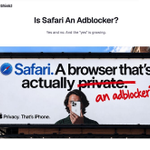
The most disturbing thing about this Safari/TTD development is what Safari is becoming under the hood.
In short: more like a traditional adblocker.
In normal browsing mode, it now:
• Uses a domain blocklist (which TTD found itself on)
• Looks set to add domains to the list remotely, as it pleases
But in a sense, it's worse.
The blocklists many adblockers run on are maintained in the open: every change is visible, and any mistake can be flagged and fixed in public as part of an open-source community.
Safari's blocklist is unpublished. Get blocked, find out the hard way, plead with Apple, and wait...


