

@NewEdgeWealth Previously: @Uber, @getgrover, @Postmates, @Wantickets
Miami, FL
Joined April 2015
- Tweets1.7K
- Following1.9K
- Followers1.2K
- Likes5.8K




Andrew Draft, CEPA® retweeted

Be Case Keenum.
> Grow up in West Texas. Two-star recruit. One scholarship offer.
> Take it. Rewrite the NCAA record book at Houston.
> Marry your high school sweetheart, the girl you took out for snow cones before any of this started.
> Go undrafted anyway.
> Spend your rookie season on the practice squad.
> Get cut. Get claimed. Get traded. Start over.
> Get your chance in Minnesota when the starter gets hurt.
> Throw the Minneapolis Miracle.
> Help take the Vikings within one win of the Super Bowl.
> Keep moving after that, too.
> Eight franchises. Different jerseys. Different playbooks. Another chance to prove you belong.
> Through all those moves, keep building a life with the girl.
> The girl from the snow-cone date becomes the mother of your two children.
> Spend years preparing for opportunities that rarely come.
> Go 1,009 days without a start.
> Keep showing up. Keep doing the work. Stay ready.
> Then, at 38, get the call. Chicago needs you.
> Walk onto Monday Night Football.
> Throw two touchdowns. Run for another. Beat the Eagles 27–7.
> Do it with both your kids watching you play in person for the first time.
> Finish the night on SportsCenter with your little girl beside you.
All those years. All those moves. All those Sundays waiting for a chance.
And when this one finally comes, you fucking crush it with your kids looking on.
Imagine what that feels like.
There are a lot of ways to teach your children to keep going.
Letting them watch you do it has to be one of the best.
Absolute legend! 🫡

"It was so much fun. I'm going to remember this night forever. This is incredible."
QB Case Keenum speaks with @notthefakeSVP after getting the start in the Bears' 27-7 win vs. the Eagles 🏈
Andrew Draft, CEPA® retweeted

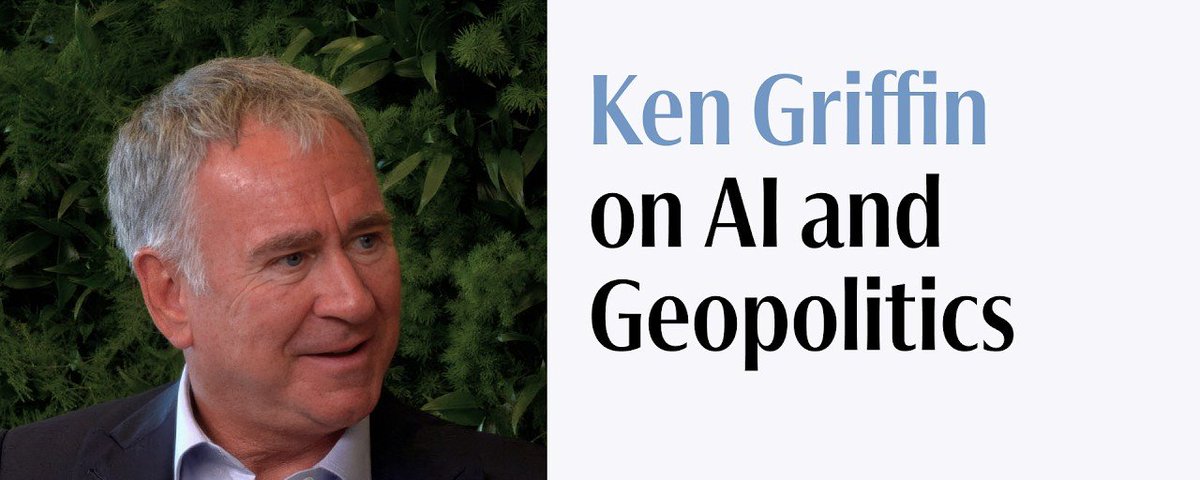
Ken Griffin says short-term alpha from calling the quarter with alt data is dying, and the next era of stock-picking belongs to those with a long-term horizon.
"I think there'll be more focus and emphasis on those who have really good vision about what companies are actually creating transformative products that will change society. The market will reward that far more intensely in the future than will a company beat this quarter's earnings or not.
I think the question of will a company beat this quarter's earnings has gotten far more difficult over the last 10 years because, for example, the rise of alternative data. I have access to the credit cards of millions of Americans. What are they spending money on? What's that mean for Starbucks revenues this quarter? What's it mean for McDonald's this quarter?
This is a decade-old transformation, but the here and now is just becoming far more transparent, far more readily understood and triaged by the combination of really bright people and really good AI technology. Where this will leave us is those who are able to see what is unfolding over years to come will be in a very valued position on a relative basis."

Andrew Draft, CEPA® retweeted

BREAKING: A group led by billionaire venture capitalist Vinod Khosla has agreed to purchase the Seattle Seahawks for $9.6 billion, according to @Sportico.
That’s the most expensive NFL sale ever.

Andrew Draft, CEPA® retweeted
BREAKING: The S&P 500 just hit a new all-time high for the first time since January, fully recovering from the 10% correction. $SPX


Andrew Draft, CEPA® retweeted

No one knows how long a correction will last when you're in it
But buying stocks when they are down tends to be a good long-term strategy
A look at what happens when you buy the stock market down 10%, 20% and 30%:
awealthofcommonsense.com/202…

Andrew Draft, CEPA® retweeted

Some of the highest quality businesses in the world are trading at extremely cheap prices. Ignore the MSM. One of the most one-sided wars in history that will end well for the U.S. and the world. And we have the potential for a large peace dividend.
One of the best times in a long time to buy quality.
Ignore the bears.
Andrew Draft, CEPA® retweeted

Former footballer Gerard Piqué has secured $63 million for his Kings League startup as investors pour money into digital-first sports formats targeting Gen Z and Gen Alpha audiences bloomberg.com/news/articles/…

Andrew Draft, CEPA® retweeted

SpaceX just acquired xAI, which has one of the wildest 3-year corporate timelines ever:

Andrew Draft, CEPA® retweeted

Google is the biggest winner in the SpaceX IPO.
Back in January 2015, Google made a decision that most venture capitalists would call insanely risky.
They threw $900 million at SpaceX when the company was valued at just $12 billion.
Elon had recently figured out how to land rockets.
Starlink was literally just a PowerPoint deck.
The company was burning through cash like water trying to prove the entire concept of reusable rockets could actually work.
On paper, this looked like Google throwing away nearly a billion dollars on a moonshot.
But they saw something everyone else missed.
A founder willing to do the impossible and a company building what would become essential infrastructure for the next decade.
Fast forward to February 2026 and that single decision is about to make Google the biggest winner in what's shaping up to be the largest IPO in human history.
SpaceX is prepping for a mid June IPO at a $1.5 trillion valuation.
Google's 7.4% stake is about to be worth approximately $111 billion.
That's an increase of over $110 billion from their original $900 million investment.
To put it another way, every dollar Google invested just turned into roughly $123.
The reason Google deserves the title of biggest winner isn't just about the raw numbers, though those are absolutely staggering.
It's because they made this bet when nobody was paying attention.
SpaceX could have easily gone under.
In 2015, SpaceX had never successfully landed a rocket and recovered it.
The Falcon 9 had only been flying for a few years.
Starlink was a concept that most people in Silicon Valley thought was a distraction from the core business.
Revenue was basically nonexistent compared to today.
Yet Google saw the market opportunity.
A company with an effective monopoly on launching things to space at scale.
A founder with unlimited conviction and a business model that would become increasingly valuable as the world's data and compute needs exploded.
What makes this different from other venture capital wins is the sheer trajectory.
If you plot SpaceX's valuation from 2015 to 2026, it's almost vertical.
From $12 billion to $36 billion by 2020.
Then jumping to $100 billion by 2021.
$180 billion by 2023.
$210 billion by mid-2024.
$350 billion by late 2024.
Now sitting at $1 Trillion in February 2026.
The IPO target is $1.5 trillion.
Every year, the valuation roughly doubles or triples.
That's the kind of growth trajectory that only happens when you're building something genuinely transformative.
Google got to ride that entire wave with a single check.
The reason Google is the standout winner compared to other early shareholders is also about timing and positioning.
Fidelity Investments also made a big bet alongside Google in 2015.
They've obviously done well too.
But Google's stake is the single largest outside shareholder position after Elon.
They're getting the ability to influence a company that's basically becoming a fourth branch of government in terms of how critical space launch capability is.
No other private company can claim that level of control over orbital infrastructure.
Here's what's actually wild about this whole thing: most people don't even know this is happening.
Because SpaceX is a private company, Google's stake has been sitting on their balance sheet essentially at cost for a decade.
The gain has been completely hidden from casual observers.
But the moment SpaceX IPOs, that $111 billion position becomes real.
It shows up in earnings.
It fundamentally changes how people view Alphabet as an investment.
That's a massive catalyst that a lot of investors aren't positioned for.
What also makes Google the biggest winner is that they didn't need to take this risk and they knew it.
Google had mountains of cash.
They were already the dominant search company.
They could have just kept doing what they were doing and still been worth hundreds of billions of dollars.
But Sundar Pichai and the team at the time made a strategic bet that space infrastructure was going to matter.
They believed that reusable rockets would become foundational.
They were convinced that SpaceX was the only company that could pull it off.
They were right.
And now they're about to collect one of the largest venture capital payouts in history.
The other thing that makes this interesting is that Google gets strategic benefits on top of the equity upside.
By owning 7% of SpaceX, Google has visibility into the company's satellite internet plans.
They can negotiate favorable launch terms for their own ambitions in space.
They're essentially hedged into the space economy at scale.
As AI compute demands keep growing and data centers need more bandwidth, having ownership in the only company that can reliably launch satellites becomes incredibly valuable.
So Google is securing their own infrastructure future.
When the IPO closes in June and Google's stake becomes liquid and tradeable, we're going to see headlines everywhere.
Google turned less than a billion dollars into over $100 billion.
But the real story is that they had the foresight to make the bet when almost nobody believed in SpaceX.
They had the patience to hold it for a decade.
While the company became the most valuable private company on Earth.
That's what separates truly great venture capital wins from lucky bets.


Andrew Draft, CEPA® retweeted

It’s December 31. Here is the updated look at annual returns by asset class over the last 15 years.
2025 offered a few good reminders for investors regarding trend persistence and diversification. 🧵👇

Andrew Draft, CEPA® retweeted
The S&P 500 ends the year up 17.9%, exceeding nearly all expectations for the 3rd straight year (note: including dividends). $SPX
bilello.blog/newsletter


Andrew Draft, CEPA® retweeted

A Christmas morning reflection…
95%
By the time your child turns 18, you've spent ~95% of the time you will ever spend with them in your lifetime.
There are specific windows, much shorter than you care to admit, during which certain people and relationships will occupy your life.
You may have only one more summer with all of your siblings. Two more trips with that old group of friends. A few more years with your grandpa. A handful of encounters with that coworker you love. One more long walk with your parents.
If you fail to appreciate these windows, they will quickly disappear.
Time Wealth is about an awareness of these windows.
But more importantly, it’s about taking action against that awareness.
It's about recognizing that you are in more control of your time than you realize.
That you can take actions to create time with the people you love most.
That you can bend these curves.
That 95% is an average—and you’ve never wanted to be average in anything your entire life.
So, show up to that recital. Plan that trip with old friends. Grab that quick coffee. Go on that walk with your parents. Have that meal with your sibling.
In the end, it's not about the journey, it's not about the destination, it's about the company. The people along the way.
Cherish the people and the rest will fall into place as it should.

Andrew Draft, CEPA® retweeted
Billionaire 2026 investing intentions
Swiss private bank UBS surveyed their billionaire clients, here's what they found:
• Emerging market equities: Strong appetite returning. 42% plan to increase exposure, driven by recovery in Greater China and APAC; only 2% plan to reduce
• Developed market equities: Net positive but less unanimous. 43% increasing, 7% reducing exposure
• PE: Polarised views. 49% increasing direct PE, while a meaningful 20% plan to cut back
• Private debt: More cautious positioning. 33% increasing, 22% decreasing exposure
• Hedge funds: Clear revival. 43% increasing allocations, versus 18% reducing, with equity long–short strategies favoured for dispersion
• Infrastructure: Rising diversification play. 35% increasing exposure
• Gold / precious metals: Regaining favour as a defensive asset. 32% increasing allocations
• Fixed income: Largely stable. Majority plan no change to developed (52%) and emerging market (66%) fixed income exposure
• Geographic tilt: Growing skepticism on North America concentration; increased emphasis on diversification and real assets
• Strategic mindset: Preference for equities over bonds, selective hedge fund use, and anchoring wealth in tangible, resilient assets over short-term trades
Source: UBS Billionaire Ambitions Report 2025: A rise of a new generation

Andrew Draft, CEPA® retweeted
An excellent piece on @Uber

1/ The primary bear case against $UBER is summarized in two words: AV disruption.
Investors fear that AVs will crush Uber's ~30% take rate, destroying profitability.
I disagree. In fact, I believe an estimated 20% AV take rate is a massive tailwind.
Here is the math. 🧵

Andrew Draft, CEPA® retweeted

The stock market's run has been historic:
US households now own more equities than real estate as a percentage of their net worth, the 3rd such occurrence over the last 65 years.
This comes as corporate equities and mutual funds rose to ~31% of net worth in Q2 2025, an all-time high.
This percentage has more than doubled since 2008.
By comparison, the 2000 Dot-Com Bubble peak was ~25%.
Meanwhile, real estate assets fell below 30% of total net worth in Q2 for the first time since 2021.
This is far below the 2006 peak of 38% recorded before the housing bubble burst.
Asset owners are winning.


