

Professor, NYUGrossmanSOM Departments of Population Health and Medicine/DGIM. Addiction Medicine Researcher and Clinician. Science Advisor at OarHealth.
NY, NY
Joined February 2015
- Tweets384
- Following252
- Followers718
- Likes573





Joshua D Lee MD MSc retweeted

It seems few people know what an “indirect cost” is or why it has to be 40-60%.
The reason the government forced universities to raise their indirect costs up to (typically) 40-60% was to force a huge amount of regulations on the universities while also minimizing the bookkeeping to comply with those regulations. This includes the work by contract managers, compliance lawyers, accountants, safety management, etc., who are required by the government per the terms of the contract. If universities had to allocate all those categories of labor to each contract hour-by-hour it would require too much bookkeeping, which would waste money. (I’m setting aside for now the question of whether or how much the regulations are wasting money and only discussing how you bookkeep the effort to comply with the regulations.)
So to save money, while also requiring universities to do these types of work, the government requires universities to roll those categories of labor into “cost pools” that must be allocated as a percent of the technical work in each of the contracts. While the actual “overhead” might be only 15%, these pooled labor charges that are required by the government are typically much more.
Second, the government doesn’t allow the universities to figure out their own indirect rates. These rates are determined by the federal government through audits every couple of years. The government then sends a document telling the university what rate to use for its cost pools. For example, the University of Colorado was told by the DHHS to use 54% (colorado.edu/controller/site…) and U. Nebraska was told by DHHS to use 55.5% (uofnelincoln.sharepoint.com/…). 40-60% is not only reasonable to fulfill the terms of the contract, it is the rate that the government tells the university it can charge for all the work the government requires the university to do.
So if the government wants to reduce the indirect rate to 15%, then it needs to do one of these two things:
Either
(A) eliminate all the federal regulations that force the universities to do those categories of work (compliance, accounting, management, safety management, tracking harmful chemicals, etc.)
Or,
(B) stop requiring universities to pool those real costs into the “indirect cost” category and allow universities to include them in the “direct costs” of the contract.
If the government chooses (A), then the safety rails have been entirely removed. (Even if the government lowers the regulations without entirely eliminating them, the costs they impose will still be real costs that probably come out to more than 15%.)
Or, if it chooses (B), then the direct costs will go way up and research will actually be less efficient because all the bookkeeping, not more efficient.
But if the government caps the indirect rate at 15% without doing either (A) or (B), then it will be impossible to do research for the federal government without going bankrupt. That’s the worst possible choice. It will kill research in the US. Is that what we want?
I can explain it for you but I can’t understand it for you. It’s up to the reader not to be ignorant.
Just out from two NYUGSOM addiction medicine fellows, Drs. Breda and Barber Grossi, great to see!
From liquid handcuffs to miracle molecule: MOTAA would expand methadone access and help fight the overdose epidemic kevinmd.com/2025/01/from-liq… via @kevinmd

New academic year, new fellows. Welcome Drs. Michelle Breda, Marco Barber Grossi and Kelechi Acholonu to the @NYULH_DeptofMed @NYUGSOM_DGIMCI addiction medicine fellowship

Great work @JosephPalamar and @NDEWSnews colleagues, re: growing unregulated use of psychedelics:
National and regional trends in seizures of shrooms (psilocybin) in th... sciencedirect.com/science/ar…
Joshua D Lee MD MSc retweeted

Our new piece in @JAMAPsych about the rapidly shifting ketamine landscape in the US
jamanetwork.com/journals/jam…

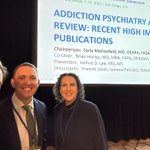
Hello San Diego! Taking a version of our @DrSarahWakeman Top Addiction Papers talk to today’s #AAAP2023 w @DrMarienfeld and Brian Hurley MD w panelists John Renner, Fran Levin, Ismene Petrakis, and Wild and Crazy Edward ‘Ned’ Nunes

Joshua D Lee MD MSc retweeted

That’s a wrap! Thanks @BellevueHosp @NYUGSOM_DGIMCI for 4 years of learning and growth!

Congrats 2022-23 NYULH Addiction Medicine Fellows! We loved working w @ekutscher , Tracy Liu, and Zaineb Shamim all year long. Thx to Lola Williams for a year as Coordinator and to all our Faculty @mannertang . Best of luck next year!!!


Addiction Science Meeting Land…1960 IM Pei Denver Sheraton (originally Hilton) is a real gem #cpdd23


2
8
1,262


Stoked as always to be at #ASAM23 {#ASAM2023 ) presenting our annual update on highest impact papers from 2022 w @DrSarahWakeman ; slides are here: drive.google.com/drive/folde…
2022’s highest rated paper was Psilocybin for Treatment of Adult Patients With Alcohol Use Disorder jamanetwork.com/journals/jam… via @JAMAPsych part of @JAMANetwork

Congrats (!!!) to our current @nyulangone Addiction Medicine Fellow @ekutscher, pls find his current JAMA Piece of My Mind: Erasing Shame in Sexuality ja.ma/3xfNfHW via @JAMA_current part of @JAMANetwork
Commentary on Ajazi et al (2021, JAM) Re-analysis of the X:BOT trial: journals.lww.com/journaladdi… Now in print, the X:BOT team's response to Ajazi et al's very interesting re-analysis of X:BOT's overdose events: they found greater differences than original report; we did not
1
About to present our annual review of highest impact publications from 2021-2022 w @JennMcNeelyMD at #ASAM2022. Missing the irreplaceable @DrSarahWakeman this year for the best of reasons 1/
2
25
The top addiction medicine paper from 2021 we scanned per @altmetric was Linda Ng Fat et al’s survey of risky alcohol use and social media use in UK adolescents: pubmed.ncbi.nlm.nih.gov/3388… . Put down those phones and go outside, kids!

Thx Tyler…somehow there is a recording eventually but otherwise slides are here:
docs.google.com/file/d/1nWyB…
This Post is from an account that no longer exists. Learn more
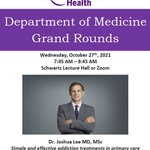
My professional life's greatest ambition at hand: presenting @nyulangone Dept. Medicine Grand Rounds tomorrow AM in Schwartz/Zoom 745am

Joshua D Lee MD MSc retweeted

Extended-release buprenorphine was acceptable among patients currently receiving sublingual buprenorphine. Patients had fewer in-jail clinic visits and increased community buprenorphine treatment retention when compared with standard daily SLB treatment. ja.ma/3n8WTrQ