

Health Insurance Whistleblower & Author of “Fixing Healthcare: How Executives Can Save Their People, Their Business, and the Economy” — OUT TODAY
Orlando, FL
Joined August 2009
- Tweets1.4K
- Following421
- Followers261
- Likes1.9K





Donovan Pyle retweeted

A $24 million revenue opportunity gets a CEO’s full attention. A benefits contract gets handed to HR.
A $1.2 million expense reduction can produce the same earnings as that entire revenue opportunity.
At a 5% EBITDA margin, $24 million in revenue leaves $1.2 million in earnings. Reduce expenses by $1.2 million, and the full amount reaches EBITDA.
We delivered that $1.2 million reduction for a client through better health benefits management.
Owners routinely scrutinize the capital, staffing, and execution required to grow revenue. Their benefits spending deserves the same financial scrutiny.
If you would personally pursue $24 million in new business, why would you approve the next benefits renewal without understanding its effect on earnings?
Love,
Dutch
Contrary to popular belief, health insurers don't pay for healthcare...your company does.
What do I mean by "healthcare"?
* Hospitalizations
* Surgeries
* Labs
* Imaging
* Rx Drugs
So if you're the one paying for this stuff, who is managing this supply chain?
Most companies in the U.S. are unknowingly delegating this task to vendors (legacy brokers, and insurers) who make more money when underlying costs go up.
Is it any wonder the average employer wasted about $4,000 per employee on benefits in 2024?
You would never work with a CPA or Attorney who was getting paid by the other side.
Getting unbiased professional advice is the first step toward solving these problems.
Not sure if your broker works for you or the insurance industry?
Ask them for their 408 compensation disclosure, feed it to Claude, and ask Claude to see if your broker gets paid by insurers and vendors.
If legacy benefits brokers really wanted to be honest with their clients, they would say something like this to them...
"Dear client,
We know you expect us to help you get the best deal on healthcare and benefits...(you don't have internal expertise in this area, and that is why you work with us).
Although many of us want to do that, it's important for you to understand that our industry was developed to sell products for insurance companies...not to help you get the best deal.
Our job is to serve as retail distribution for health insurers...so, we get paid by the same insurance companies you are asking us to negotiate against.
In fact, since many of us still work on commission and collect bonuses from the large insurance companies, we actually make more money when your costs go up, not down.
So when you ask us to get you the best deal, what you are doing is asking us to work against our own financial interests.
And like most humans, we are not very good at that.
Many of us didn't actually know this was the role we were taking on when we entered the system...it's just how things evolved.
We understand you are facing real challenges. But it is nearly impossible for us to turn away the contingency bonuses that make up a meaningful share of our revenue.
It would also be difficult for some of us to walk away from the loans and lines of credit we get from insurance companies, or to divest the equity positions some of us hold in the very carriers you expect us to negotiate against.
We really wanted to be clear with you about how we make money and who we work for, so instead of waiting for you to ask us for our annual compensation disclosure (required by federal law), we are going to give it to you every year without being asked.
And we are going to pull these conflicts of interest out of the fine print so you actually understand our role and who we work for.
Sincerely,
Your National Legacy Broker"
------------------------------------------------------------------------------------------------
Ask your broker for a written compensation disclosure today.
@mcuban
Have you taken @mcuban’s advice and hired a Chief Benefits Officer (CBO) to help control healthcare costs at your company?
There are only about 600 benefits professionals who have advanced designations in healthcare financing and procurement in the U.S.
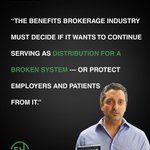
The benefits brokerage industry was developed to sell you insurance.
It wasn’t developed to help you get the best deal.
Brokers get paid bonuses by insurers.
They serve as retail distribution for insurers.
And this is why they make more money when your costs go up — not down.
There’s absolutely nothing wrong with selling insurance.
However, a problem arises when brokers present themselves as giving employers “independent advice”.
Even if that’s their intent, it’s not what they do.
You can’t give independent advice when you’re getting paid by the insurers employers expect you to negotiate against.
Just like a CPA who gets paid by the IRS won’t give effective tax advice.
The rest of your outside advisors know that getting paid by the other side conflicts with your interests.
Your attorney and CPA do not get paid by the other side…you would fire them if they were.
Every week we meet with employers who are suffering because of conflicted benefits advice.
And they’re realizing that the first step to driving more value to their bottom line and their people is getting unbiased professional benefits advice.
They want benefits firms that..
1. Only get paid by them
2. Providers certified expertise
3. Have a robust scope of service that makes their lives easier
4. Are contractually obligated to serve their best interests
This shift is long overdue, and it’s happening now.
"We do electrical work."
You're renovating your home and this is your electrician's entire scope written on the contract...
It doesn't list how many outlets you get, where they are, or what amperage they use.
It doesn't say when the work will be done or by whom.
Three months later, you've spent a lot of money on electrical work, but nothing in the home is working properly.
And the problem is that you can't hold your electrician accountable because their scope simply said "we do electrical work".
You would never sign that contract, and yet, when it comes to most companies' benefits programs, that's exactly what is happening in many cases.
Every week, my team meets with employers who show us their broker's contract and/or compensation disclosure, and the scope simply says "Insurance brokerage and consulting services."
What does that actually mean?
What do they actually do? By who? By when? How often? For how much?
The brokerage industry developed to sell products for insurers...not help you get the best deal on insurance.
Product salespeople don't write scopes.
Contractors do.
Demand the same from your advisor.
How much time should CFOs spend on company healthcare each year?
At a recent speaking event, I asked a group of CFOs that question.
They averaged about 6 hours per year.
Here was my challenge to them: if you invested an additional 4 hours per year, and that saved your company about $1,000 per employee in 2027, would that be a good use of your time?
For a CFO making $300K ($150/hour) with 500 employees, that ~555X return.
Sure, there might be a few things they do to drive more value to their company and their people in 4 hours, but it’s hard to think of them.
CFOs: many of you spend ~2 hours a year on your company's health plan...if you were able to save your company over $1,000 per employee each year by bumping your annual engagement up to ~8 hours a year, would that be worth it?
Let’s check the math for a 500-employee company with a CFO making $300k/year (~$150/hr):
• Additional time investment: 6 hours = $900
• Annual company savings: $500,000
That is a 555x return on your time.
Where else in your business can 6 hours of work yield a $500,000 bottom-line impact?
If you want to see exactly how we unlock these savings without cutting benefits, let’s connect.
This is exactly why my team developed the Compensation Integrity Index™️ (CII), which audits broker and consultant 408 compensation disclosures so that employers understand conflicts of interest that produce fiduciary risk.
This is akin to the service @TonyRobbins provided businesses when 408 compensation disclosures became required in the retirement industry 20 years ago.

Don't you wish CEOs knew what was in their HC benefits, brokers and consultants contracts?
I bet they can add more cash flow by paying attention to this than 90 pct of the things they want to do for their business today
I'm still amazed that VCs and PE don't use reducing benefits costs as a source of cash. It's easy
If you profit from system failures, you’re not financially incentivized to fix them.
#healthcare #brokers
Advanced tax strategies are never recommended by CPAs who get paid by the IRS.
And advanced healthcare financing and procurement strategies are never actively recommended by legacy benefits brokers.
That’s because legacy brokers would have do more work and make less money if those strategies were adopted by their clients.
And this conflict of interest costs businesses millions each year.
At Health Compass, we are like advanced tax strategists for your company’s health plan.
Want better results? Message me.
A little piece of me dies every time an executive tells me they’ve been googling something about health plans and benefits.
They have in-house HR and/or benefits teams.
And they work with a legacy broker.
But still, no one is leading them to where they want to go.
So they rely on google…good luck with that.
Under federal law, fiduciaries (often execs) who are not experts in benefits are required to hire people who are.
But here’s the rub: the benefits industry as done a terrible job educating fiduciaries about what credentials to look for…
So here’s your cheat sheet:
- State insurance license: this is essentially a “GED” (good enough degree) for the industry. It legally allows you to advise employers on how spend millions each year, with virtually no training at all.
- CEBS: this is like a bachelors degree in benefits. It’s a solid program, but really broad in scope. It does not teach benefits professionals how to help businesses progress through the health plan maturity model (HPMM).
- REBC (Registered employee benefits consultant): thanks to the work of David C. Smith JD, REBC and others at NABIP, this is like a masters degree in health plan management, financing, and procurement. There are ~500 benefits professionals in the US with this designation. Look for them.
- CHVP (Certifed health value professional): this is PhD level training on health plan innovation. Developed by the Validation Institute, it contains 13 courses that created and taught by veteran industry professionals like Brian Klepper, Ron E. Peck, Emma Fox, CHVA, and others. There are about 100 CHVPs in the market. Note: I chair the advisory board for this designation.
If you’re an executive who has ever had to google something about benefits, it’s time to consider upgrading your advisor.
People who “dabble” in employee benefits are more likely to create risk, than manage it.
Use the criteria above as a starting point in your search.
Cheers and happy Friday.
How much is it going to cost to have this meeting?
It’s easy to disparage corporate best practices, but you can often tell when someone has never worked in that environment:
The clues include…
- no clear meeting agenda or understanding of what decisions need to be made
- no introductions
- no action items
Result?
No action…and negative ROI.
That said, I’m trying to more actively consider how much it is going to cost to have every meeting and quickly weigh the cost/benefit analysis before sending an invite.
And I certainly make mistakes too, so feel free to call me out when neglect these best practices.
I’m not a fan or work about work, but what other best practices are you using to increase ROI?
Commercial friction is quietly bankrupting the American middle class.
Every single year, U.S. businesses bleed over $300 billion in healthcare overspend.
Let that number sink in.
That is roughly $4,000 per employee, per year—completely wasted.
Why is this happening?
It isn’t a lack of medical innovation. We have incredible value-based healthcare solutions available right now: transparent pharmacy benefit managers, Direct Primary Care, and high-performance networks.
Think of these value-based solutions as a fleet of Ferraris.
The problem is that we are trying to drive these Ferraris down a commercial highway that is completely destroyed by potholes.
Those potholes are misaligned legacy broker incentives.
When the person advising your company on how to buy healthcare to is paid commissions and bonuses by the insurance carriers selling it, they make more money when your costs go up.
They act as a tollbooth, actively blocking high-performance (lower-cost) solutions from reaching your business.
That is commercial friction at its worst.
In my work advising foreign governments on macro-healthcare frameworks, the contrast is staggering.
When you remove the conflicted middlemen, the friction disappears. The math finally works. This isn't just a U.S. policy issue; it's a universal lesson in supply-chain governance.
So, how do U.S. employers fix the road?
You change the legal standard of your advice. You fire the conflicted broker and hire a fee-based Fiduciary Advisor.
At Health Compass, we deploy our Fiduciary Governance Protocol™ (FGP) to bypass the potholes entirely.
We audit the hidden fees, strip out the friction, and finally align the financial incentives with the employer and the employee.
I wrote Fixing Healthcare to give CEOs and CFOs the exact blueprint to stop paying this $4,000 invisible tax and start demanding the truth.
It’s time to pave the road.
Message me for more info.

60% of employees are on self-insured health plans.
If the patient has insurance from a self insured employer, call the CEO. It is ALWAYS their final decision. They can override the insurance company.
They are responsible for the employees that use the plans the CEO approved and signed the contract for. They usually just don’t know it.
Ask nice first. Post here second, and tag me.
When you threaten the medical industrial complex, it’s immune system tries to kill you.
Don’t let it.
Employers and patients need you.
Selling advice or selling products?
These are two completely different value propositions, and trying to do both makes you a double-agent that does neither well.
In healthcare, this dynamic costs US employers in over $300 billion in waste annually.
CFOs: if you want to stop getting fleeced by the health insurance and medical industrial complex, you need someone to diagnose your problem.
Since legacy brokers serve as retail distribution for the extraction machine, they are not in the business of diagnosing your illness.
In fact, they financially benefit from the disease.
That said, there’s a good chance no one has ever quantified how your organization is performing in the 7 categories of benefits value.
Without this visibility, you probably don’t know what opportunities exist, what goals to pursue, or what road map you can use to achieve them.
This lack of clarity often leaves executives frustrated, and disengaged.
Net result?
Avg business wastes over $4,000 per employee, per year, on healthcare.
Want a different approach that yields better results?
Send me a message.
If your company wants to stop being fleeced by the medical industrial complex, you need to stop focusing on products and take a look at your process.
There are millions of ways to buy healthcare for employees.
Anyone who says they know what you should buy before diagnosing your challenges is committing malpractice.
Legacy brokers are retailers that make more money when your costs go up.
That’s why they almost always prescribe before diagnosing.
This lack of alignment and process is costing you more than $4,000 per employee each year.
Change your process.
Change your outcomes.
Questions? Send me a message.