
Dean-Emeritus, College of Integrative Medicine & Health Sciences, Saybrook Univ. New book on self-care for chronic illness, Integrative Pathways (Springer).
Saybrook Univ. Pasadena, CA
Joined April 2009
- Tweets2K
- Following213
- Followers689
- Likes24
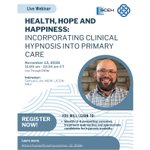



Mark your calendars now. This November 13 Webinar is sponsored by the Society for Clinical and Experimental Hypnosis -- #SCEH -- and addresses strategies for applying clinical hypnosis in primary care.
Register at tcsppofficeofce.com/nov_13_2…

Society for Clinical and Experimental Hypnosis WEBINAR
From Mind to Medicine: Modified States of Consciousness in Patient Care
#SCEH
Presented by Audrey Vanhaudenhuyse, PhD
Friday, October 9, 2026
9am-10:30am PT/ 11am-12:30pm CT/ 12pm-1:30pm ET
Register: sceh.us/webinars
Presenter Audrey Vanhaudenhuyse, PhD will discuss the clinical relevance of complementary approaches that engage modified states of consciousness—such as hypnosis, virtual reality–hypnosis, and other trance-based methods—in helping patients manage both acute and chronic pain (Bicego et al., 2022; Louras et al., 2024; Marie et al., 2024). These clinical insights will be enriched by an overview of behavioral, neuroimaging, and electrophysiological research carried out at the University Hospital and University of Liège (Belgium) (Vanhaudenhuyse et al., 2020).
In addition, she will describe our work integrating hypnosis with self-care training, which has encouraged patients to move from passive toward active engagement in their recovery. This transformation has been linked to decreased pain intensity, lower emotional distress and fatigue, and a greater sense of treatment efficacy (Bicego et al., 2021; Vanhaudenhuyse et al., 2015, 2018). In this perspective, complementary approaches based on modified states of consciousness act as a bridge that reconnects individuals with their inner strengths and healing capacities, ultimately fostering a more balanced and meaningful quality of life.
This program, when attended in its entirety, offers 1.5 CEs for Psychologists, 1.5 IL CEUs for Counselors and Social Workers, or 1.5 BBS California CEUs for LPCCs, LPSWs, and LMFTs.
General Admission: $65.00
SCEH Members: $55.00
Students: $15.00* See less

Don’t miss: SCEH Webinar providing practical guidance for research on hypnosis and other mind-body practices.
Friday July 31, 2026, 12:00 Noon to 1:30 PM Eastern
Hypnosis Research Workshop: Designing Case Studies and Randomized Clinical Trials & Preparing Papers for Publication
Presenters: Gary Elkins, PhD, and Vanessa Muñiz, MA
Category: Hypnosis Research
This workshop, led by the editor and managing editor of the leading journal in hypnosis research, the International Journal of Clinical & Experimental Hypnosis (IJCEH), provides a comprehensive guide on designing rigorous hypnosis research and preparing manuscripts for successful publication. Attendees will learn about the various types of manuscripts considered for publication, including theoretical papers, pilot studies, efficacy studies, and clinical case studies.
A significant portion of the presentation focuses on the requirements for designing rigorous case studies. While case studies are valuable for advancing scientific knowledge, identifying new interventions, and informing clinical practice, successful case study manuscripts in the field of hypnosis require meticulous planning and specific components. This presentation addresses how to conduct quality case studies that are suitable for publication.
The second major area of focus in this workshop is preparing papers for publication. Attendees will receive specific guidance on scholarly writing style, the structure of research papers and preparation of papers for submission for publication. An outline of the process of submitting manuscripts for publication and navigating the peer review process, including expected timelines and procedures for responding to revision requests, will be discussed. This workshop will be of interest empirically minded clinicians, researchers, experimental and clinical graduate students, interns, fellows, and residents, as well as professionals in the field who wish to learn more about the potential of hypnosis research to inform clinical practice.
This program, when attended in its entirety, offers 1.5 CEs for Psychologists, 1.5 IL CEUs for Counselors and Social Workers, or 1.5 BBS California CEUs for LPCCs, LPSWs, and LMFTs.
For more information and registration: tcsppofficeofce.com/july_31_…

SCEH WEBINAR this Friday
Addressing Loneliness and Social Isolation Through Process-Oriented Hypnosis
Presented by Shawn R. Criswell, PhD, LPC
Friday, July 10, 2026
9am-10:30am PT/ 11am-12:30pm CT/ 12pm-1:30pm ET
Live through Zoom or Homestudy
Positive social connections are an important factor in well-being. Yet loneliness and social isolation, along with their biopsychosocial consequences are all too common throughout the world. Research has shown that loneliness and social isolation can have health consequences that are comparable to those of cigarette smoking or a lack of physical activity (Holt-Lunstad, 2022). Yet, this health factor is modifiable. Increasing the quality of a person’s social connections can yield many benefits. The Harvard Study of Adult Development (Waldinger & Schulz, 2023) has demonstrated that the happiest, healthiest people are those with warm, positive connections with others.
While clinicians often encourage social connection, they may neglect important steps in assessing and then building client skills and resources for successful social engagement.
This presentation explores how clinicians can help their clients move from loneliness and social isolation to improved social health. Participants will learn how to use experiential techniques such as hypnosis, role-plays, and homework assignments to help clients build essential social skills. Clients need skills and the motivation to use them. Hypnosis can be used to encourage clients to value connections with others.
Valuing connections can enhance motivation to take actions toward the creation and maintenance of good quality relationships. Hypnosis can be an excellent way for clinicians to help clients develop their confidence in using their developing social skills so that they move from loneliness and social isolation to satisfying social connections.
Registration: sceh.us/webinars
This program, when attended in its entirety, offers 1.5 CEs for Psychologists, 1.5 IL CEUs for Counselors and Social Workers, or 1.5 BBS California CEUs for LPCCs, LPSWs, and LMFTs. See less

Don't miss an upcoming webinar on hypnosis interventions for sleep.
"Sleep Architecture, Brain Waves, and Hypnosis: How Hypnosis Can Help People Sleep Better"
Presented by Dyan Haspel-Johnson, PhD
Friday, May 8, 2026
9am-10:30am PT/ 11am-12:30pm CT/ 12pm-1:30pm ET
Live and Recorded for Homestudy
Half of all adults experience regular sleep disturbances, with significant portions of the population suffering from chronic insomnia, according to Rand’s 2023 Global Report.
Hypnosis can be very helpful with inducing relaxation, releasing anxiety, and controlling the spinning thoughts that often accompany insomnia through shifting and refocusing attention and having more control over somatic and emotional content (Jiang et al. 2016). Additionally, hypnosis has been shown to increase parasympathetic nervous system (PNS) activation (the body’s rest/relief/safety response) (VandeVusse et al. 2010) making it naturally conducive to sleep. It has been this speaker’s experience that understanding sleep architecture and the specific components of sleep may enable the practitioner to design and deliver unique suggestions that can effectively target sleep and wake cycles.
One key commonality between hypnosis and sleep is the prevalence and importance of theta brain waves in both. Because of the activation of theta brain waves during the 1st and 2nd stages of sleep (Patel, et. al, 2024) and also during hypnosis (e.g., De Pascalis, 2024; Jensen, Adachi, and Hakimian, 2015), there may be value in exploring the use of hypnotic suggestions that target theta brain waves and the stages of sleep to improve sleep quality, depth, and health.
In this workshop, we will discuss the foundations of sleep in the body and brain, talk about some of the architecture of sleep and hypnosis, and learn how to address sleep/wake issues – especially insomnia – using hypnotic metaphors, language, and specific suggestions. Demonstration of a hypnotic intervention will be included.
This program, when attended in its entirety, offers 1.5 CEs for Psychologists, 1.5 IL CEUs for Counselors and Social Workers, or 1.5 BBS California CEUs for LPCCs, LPSWs, and LMFTs.
To register: sceh.us/webinars

Don't Miss Friday's Hypnosis Webinar:
"Creating Reliably Effective Hypnosis Interventions for Chronic Physical Symptoms" with Olafur S. Palsson, PsyD, Professor Emeritus of Medicine, University of North Carolina at Chapel Hill
April 10, 2026, at noon EDT
To register, go to: sceh.us/webinars
Overview: Chronic physical symptoms that have already proven unresponsive to the usual medical treatment methods can present formidable challenges in healthcare. Clinical hypnosis offers unique techniques for addressing medically unresponsive symptoms, but for the best effects the clinician often has to apply treatment differently than in other hypnosis applications. In this webinar, Dr. Palsson will provide participants with a detailed overview of a specific structure and set of essential elements for hypnosis treatment that together produce high probability of improvement in chronic physical symptoms. The success of this specific approach has been consistently demonstrated in twelve published research studies on gastrointestinal disorders, including IBS, chronic abdominal pain, inflammatory bowel disease, functional dyspepsia and esophageal disorders, but the same framework is equally applicable to other chronic health problems, such as migraine and fibromyalgia. It involves the preparation of the client for treatment, formulating the hypnosis sessions to contain key principles and sequence of steps that maximize therapeutic impact, and crafting suggestions and metaphors that effectively target psychological and physiological processes that influence body symptoms.

I am pleased to announce a new Special Issue of the International Journal of Environmental Research and Public Health, dedicated to Nature Immersion, Health, and the Community. I will head a team of guest editors for this issue, including Tamami Shirai, School of Medicine, University of California San Diego (and a Saybrook University graduate, and Kersten McEwan, University of Derby, United Kingdom. Papers must be submitted by September 2027. More details can be found at: mdpi.com/jou.../ijerph/speci…


I am excited to announce my latest publication, an article in the journal Brain Sciences, on The Relevance of Heart Rate Variability for Hypnotherapy and Psychotherapy. This article is part of the Special Issue Hypnotherapy: From Basic Research to Clinical Practice, edited by my friend and colleague, Dr. Giuseppe DeBenedittis of Milan, Italy.
The article is available with Open Access at:
mdpi.com/2076-3425/16/4/352

Mark your calendars now for this SCEH Webinar on "The Impact of Language on Healing."
Presenter: Holly Forester-Miller, PhD, LCMHC.
January 9, 2026 at Noon Eastern.

Saybrook University Graduate, Dr. Myrna Saadeh White, Publishes New Book
"First-Time Parent, Expecting Better"
What a beautiful book, timely and practical for any woman or couple facing pregnancy. Myrna Saadeh White has experienced what she expresses in this book. Personally, she was born by an emergency C-section to a mother who had suffered seven miscarriages. She experienced a miscarriage herself and achieved pregnancy later in spite of challenges. Professionally, Dr. Saadeh White is also a counselor who has guided countless women and couples through fertility challenges, pregnancy, and mothering. She went on to earn a doctorate in mind-body medicine at Saybrook University from the first graduate program to provide this breakthrough degree. In "First-Time Parent, Expecting Better," she offers the reader practical wisdom distilled from research, her patients’ experiences, and her own life. I recommend this book highly. Buy it and read every page twice! [Available on Amazon].
Reviewed by Donald Moss, PhD, Saybrook University

Mark your calendar and plan to join us at an upcoming event.
#HypnosisTraining #ClinicalHypnosis #EvidenceBasedPractice
sceh.us/annual-conferences

Vanderbilt University Integrative Medicine Faculty Address Hypnosis for Pelvic Pain
Don’t miss this upcoming webinar, sponsored by the Society for Clinical and Experimental Hypnosis:
November 14, 2025, at 12 Noon Eastern
Hypnosis for Pelvic Pain and Lower Urinary Tract Symptoms
Lindsey McKernan, PhD, MPH, Associate Professor in the Department of Psychiatry and Behavioral Sciences at Vanderbilt University Medical Center
Elizabeth G. Walsh, PhD, Assistant Professor in the Department of Physical Medicine and Rehabilitation at Vanderbilt University Medical Center
Chronic pelvic pain and lower urinary symptoms are under-addressed and at times debilitating symptoms that predominate presentations of common pain conditions such as chronic pelvic pain, endometriosis, interstitial cystitis, chronic prostatitis, and vulvodynia. These symptoms disproportionally affect individuals assigned female at birth (AFAB), and they often co-occur (Al-Shaiji et al., 2021). Genitourinary symptoms can significantly impact quality of life and psychological well-being and are often not well controlled by traditional medical therapies. Treatment and diagnostic testing often involve sensitive procedures that can be experienced as invasive and uncomfortable by patients. Hypnosis has been shown to be effective for addressing both acute and chronic pain, as well as procedural anxiety. While hypnosis has not been widely studied in the treatment of pelvic pain (Biurra et al., 2023), it shows promise particularly for improving quality of life and can reduce lower urinary tract symptoms associated with pain (McKernan et al., 2023).
This webinar will present a brief overview of the prevalence, impacts, and mechanisms of chronic pelvic pain and urinary symptoms. The speakers will then discuss applications of clinical hypnosis as an adjunctive treatment for chronic pelvic and urinary symptoms in an outpatient integrative medicine clinic and a urology subspecialty clinic. Providers will share recommendations regarding how to introduce and explain hypnosis for this application, and detailed examples of induction strategies, varied applications, and suggestions to target pain and symptom experiences for this undertreated population.

Related SCEH Webinar, October 3, 2025 at noon EST
Presenter: Ciara Christensen, PhD
Title: Bridging Hypnosis with Psychedelic-Assisted Psychotherapy: Preparation and Integration Strategies
To register: tcsppofficeofce.com/sceh/
Overview: This webinar explores the intersections between hypnosis and psychedelic experiences, combining historical research with contemporary insights. Participants will learn how hypnosis can serve as a useful tool during the preparation and integration phases of a psychedelic-assisted psychotherapy (PAP), enhancing the therapeutic potential of such experiences. We will begin by exploring the shared characteristics of hypnosis and psychedelics, emphasizing their historical use and the growing interest in their combined therapeutic applications. Drawing from both personal and professional experiences, I will illustrate how hypnosis can help prepare individuals for increased openness, which complements psychedelic experiences. We will also explore how hypnosis can be applied post-journey to integrate insights and solidify personal growth.
About the Presenter: Ciara Christensen, PhD, earned her doctoral degree in Clinical Psychology from Washington State University in 2012. She is licensed as a clinical psychologist in Idaho, Colorado, Wisconsin, and Washington and has extensive experience in both hospital and private practice settings. Dr. Christensen is the former President of the Society for Clinical and Experimental Hypnosis (SCEH) and President-Elect of the American Psychological Association's Division 30, Society of Psychological Hypnosis.

Don't miss Hypnosis Webinar:
Hypnosis for the Curious: Everything You Need to Know about Hypnosis
Presented by Donald Moss, PhD, Lisa Lombard, PhD, Janna Henning, JD, PsyD, Barbara McCann, PhD, and Eric Willmarth, PhD
Friday, August 1, 2025
9am-10:30am PT/ 11am-12:30pm CT/ 12pm-1:30pm ET
Event held online via Zoom, link to access provided upon registration. Registration: sceh.us/webinars
Many professionals are curious about hypnosis and consider utilizing it for their patients. Yet many also have a narrow idea of the potential applications of hypnosis. The webinar will provide an overview of the hypnosis applications that are well supported by outcomes research and clinical experience, including hypnosis-assisted therapies for medical disorders, mental health disorders, and other problems.
Next, a series of hypnosis practitioners will describe their experience using hypnosis for anxiety, depression, pediatric problems, trauma, chronic pain, digestive disorders, labor and delivery, preparation for medical procedures, management of cancer pain and the adverse effects of chemotherapy, and a variety of other disorders and problems. This webinar is supported by both the Society for Clinical and Experimental Hypnosis and Division 30 of the American Psychological Association.
Zoom link will be available on course page in “My Courses” upon event registration.
This program, when attended in its entirety, offers 1.5 CEs for Psychologists, 1.5 IL CEUS for Counselors and Social Workers, or 1.5 BBS California CEUs for LPCCs, LPSWs, and LMFTs.

Don't miss this upcoming hypnosis webinar.
Using Science about the Unconscious to Promote Hypnosis and Psychotherapy
Presented by David Patterson, PhD, ABPP, ABPH
Friday, June 13, 2025
9am-10:30am PT / 11am-12:30pm CT / 12pm-1:30pm ET
Event held online via Zoom, link to access provided upon registration.
To Register: tcsppofficeofce.com/june_13_…
Workshop Description: 95% of cerebral processing is unconscious. The speaker is not advocating that psychotherapy should be conducted at an unconscious basis because this practice would likely lead to unreliable outcome, if not even sloppy practice. On the other hand, the speaker proposes that providing a strong foundation of theory and science for psychotherapy can be enhanced by enlisting unconscious processing. What’s more, recent science on neurophysiology has provided us with paradigms where the unconscious can be combined more effectively with conventional psychotherapy.

Don't miss this exciting hypnosis webinar:
May 9 , 2025, Noon Eastern Standard Time
Suggestive Communication with the Critically Ill
Katalin Varga, PhD, Professor, Eötvös Loránd
University (ELTE), head of the Department of
Affective Psychology, Budapest, Hungary
This webinar will present research results proving that appropriate communication strategies – which our team calls Psychological Support Based on Positive Suggestions- can improve medical care in various settings: intensive care, eye surgery, orthopedic surgery, obstetrics, and others.
To register: sceh.us/webinars

Don't miss the Saybrook University Dean's Seminar,
May 8, 2025 at 8 PM Eastern, with presentations by Saybrook graduates of their doctoral research. An open session.
Join Zoom Meeting
tcsedsystem.zoom.us/j/989015…
Meeting ID: 989 0154 2150
May 8 topics:
1. Exploring a Movement-and-Awareness Practice: Finding Calm, ‘I Can,’ and Feelings of Well-Being.
2. The Role of Mind and Spirit in Diabetic Wound Healing

My latest publication. A self-care and lifestyle guide for persons with chronic medical and emotional conditions. Available on pre-order from Amazon.

My latest article was just published online: rdcu.be/eaz30
The article, "Brain-Heart Interactions and Optimizing Psychotherapy," will be published in print in a special issue of the journal Applied Psychophysiology and Biofeedback, on the topic, "Integrating Psychophysiology with Psychotherapy." I am editing that special issue with my friend and colleague, Dr. Patrick Steffen of Brigham Young University. My article summarizes what we know about mind-body practices and how they impact on the nervous system, enabling better emotion regulation, improved social engagement, and cognitive/mental flexibility.