




A 58 year old man has a painful blistering rash in a single band on the one side of chest that does not across the midline.
What is most likely diagnosis ❓
A 22 year old man present with multiple, asymptomatic, translucent, skin coloured papules and vesicles over the right side of face and neck since childhood.The lesions have gradually increased in size ❓
What is most likely diagnosis..
A 28-year-old patient develops multiple target-shaped skin lesions with concentric rings following a recent herpes simplex infection.
What is the most likely diagnosis?
A. Stevens-Johnson Syndrome
B. Erythema Multiforme
C. Urticaria
D. Bullous Pemphigoid
A 58-year-old man presents with unintentional weight loss and this firm, erythematous nodule at the umbilicus.
What is the diagnosis?
A. Sister Mary Joseph nodule
B. Caput medusae
C. Umbilical hernia
D. Pyogenic granuloma

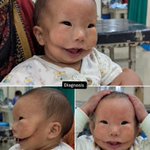
Patient 6-month-old + congenital facial asymmetry with a broad, flattened facial contour + bilateral prominent cheeks and perioral fullness + sparse scalp hair over the frontal region + distinctive facial morphology with an apparently happy expression + relative preservation of spontaneous facial movements. Careful examination should assess mandibular development, tongue size, abdominal wall defects, and glucose regulation. The characteristic combination of bilateral cheek fullness and a persistently smiling facial appearance is the key diagnostic clue.
🩺 Can you guess the diagnosis?

A 24 year old man has a painful round White ulcer with a red rim on the inner lip that recurs every few weeks.
What is most likely diagnosis ❓
The ‘Mount Fuji’ sign on a non-contrast head CT is classic for tension pneumocephalus.
What is the Mount Fuji Sign?
Pathophysiology: It occurs when trapped intracranial air under pressure exerts significant mass effect on the frontal lobes, compressing and separating them.
Radiological Appearance:
The compressed, pointed frontal lobes resemble the peaks of Mount Fuji.
The large air collections in the subdural/epidural space outline these peaks, creating the classic silhouette.
Clinical Context: It typically occurs following neurosurgery (e.g., craniotomy, posterior fossa surgery), severe head trauma, or skull base fractures.
Clinical Significance
Unlike a simple benign pneumocephalus, a tension pneumocephalus is a neurosurgical emergency. The pressurized air leads to increased intracranial pressure (ICP), risk of brain herniation, and severe neurological decline, requiring urgent surgical decompression.

The correct answer is b) Gardnerella vaginalis.
Clinical Breakdown
Gardnerella vaginalis (along with an overgrowth of anaerobic bacteria like Atopobium vaginae, Prevotella, and Mobiluncus) is the classic cause of Bacterial Vaginosis (BV).
Key Diagnostic Features (Amsel Criteria):
Clue Cells: Vaginal epithelial cells heavily coated/studded with bacteria, obscuring their cell borders (seen on wet mount).
Fishy Odor: A positive Whiff Test (release of an amine/fishy odor upon adding 10% KOH to vaginal secretions).
Vaginal pH: > 4.5.
Discharge: Thin, homogeneous, white-to-gray discharge.
Why the Other Options Are Incorrect
a) Candida albicans: Causes Vulvovaginal Candidiasis (Yeast Infection). Presents with thick, white, curd-like ("cottage cheese") discharge, severe pruritus, normal pH (\le 4.5), and pseudohyphae/budding yeast on wet mount. Odor is typically non-offensive.
c) Trichomonas vaginalis: Causes Trichomoniasis. Classically presents with a frothy, yellow-green malodorous discharge, a "strawberry cervix" (punctate hemorrhages), elevated pH, and motile flagellated protozoa on wet mount.
d) Neisseria gonorrhoeae: Causes Gonococcal Cervicitis. Presents with mucopurulent cervical discharge, cervical motion tenderness, and intracellular Gram-negative diplococci on Gram stain.

The correct answer is D) Heavy salt intake daily.
How Heavy Salt Intake Increases Stomach Cancer Risk
While spicy food, coffee, and artificial sweeteners are frequently suspected by the general public, epidemiological and clinical evidence consistently points to high dietary salt (sodium chloride) as a major direct dietary driver of gastric adenocarcinoma.
The primary mechanisms include:
Direct Mucosal Damage & Inflammation
High concentrations of salt irritate and disrupt the gastric mucosal barrier.
This erosion triggers chronic inflammation (atrophic gastritis), making the stomach lining significantly more vulnerable to chemical mutagens and carcinogens.
Synergy with Helicobacter pylori
High salt concentrations alter the gene expression and virulence of H. pylori (a Group 1 carcinogen), encouraging colonization and increasing its inflammatory potential.
Chronic severe inflammation accelerates the precancerous cascade: Normal Mucosa → Chronic Atrophic Gastritis → Intestinal Metaplasia → Dysplasia → Adenocarcinoma.
Formation of Carcinogenic Compounds
Salt-preserved, cured, and highly salted foods often contain or generate N-nitroso compounds (NOCs), which directly damage DNA in gastric epithelial cells.
Why the Other Options Aren't the Primary Link
A) Very spicy food: Capsaicin (found in chili peppers) can cause functional dyspepsia or temporary mucosal irritation, but high-quality systemic evidence does not establish it as a primary cause of gastric carcinoma. In fact, capsaicin is actively studied for potential anti-inflammatory and anti-neoplastic properties in certain concentrations.
B) Coffee on an empty stomach: May stimulate gastric acid secretion and exacerbate symptoms of GERD or gastritis in sensitive individuals, but it is not linked to an increased risk of stomach cancer. Large cohort studies actually suggest neutral or weakly protective associations for coffee against certain GI malignancies.
C) Artificial sweeteners: While subjected to ongoing safety evaluations, current clinical evidence does not link non-nutritive sweeteners directly to gastric carcinogenesis.

The correct answer is D) No risk in ordinary kissing.
Why There Is No Risk:
Saliva Contains Inhibitory Factors: Human saliva contains enzymes, antibodies, and proteins (such as secretory leukocyte protease inhibitor or SLPI) that naturally neutralize and inhibit HIV.
Low Viral Load in Saliva: Even in an untreated individual, the concentration of HIV particles (virions) in saliva is extremely low to undetectable compared to high-risk fluids (blood, semen, vaginal fluids, rectal fluids, or breast milk).
Absence of Open Wounds/Blood: Without visible blood, active bleeding, or open mucosal lesions in either person's mouth, there is no viable route for blood-to-blood or systemic transmission.
Key Takeaways & Clinical Rules:
Closed-mouth / Casual Kissing: Carries zero risk of HIV transmission.
Deep / Open-mouth Kissing: Extremely safe. Transmission is practically non-existent unless both individuals have actively bleeding gums, severe oral ulcers, or open sores creating a direct blood-to-blood transfer pathway.
Casual Contact: HIV is not transmitted through saliva, tears, sweat, sharing utensils, hugging, or touching.

The image illustrates the classic cardinal diagnostic triad for Parkinson's Disease (Parkinsonism).
Diagnosis: Parkinson's Disease
Breakdown of the Cardinal Triad:
Resting Tremor ("Pill-rolling" tremor):
Frequency: typically 4 – 6\text{ Hz}.
Present at rest and decreases with purposeful voluntary movement or sleep.
Classically involves the thumb and index finger sliding back and forth against each other.
Rigidity:
Increased resistance to passive joint movement throughout the entire range of motion.
Lead-pipe rigidity: Smooth, sustained resistance.
Cogwheel rigidity: Ratchet-like, jerky resistance resulting from underlying tremor combined with increased muscle tone.
Bradykinesia:
Slowness of movement, difficulty initiating voluntary movement, and progressive decrease in amplitude or speed during repetitive tasks (hypokinesia/akinesia).
Clinically leads to a stooped posture, reduced arm swing, shuffling gait, micrographic handwriting, and a masked facies (hypomimia).
Pathophysiology & Pharmacology Quick Summary:
Pathophysiology: Degeneration of dopaminergic neurons in the Substantia Nigra pars compacta (\text{SNpc}), leading to dopamine deficiency in the striatum. Presence of Lewy bodies (intracellular aggregations of \alpha-synuclein).
First-Line Treatment: Levodopa + Carbidopa (dopamine precursor + peripheral DOPA decarboxylase inhibitor) or Dopamine Agonists (e.g., Pramipexole, Ropinirole).


The correct answer is d) Dopamine.
Physiology of the Reward Circuit
Dopamine: Acts as the primary driver of the brain's reward, motivation, and pleasure pathways (specifically via the mesolimbic pathway, projecting from the ventral tegmental area to the nucleus accumbens). Sexual stimulation and orgasm trigger a rapid surge of dopamine, reinforcing the feeling of pleasure and anticipation.
Oxytocin & Endorphins: During and immediately after climax, oxytocin (often called the "bonding hormone") and endorphins are released, promoting feelings of relaxation, intimacy, and emotional satisfaction.
Prolactin: Post-orgasm, prolactin levels rise, which counteracts dopamine and contributes to the refractory period and post-climax drowsiness.
Why the other options are incorrect:
a) Melatonin: Synthesized by the pineal gland, melatonin primarily regulates the circadian rhythm and sleep-wake cycles.
b) Oxytocin: While oxytocin plays a key role during orgasm (promoting smooth muscle contraction and post-coital relaxation), it is not the core neurotransmitter driving the central reward/pleasure reinforcement system.
c) Glycine: An inhibitory neurotransmitter in the central nervous system, primarily operating in the spinal cord and brainstem.

⚠️ Clinical Alert: Late VKDB carries a severe prognosis. Intracranial hemorrhage can lead to permanent neurological damage, developmental delays, or mortality.
4. Standard Dosing & Administration
Dose & Route: 1 \text{ mg} (intramuscular, IM) of Phytomenadione (Vitamin K1) administered into the anterolateral thigh (vastus meatus / vastus lateralis muscle).
Preterm Infants: Dose is typically adjusted based on birth weight (e.g., 0.5 \text{ mg} IM for birth weight < 1.5 \text{ kg} / < 32 weeks gestation).
Oral vs. IM Prophylaxis: Single-dose oral Vitamin K is far less effective, has erratic absorption, and does not provide sustained protection against late-onset VKDB. Therefore, single-dose IM injection remains the standard of care recommended by the WHO, AAP, and global pediatric guidelines.


The diagnosis is Ménière’s disease (also known as idiopathic endolymphatic hydrops).
Classic Clinical Triad:
Episodic Vertigo (spontaneous, spinning sensation lasting 20 minutes to several hours, often accompanied by nausea and vomiting)
Fluctuating Sensorineural Hearing Loss (typically low-frequency in the early stages)
Tinnitus (often described as low-pitched, roaring, or ringing)
💡 Bonus Clinical Pearl: Patients often report a 4th feature—a feeling of aural fullness or pressure in the affected ear prior to or during an attack.
Pathophysiology & Management Overview
Pathophysiology: Caused by excess accumulation/impaired absorption of endolymph within the inner ear (endolymphatic hydrops), leading to increased hydraulic pressure in the membranous labyrinth.
Acute Attack Treatment: Vestibular suppressants (e.g., Meclizine, Diazepam) and antiemetics (e.g., Ondansetron, Prochlorperazine).
Maintenance / Prevention: Lifestyle modifications (low-sodium diet, limiting caffeine/alcohol) and diuretics (e.g., Hydrochlorothiazide/Triamterene) to reduce endolymphatic volume and fluid retention.
What clinical triad or case scenario shall we tackle next?
The clavicle (commonly known as the collarbone) is called the "Beauty Bone."
Why is it called the Beauty Bone?
Aesthetics & Definition: It is one of the most visible bones on the upper body. A well-defined clavicle is often celebrated in fashion, photography, and high-fashion modeling as a symbol of grace, elegance, and fitness.
Structural Framing: It subtly accentuates the shoulder line and highlights the neckline, giving a balanced silhouette to the upper torso.
Quick Medical Facts 💡
S-Shaped Structure: It is a doubly curved long bone that acts as a strut between the shoulder blade (scapula) and the breastbone (sternum).
Horizontal Long Bone: It is the only long bone in the human body that lies horizontally.
No Medullary Cavity: Unlike most other long bones, it does not have a central medullary (bone marrow) cavity and consists of spongy bone covered by a shell of compact bone.
Common Fracture Site: Because of its exposed position and role as the main connection transmitting forces from the upper limb to the axial skeleton, it is one of the most frequently fractured bones in the body.
The correct answer is B) Epinephrine 1 mg every 3–5 minutes.
Why Epinephrine?
In advanced cardiac life support (ACLS) for non-perfusing shockable rhythms—specifically Ventricular Fibrillation (VF) and Pulseless Ventricular Tachycardia (pVT):
Epinephrine (1 mg IV/IO every 3–5 minutes) is the primary vasopressor indicated. Its \alpha_1-adrenergic agonist effects induce peripheral vasoconstriction, which increases aortic diastolic pressure and improves coronary and cerebral perfusion pressure during CPR.
Antiarrhythmics: If VF/pVT persists after initial defibrillation and vasopressor delivery, antiarrhythmic agents like Amiodarone (or Lidocaine) are administered alongside high-quality CPR and shocks.
Why the other options are incorrect/contraindicated:
A) Verapamil: A non-dihydropyridine calcium channel blocker. It is contraindicated in VF because its negative inotropic and vasodilatory properties can worsen hemodynamic instability, collapse blood pressure, and cause cardiac arrest to degenerate further.
C) Digoxin: Used primarily for rate control in atrial fibrillation or in heart failure management; it has no role in acute cardiac arrest or VF resuscitation.
D) Amlodipine: A dihydropyridine calcium channel blocker used for hypertension and angina. It causes systemic vasodilation and is not indicated in resuscitation.
Standard ACLS Sequence for VF / Pulseless VT:
CPR + Defibrillate (Shock)
CPR 2 mins + IV/IO Access
Defibrillate (Shock)
CPR 2 mins + Epinephrine 1 mg IV/IO (repeat every 3–5 minutes) + Consider Advanced Airway
Defibrillate (Shock)
CPR 2 mins + Amiodarone (300 mg first dose, then 150 mg second dose) or Lidocaine (1–1.5 mg/kg first dose, then 0.5–0.75 mg/kg second dose) + Treat reversible causes (H's \text{ and } T's)

