

Applied scientist at @amazonscience Barcelona, Catalonia. Made at @la_upc & @columbia. Promoting @dlbcnai. Opinions my own.
Badalona, Catalonia
Joined July 2012
- Tweets6.5K
- Following1.8K
- Followers3K
- Likes16.7K




Pinned Tweet
X and @elonmusk have failed into promoting the values of democracy and human rights. Time to leave this platform.
We learned a lot here, thanks to those who made it possible.
Find me on LinkedIn and Bluesky.

La #UPC deixa de publicar a X per mantenir la seva comunicació en entorns que garanteixin la qualitat i la veracitat de la informació.
Una decisió que ha pres per consens el #ConsellGovernUPC, el 19 de febrer.
🔗upc.edu/ca/sala-de-premsa/no…

Xavi Giró retweeted

For anyone interested in the theory of neural net representations, and representational alignment, I highly recommend Sharut’s PhD defense talk, linked below, which is an amazingly clear and deep presentation!
youtu.be/CW1g43R9E3s


Seems like a good time for a little life update ✨
I recently defended my PhD at @MIT_CSAIL and joined @GoogleDeepMind as a Research Scientist on the RSI team!
My years at MIT were quite a ride! I got to follow my curiosity wherever it took me, work on ideas that sometimes sounded better on a whiteboard than in practice, and learn a lot along the way. Looking back, I wouldn’t have had it any other way.
I owe so much to my wonderful advisors @phillip_isola and @StefanieJegelka for believing in me and giving me the freedom to find my own way. I’m also grateful to my committee members Kaiming He and Tommi Jaakkola for their thoughtful feedback. And to all my mentors, collaborators, labmates and friends, thank you for making the years as fun as they were intellectually rewarding ❤️
It's also been a pretty exciting first month at DeepMind, getting to work on the newly released Gemini 4 Argon! Couldn’t have asked for a more fun start ✨
For anyone curious, here’s my PhD defense talk: youtube.com/watch?v=CW1g43R9…


Xavi Giró retweeted

Submission for #DLBCN spotlights and posters is open until this Saturday, October 17th. Did you submit your peer-reviewed publication yet?
sites.google.com/view/dlbcn2…
Xavi Giró retweeted

(1/7) I'd like to provide some additional context for the remarks that can be found in this interview.
(2/7) My discomfort with the attention being paid to existential risk---and with the ongoing dominance of the public discussion of such risks by a few so-called thought leaders---is that there's an elephant in the room that is being missed. That elephant is the effect of all of this discussion on young people, and indeed the effect---beginning with social media a decade ago---of information technology on young lives broadly speaking.
(3/7) I recently read an interview by Jill Lepore in which she reports on discussions that she had recently with a group of college students: "They had just three things to say. One, social media completely destroyed their childhoods. Two, AI is destroying their college education and their likely prospects for employment. And three, what the hell are we all doing?" To add a fourth bullet that I've heard in similar discussions: "I'm not going to have children, because the existential risk is just too high."
(4/7) Please contemplate such a statement, those of you who think that it's OK that the public, widely diffused, discussion coming from seemingly authoritative figures is so adamant about existential risk.
(5/7) Let me add that I have little interest in a debate about what "superintelligence" might mean, or whether we're currently seeing the emergence of superintelligence. For what it's worth, I would certainly agree that the solution of extremely challenging math problems (for example) exhibits a very impressive form of intelligence, although I would want to argue that such intelligence is impossible to dissociate from the collective of humans that provided data to the machine learning system (which itself has become a kind of collective).
(6/7) Such philosophical debates are entertaining and even important, but when they then head in the direction of "when such superintelligence emerges, there's a good chance that it will want to kill all humans", I say "science fiction". Again, I don't think that it's bad to consider such thoughts, but I strongly believe that it's bad for society, and especially young people, for such thoughts, unaccompanied by any serious real-world analysis, to become a dominant form of discourse of the era.
(7/7) We are damaging human lives, and the consequences of that damage will no doubt be a major theme of the next several decades.
Xavi Giró retweeted
Scientists from the leading worldwide institutions make DLBCN possible every year. These are the most frequent affiliations of our presenters:


Xavi Giró retweeted

Big fan of such works ever since ASIF (Coupled Data Turns Unimodal Models to Multimodal Without Training) came out a while ago, though without much traction until now arxiv.org/abs/2210.01738
Nice work!


DINOv2 has never seen a caption, and Qwen3 has never seen an image. We still aligned their embedding spaces without a single image-caption pair.
It even works when the images and the captions come from different datasets.
Project page: dominik-schnaus.github.io/un…
⬇️
Xavi Giró retweeted
This is a result I’ve dreamt about for many years: *unpaired translation between images and text*
I thought it might be only slightly possible, the kind of thing you have to really squint at. But Dominik proved this wrong. You don’t have to squint. Worth looking for yourself:
DINOv2 has never seen a caption, and Qwen3 has never seen an image. We still aligned their embedding spaces without a single image-caption pair.
It even works when the images and the captions come from different datasets.
Project page: dominik-schnaus.github.io/un…
⬇️
Xavi Giró retweeted
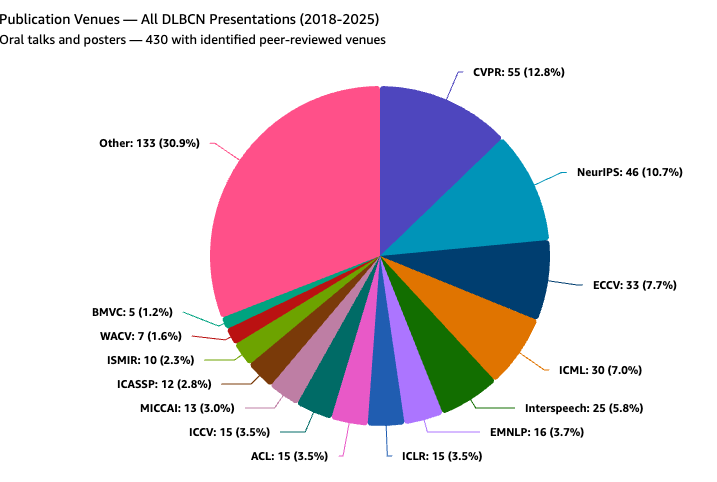
Most frequent publication venues for talks and posters at the Deep Learning Barcelon Symposium.
@CVPR @NeurIPSConf @icmlconf @aclmeeting @iclr_conf
If you published in one of these venues during 2026, you can submit your proposal before October 18:
sites.google.com/view/dlbcn2…

Xavi Giró retweeted

I care a lot about AI safety
But I do find the constant “AI will kill us all by the end of the decade” commentary increasingly unhelpful, and, frankly, a little tiresome.
Sometimes I feel certain people in Silicon Valley have lost touch with reality and normal people.
There are so many other pressing problems. A relatively small, wealthy, technologically immersed community in the Bay Area can spend an extraordinary amount of cognitive bandwidth on scenarios that feel overwhelmingly important from inside that community, while a normal person is worrying about housing, healthcare, war (especially with all the new wars that seem to have started **by humans** recently), crime, their children, energy prices, employment, climate, poverty, or simply getting through the week.
In fact, I think the more extreme rhetoric can be actively counterproductive. It collapses a very broad field: robustness, misuse, autonomy, cyber/bio risk, deception, control, systemic risk, military applications, concentration of power into one spectacular endpoint. And because the endpoint is so extreme and so uncertain, it encourages people either to become quasi-religiously preoccupied with it or to dismiss AI safety altogether.
And there is an important technical distinction between:
“The tail risk is serious enough that we should invest heavily in understanding and reducing it”
and
“The median outcome is human extinction within a few years.”
The first proposition can be justified even when the second is very poorly supported. Nuclear safety is an obvious analogy: you don't need to believe nuclear war is virtually certain next Tuesday to think command-and-control, escalation, verification and weapons safety deserve enormous attention.
I also think a mature AI-safety programme should deliberately cover several timescales. Immediate harms and misuse matter because they are happening now. Emerging agentic risks matter because systems are becoming more autonomous. And genuinely catastrophic or existential risks matter because even a relatively small probability multiplied by an enormous consequence warrants serious research. Those positions aren't in competition.
There is a further strategic problem with constant doom rhetoric: it makes calibration almost impossible. If every capability advance is “the last warning”, every model is “terrifying”, and every year is supposedly the crucial year before catastrophe, observers eventually discount the signal. Safety researchers ought to be unusually disciplined about uncertainty, evidence, falsifiability and updating—not less disciplined because the stakes are high.
(no AI was harmed in the making of this post)
repost if you agree to restore some sanity to the debate
Xavi Giró retweeted

📣 Amazon Research Awards fall 2026 call for proposals is now open for submissions. Successful applicants will receive unrestricted funds, AWS promotional credits, and training resources.
Research areas:
• Agentic AI
• AI for Information Security
• Amazon Security
• Automated Reasoning
• AWS Cryptography
• Build on Trainium
• Multilingual and Contextual AI Evaluation
• On-Device Multimodal Perception
• Synthetic Data Generation for Multimodal Perception
Deadline: November 4
#AmazonResearchAwards
amazon.science/research-awar…


Xavi Giró retweeted
Antonio M. López from the Computer Vision Center (@CVC_UAB) will be an invited speaker at #DLBCN 2026.
scholar.google.com/citations…

Xavi Giró retweeted

Accepted at #NeurIPS26. See you in Paris (hopefully).


Xavi Giró retweeted

I’m 36.
Solo founder from Catalonia.
Wish all expats speak catalan and learn about our traditions.
Live is better when you get out from expats bubble.
With love from Premià de Mar.


Xavi Giró retweeted

Do authors understand their own papers?
Our desk rejection rate at TMLR is about 53% while it was only 6% in 2023
To understand the situation and assess our process, Nihar asked authors about their own TMLR submissions
Learn the findings of the pilot study & share your thought

TMLR has faced a deluge of submissions, necessitating stricter desk rejection policies due to limited reviewer capacity
Co-EiC Nihar Shah reached out to authors of 10 papers slated for desk reject. Could they answer questions about their *own* submission?
medium.com/@TmlrOrg/asking-a…

Xavi Giró retweeted

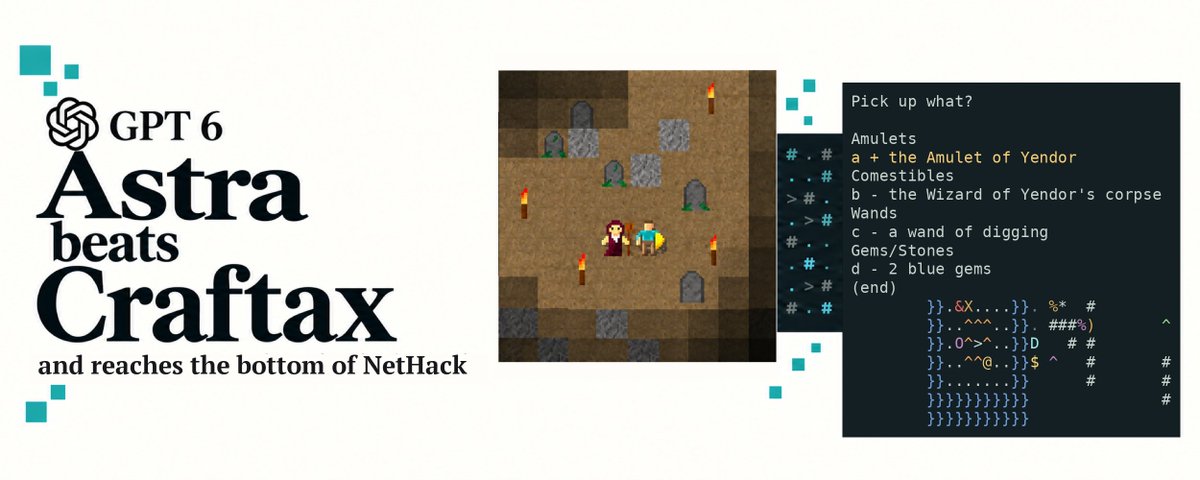
What is the role of academic computer vision research in the age of increasingly powerful large models? Is GPT-6 Astra a step change? How can a researcher have an impact today in academia?
These are the questions I ask myself as I head off to ECCV 2026, a conference I’ve attended since 1992. One of my papers this year is VIGA, a method that takes an image as input and outputs a 3D Blender scene that represents that image. This is a classical inverse-graphics task and VIGA was the first method to solve it using an agentic approach.
The idea is now several years old and the first version of the paper was rejected. This delayed publication significantly. After it was accepted at ECCV, it was quickly surpassed by people using Claude Code for the same purpose. Today GPT-6 Astra blows away all previous results. But we still head off to ECCV to tell the community about our invention that is now fully out of date.
The way academic work often progresses is that one reads recent papers, notices that they have limitations, comes up with a new idea, explores this, publishes it, etc. Any published paper I read today is based on ideas that are at least a year old. And those ideas were based on the literature of the time, which was also a year old. That means that any paper I see at ECCV is likely two years out of date. In AI today, two years means your work is likely irrelevant.
At CVPR this summer I noticed that many authors have not gotten the message. They continue to work on “old” problems that have a long history. This history is based on assumptions about how the “vision problem” will be “solved”. The truth is that it is being solved in a very different way and many of these problems are no longer relevant. Another group of papers focuses on very niche problems where large models likely fail because of insufficient data or lack of business interest. The impactful papers were largely from industry and had long author lists and massive data+compute behind them. These papers were also out of data, describing systems that had been released months before, but at least they served to provide the community with more complete documentation and analysis of commercial systems.
So what should academics do? First, we need to put aside the tools we’ve used for years and start from scratch. Every project should start by trying really hard to solve the problem with existing tools. I would like to see every paper begin with a detailed experimental analysis of how existing models perform and why they fail (if they do). This gives the kind of insight we need today. Then, assuming current models fail, the solution should provide some fundamental insight that will outlive the next release of such models.
Reviewers today still focus on technical novelty. This pushes people to focus on tweaking architectures rather than clearly moving the field forward. Papers need to be judged based on their novel insight and not their novel technical contribution. This is a real shift in thinking but it focuses us on what matters - progress of the field.
If we want there to be a “field” of computer vision, then it can’t become a marginal backwater, focusing on esoteric problems. If you haven’t tried using Astra (or whatever comes next) to solve your problem, then you have not done your homework. This omission should be seen as negatively as not having a previous work section.
Concretely, I think papers should include a new section analogous to “Related Work” where that related work is current models and how they perform on the task. Reviewers should start asking for this and expecting authors to be able to articulate their insights about the limitations of existing large models.
I'm interested in your thoughts.
Xavi Giró retweeted

My journey to develop AGI spans 25 yrs, including 10+ yrs thinking about technical & societal perspectives at Google DeepMind.
AGI is on the horizon - we need deeper understanding of its implications. To help, we've created the DeepMind Institute.

Xavi Giró retweeted

BREAKING: OpenAI might have stolen another major proof.
In a detailed Mastodon post, which I report in full in the comments, Andreas Thom presents several pieces of evidence suggesting that OpenAI may have trained Astra on conversations in which he and Gábor Kun were working on Gromov’s soficity conjecture, one of the ten problems OpenAI later announced Astra had solved.
I know Andreas. We met several times early in our careers. He is an exceptional mathematician, a leading expert on sofic and hyperlinear groups, and one of the most respected scholars in the field. He has spent two decades working on this problem.
If his account is correct, this is not a minor dispute over attribution. It would mean that unpublished human work was absorbed into a model and then presented to the world as a breakthrough by the model itself.
And if the allegations raised by Levent Alpöge, Tristan Buckmaster, and now Andreas Thom are all substantiated, we are no longer looking at isolated incidents.
We may be looking at one of the greatest intellectual scandals in the history of science.
AI is not discovering new mathematics.
AI is stealing human discovery.

Xavi Giró retweeted

What a paradigm shift for TTS, going end to end and breaking many inductive biases in speech synthesis: waveform level (no vocoding), categorical (no regression), dil. causal convnet (no RNN) 🤷♂️
And lucky me to witness the demo from @heiga_zen in the SSW9 right after unveiling

10 years today since we unveiled WaveNet!
Autoregression with long context before it was cool😅
Maybe it looks a bit silly now that we didn't use a Transformer, but we had a good reason: it would take another year for that to be invented🙃 Thanks @heiga_zen for the reminder!
Xavi Giró retweeted

“we cannot rule out that de-identified data derived from their usage of our products helped improve our models.”
i mean props to them for straight coming clean.
(so far the proof looks more along the lines of another euler blowup proof we had, off of whose ansatz naming we were making really stupid puns like “smooth criminale”, unlike the much better “ideal fluids explode”, Tristan)
so i’ll now give a bit on my thinking here. i actually woulda been pumped to collaborate on this, there are a lot of people at oai i like (ok, clearly some were indirectly dicks to me because of being part of the whole situation, but im a big boy, i still like them), idgaf about authorship on that step anyway, coulda been me Tristan and every fte at oai for all i care (on that Tristan would disagree:p). but on hearing the loud convo in the hallway, especially the part where a millennium prize was offered if i’d just be removed from the paper, it was kinda clear the die had been cast and things were locked. pretty wacky, unstrategic, and unnecessary, since on my side things were mostly me and claude having a good time yoloing random stuff in the corner rather than anything institutional. i also like the idea of the labs cooperating, and even better on scientific progress. it’s a shame!

We congratulate Levent Alpöge and Tristan Buckmaster on their remarkable mathematical work.
We (the researchers and the agents) did not see any of their work through any means until they released it publicly — in particular, no specific user data was accessed in order to solve this problem.
While unlikely, we cannot rule out that de-identified data derived from their usage of our products helped improve our models.
However, our proofs differ significantly and even the precise results proved are different in the Euler case (forced vs. unforced).
Xavi Giró retweeted

in view of OpenAI's claim about Navier Stokes, it is important that we hear alternative points of view on how it happened. From Tristan Buckmaster, Prof. at NYU. cims.nyu.edu/~tristanb/state…