

I tweet about #money, #markets, #investments, #businesses and #finance, with special focus on #Malaysia. All info is publicly available.
Malaysia
Joined February 2021
- Tweets8.5K
- Following105
- Followers1.8K
- Likes2.3K





Important new data: Gen Z is doing significantly better than Millennials.
Real, inflation-adjusted analysis shows Gen Z is earning 20% to 40% more than Millennials did at the same stage in their lives.
This advantage holds across the entire income distribution, from the lowest-paid jobs to the top percentiles.
Key Generational Definitions:
Millennials: Born approx. 1981–1996 (working working adults aged ~19–34 in 2015).
Gen Z / Zoomers: Born approx. 1997–2012 (working adults aged ~13–28 in 2025).
Humanity is progressing.

The AI race is shifting from capability to cost control! 🚀
DeepSeek just dropped V4.1-Flash-1017, beating Claude Opus 5 on select agentic benchmarks with 16B active parameters at 1/10th the cost ($0.10–$0.20/task).
More reason for Black Monday

🚨INSANE: China's new DeepSeek V4.1 Flash takes on OpenAI's GPT-6.1 at a reported 90% LOWER cost.
The entire test reportedly cost just 0.44 cents in DeepSeek API fees.
DeepSeek also ran at over 237 tokens per second in the same test.
Credit: @SPAC89
Tomorrow (19 Oct 2026) is the 39th anniversary of Black Monday (19 Oct 1987) where DJIA dropped 22% in a single day.
The chart overlay between current date and 1987 are eerily identical.

BLACK MONDAY 😱📉
It would be a complete dishonour for a market technician not to share this technical setup.
Monday marks the 39th anniversary of Black Monday October 19, 1987 when markets crashed an astonishing 22% in a single day.
While modern circuit breakers protect us from a total free-fall, the structural overlay between 1987 and today’s 2026 setup is eerie.
It would be something if Monday marks the beginning of something so beautiful, yet so consequential.
For one's private perusal.
Enjoy .

Perak holds the highest proportion of elderly residents in Malaysia 🇲🇾📊
According to 2026 estimates, 8.4% of Malaysia's overall population is aged 65 and above.
👴 Highest Percentage of Aged Population (65+):
• Perak: 10.8%
• Sarawak: 9.7%
• Kedah: 9.7%
• Penang: 8.8%
• Perlis: 8.8%
👶 Lowest Proportion of Senior Residents:
• Putrajaya: 2.2%
• Labuan: 6.0%
• Sabah: 6.5%

Kuala Lumpur records the highest estimated median age in 2026 at 36.5 years (+2.9 years since 2020).
📈 Highest Median Ages in 2026e:
• Kuala Lumpur: 36.5 (up 2.9 yrs)
• Selangor: 34.2 (up 2.6 yrs)
• Penang: 34.0 (up 2.2 yrs)
• Sarawak: 33.2 (up 2.3 yrs)
🇲🇾 National Average: 31.7 years (+2.0 years vs 2020)
👶 Youngest States: Kelantan (26.2), Putrajaya (27.7), Terengganu (27.7), and Sabah (28.0)

Following up on demographics, Selangor also leads the nation in young residents 🇲🇾📊
Out of 7.3 million young people (aged 14 and below) in Malaysia, here is the state breakdown:
👶 Top States by Young Population Share:
• Selangor: 20.6% (~1.5 million residents)
• Johor: 11.9%
• Sabah: 11.8%
Balancing education, childcare, and future workforce infrastructure will be critical as these numbers grow.

Malaysia’s demographic landscape is shifting 🇲🇾📊
Out of the 2.9 million seniors (aged 65+) in Malaysia, Selangor holds the largest share:
👴 Top States by Elderly Population Share:
• Selangor: 22.6% (~650,000 seniors)
• Johor: 11.9%
• Perak: 9.7%
As the population continues to age, healthcare infrastructure, senior care services, and pension sustainability will be key focus areas.

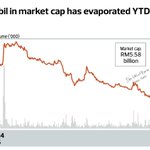
A stark chart showing a prolonged markdown phase 📊
From ~RM2.90 in Sept 2025, the stock hit a low of RM1.45 on Oct 16.
Total market cap has dropped to RM5.58B, erasing more than 50% (RM5.81B) in value YTD.
With recurring volume spikes on down legs, is this counter nearing a capitulation floor or continuing its downtrend? 👇

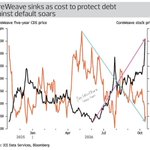
Cracks showing in AI infrastructure debt markets? 🚨
CoreWeave’s 5-year Credit Default Swap (CDS) spread has spiked toward 1,200 bps, signaling an implied 5-year default probability exceeding 60%.
Meanwhile, the stock price has plunged below $70, down sharply from its May/June 2026 highs.
As capital expenditure pressures mount across high-leverage AI cloud providers, credit markets are rapidly repricing default risk.

Nomura Research turned more bullish on Malaysian Banks.
Upgraded a few of them to buy calls, due to
1. higher increase income from higher bond yield and potential rate hike
But trimmed target prices industry wide due to:
1. weaker bond trading income
Here is a snapshot of Malaysian banks as at Oct 12:
🟢 Buy Ratings: (do your own research, don't follow blindly. Not financial advice)
• CIMB Group: TP RM8.90 (+21.9% upside)
• AMMB Holdings: TP RM8.00 (+30.1% upside)
• Maybank: TP RM11.70 (+30.1% upside)
• Public Bank: TP RM5.40 (+15.9% upside) ⬆️
• RHB Bank: TP RM8.80 (+22.4% upside) ⬆️
⚪ Neutral Ratings:
• Hong Leong Bank: TP RM24.60 (+14.4% upside)
• Alliance Bank: TP RM5.20 (+14.5% upside)
• Affin Bank: TP RM2.20 (+12.8% upside)
Maybank leads market cap at US$29.5B, while AMMB & Maybank offer the highest upside potential at +30.1%.
Source: Nomura, The Edge

Here is a snapshot of selected Bursa-listed Oil & Gas players as of Oct 14, 2026:
📈 Top YTD Performers:
Hengyuan Refining: +388% (P/E 2.08)
Marine & General: +80%
Hibiscus Petroleum: +54%
📉 Under Pressure:
Lianson Fleet Group: -25%
Deleum Bhd: -22%
Velesto Energy: -20%
Petronas Dagangan leads market cap at RM19.11B.

Here is the Brent forecast in 4Q2026.
Barclays USD115/b
Fitch Solutions USD107/b
Morgan Stanley USD105/b
US EIA USD105/b
StandChart USD101/b
UBS USD100/b
Kenanga USD100/b

Is $100+ crude becoming the new macro baseline? 🛢️
Look at the geopolitics driving Brent crude over the last 4 years:
📍 2022: Russia-Ukraine war sparks a spike toward $130/bbl.
📍 2023–2025: Sluggish growth & supply adjustments pull oil down to $60–$70.
📍 2026: US-Iran conflict triggers another major supply shock back toward $110+.
Every time peace dividends fade, energy risk premiums return with a vengeance—re-igniting global inflation fears.
Where do you see oil heading next? 👇

Malaysia’s wage gap by skill category (2021–2025) 🇲🇾📊
DOSM data shows a stark structural divergence in median monthly salaries across skill levels:
🔹 Skilled: RM5,057 (Strong acceleration after 2022)
🔹 Semi-skilled: RM2,223 (Steady, gradual upward slope)
🔹 Low-skilled: RM1,758 (Climbing slowly alongside minimum wage floors)
Key takeaway:
The premium for high-skilled roles continues to widen. While minimum wage policy lifts the floor for low-skilled workers, semi-skilled wages remain relatively flat, highlighting the growing premium placed on specialized talent in Malaysia's modernizing economy.

The reality of fresh degree graduate salaries in Malaysia 🇲🇾📊
According to Ministry of Higher Education (MOHE) tracer data for 2025 bachelor's degree graduates:
🔹 RM2,001 – RM3,000: 36.2% (The dominant baseline)
🔹 ≤ RM2,000: 27.8% (6.6% earning ≤ RM1,000; 21.2% earning RM1.0k–RM2k)
🔹 RM3,001 – RM4,000: 23.8%
🔹 > RM5,000: Only 4.7% (with just 0.8% breaking RM10,000)
Key takeaway:
Over 64% of fresh degree holders start at or below RM3,000/month. While entry-level wage floors are slowly adjusting, high-value skill premiums (>RM5k) remain tightly concentrated at the top top.

Malaysia’s corporate earnings dilemma 🇲🇾
A long-term look at the FBM KLCI (2010–2025) shows a clear structural pattern: earnings per share (EPS) for Malaysia’s largest listed companies have essentially moved sideways over the past decade.
Key takeaways from the data:
🔹 EPS Stagnation: Earnings peaked around 2014 and have struggled to break out into a sustained upward trend since.
🔹 Valuation Floor: The KLCI Index has closely tracked this earnings plateau, staying bound within a multi-year range.
🔹 Growth Re-rating: Without structural earnings expansion among big-cap constituents, market reratings remain heavily reliant on liquidity and dividend yields rather than fundamental growth.
Can structural reforms and macro tailwinds finally break this decade-long earnings ceiling? 📈

Minimum wage in Malaysia has doubled since 2013, but has purchasing power really kept up? 📈
Looking at DOSM data:
🔹 Minimum Wage: Frequent step-ups (latest jump to RM1,700)
🔹 Overall Inflation: Moderately steady
🔹 Food Away From Home: Steep upward trajectory
Wages are rising, but everyday living expenses—especially dining out—continue to squeeze margins.
Let's go hardworking Malaysians!

In Malaysia Budget 2027....
With higher operating expenditure which came from higher salary to civil servants and debt service...
There are less for Development Expenditure.
As we can see from this chart, % of development expenditure to GDP continued to drop.

