

This account is inactive. Follow @NASAScience_ to stay in touch & discover ways you can #DoNASAScience! Verification: https://xitter.cf/t.co/odV957Fb0i
- Tweets1.5K
- Following91
- Followers32.8K
- Likes2.1K




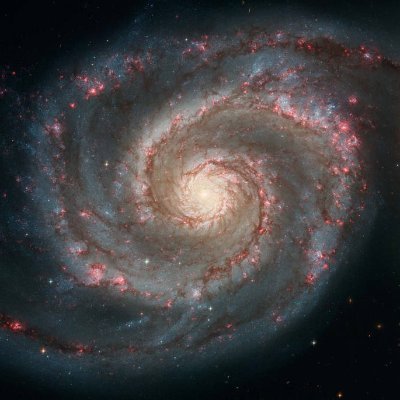


ALT Close-up view of a spiral galaxy with web-like structures in warm reds, browns and yellow hues, with a glowing bright star in the center


ALT A sunset sky with wispy, glowing clouds in shades of blue and white above a dark silhouette of trees and bushes on the horizon.


ALT A row of people bundled well against the cold, stand on snow beneath the green light of the aurora


ALT Close-up, frame-filling view of the oval-shaped, spiral galaxy, NGC 2566, captured by the NASA/ESA/CSA James Webb Space Telescope. This galaxy is located in the constellation Puppis. Its core is a compact, pale spot that glows brightly, filling the disc with bluish light. Faint strands of pale reddish dust swirl out from the core to the far sides of the disc. They each join up with an arm of thick, cloudy, red dust with brighter orange patches that follows the edge of the disc around to the opposite end and a little off the galaxy.


ALT A screenshot of the Galaxy Zoo website, where users classify galaxies based on their appearance. The image displays a distant galaxy with a bright central area and a spiral arm. On the right, users are prompted to determine if the galaxy is smooth and rounded or if it has features like a disk. Image credit: Galaxy Zoo, Zooniverse, and the Cosmic Evolution Early Release Science Survey. Inset galaxy: NASA/STScI/CEERS/TACC/S. Finkelstein/M. Bagley/Z. Levay/A. Pagan.


ALT A bright ball at the center of the image represents a white dwarf star that glows in pale yellow. Surrounding the star is a disk of material. The disk starts a little distance away from the star and is tilted down to the right. The disk glows in orange closest to the star and fades to grays out to its edges. In the lower left is a blotchy cloud of white gas and dust with a trail leading to the edge of the material disk. The image is watermarked “Artist’s concept” and “Credit: NASA’s Goddard Space Flight Center/Scott Wiessinger.”


ALT Earth, seen from the International Space Station, at night and covered with the wispy, bright green swirls of the aurora borealis. Beneath the aurora borealis are bright yellow dots of light from cities. The Space Station’s solar arrays are in shadow and cut through the center of the image. Credit: NASA/Josh Cassada

ALT Astronaut photograph of Chile’s Laguna Verde, a bright blue lake in the center of the image. The surrounding landscape is dark brown and mountainous with streaks of tan and white.

ALT A view of looking up at a tree. The brown tree trunk is in the center and foreground of the image. In the background, is a canopy of bright green leaves against a bright white sky.

ALT Hot stars burn brightly in this ultraviolet image of the Andromeda galaxy from NASA's Galaxy Evolution Explorer. Blue-white bands making up the galaxy's striking rings are neighborhoods that harbor hot, young, massive stars. Dark blue-gray lanes of cooler dust show up starkly against these bright rings, tracing regions where stars currently form in dense cloudy cocoons. Eventually, these dusty lanes will blow away when the forming stars ignite nuclear fusion in their core. Meanwhile, the central orange-white ball reveals a congregation of cooler, old stars that formed long ago. This image is watermarked “Credit: NASA/JPL-Caltech”


ALT En esta imagen, se ve el primer plano de un antebrazo y una mano que sostiene un teléfono móvil blanco. En la pantalla del celular se muestra una porción del fondo de la imagen en sí: un paisaje de colinas en tonos de verde y un cielo nublado.


ALT Wispy, colorful, glowing noctilucent clouds shine above a grassy landscape just after dusk

ALT Shareable for the 20 March 2025 GLOBE Observer Connect Event. The shareable contains a photo of land with trees, mountains, and grass. There is also a brown area with white text.

ALT Four screen shots from the GLOBE Observer Trees Tool focusing on tree genus and species identification. There are four screenshots containing colored boxes and text.