

@DjohnAgentIncom
Account based inUkraine
About this account
- Account based in
- Ukraine
- Connected via
- Ukraine App Store
Account-level information from X, not a live location or the device used for a specific post.
AI × Money. Tools, workflows, and side hustles that actually work.
Joined July 2026
- Tweets54
- Following84
- Followers22
- Likes26


"If money stops mattering, what will matter is what can't be bought: time, attention, and ideas."


Elon Musk just described an extraordinary future where SI, robotics, and space infrastructure could create an economy one million times larger than Earth's current economy
A future where conventional money and work become irrelevant, and everyone has access to practically unlimited goods and services
“I don't think money is going to matter in the future. Anyone will be able to have any goods and services that they want”
The one who leaked this JEV trading desk should be running a book.
I thought putting an agent on a live order book meant throwing GPT at a chart and praying it doesn’t short the top on vibes.
Turns out, no.
The actual setup is far more interesting:
→ WATCHER streams ticks from 6 assets in parallel. No reasoning yet. Pure context gets passed to the analyst.
→ ANALYST calls act? on every tick in milliseconds. Returns a probability or skips. “Maybe wait” is not allowed.
→ CHOICE picks LONG or SHORT from a two-element set with confidence. “Stay in cash while you think” is not an option.
→ RISK evaluates side × size against the drawdown budget before the executor ever touches the book. Silently zeros out anything that breaches 0.5%.
→ GATE compares against the threshold. Below it goes to a human. Above it executes. It also flags the ticks where the gates held while the market already moved.
What you end up with:
Ticks stream. Actions get gated. Sides are typed. Risk is capped.
The interesting part isn’t predicting the market harder.
It’s giving every tick a gate that the executor physically cannot shoot past.
Instead of running 10,000 ticks through a full model and praying the JSON parses before SOL moves, you run them through a narrow pipeline. Cheap. Fast. With a clear gate pass rate. And every decision logged against what actually executed.
Watch the tick.
Gate the action.
Cap the size.
Everything else isn’t about how smart the model is.
It’s about how many times it’s even allowed to press the button.
Agencies charge $2-5K and a week of work for a dashboard and a video report.
Now it's done in a chat in one evening.
But the money won't go to whoever hits the button fastest. It'll go to whoever knows which decision the numbers should drive.
Breakdown below 👇

1/
Anthropic just taught Claude to do two things agencies charge real money for.
Live dashboards from your data. And animated videos from your reports.
Here's what it means if you make money with AI 🧵
2/
Claude Dashboards:
→ connects to Snowflake, BigQuery, Databricks, Salesforce
→ you ask a question in plain language
→ you get a dashboard that updates as the data changes
And the key part: you can see the queries behind every number. Check them before showing a client.
3/
Claude Motion:
→ type /motion in the chat
→ feed it a quarterly report or a chart
→ get a short animation that exports to MP4
It's not a video model. Claude writes animation code, so any word, number or timing can be edited after the first version.
4/
Why this matters more than another "wow" model:
Businesses don't need a chat with AI. They need the things work runs on: reports, dashboards, presentations.
That used to cost hours of an analyst and a motion designer.
5/
Where the money could be (my hypotheses, not guarantees):
1Done-for-you analytics for small businesses: connect the data, set up the dashboard, charge a monthly retainer
2Video reports for founders: "your monthly numbers in 60 seconds"
3Packaging complex data for consultants and agencies
6/
The limits hype accounts won't mention:
• both features are in beta
• Dashboards is on paid plans only, Motion on Team and Enterprise only
• on Enterprise both are off by default until an admin enables them
• Anthropic hasn't published accuracy or reliability numbers
Verify the numbers before sending anything to a client.
7/
Bottom line: the value is shifting from "I can make a pretty report" to "I know which decision it should drive."
Whoever gets that first will take clients from people selling hours of work.
Follow for more on how to build income on this 👇
Didn't expect 𝗚𝗿𝗼𝗸 𝗕𝗼𝘁 to blow me away like this.
Any task you'd do on a laptop, it just takes and does. Online shopping, booking flights and hotels, tasks that involve payment. So far I haven't seen it get anything wrong.
Each bot has its own cloud computer. Close your laptop and it keeps working.
I'm still exploring what 𝗚𝗿𝗼𝗸 𝗕𝗼𝘁 can do, and I add new tasks every day.
If you're still using AI only as a chat, you're missing the point: it can do things, not just give advice.
My tip: start with one bot and one specific job, and keep payments and purchases behind your approval. Before you know it, you won't be able to do without it.

Literally have no idea how incredible Grok Bot really is
Basically any task you can think of that you want to do on a laptop it does it... I didn't see it do anything wrong tbh, such as with the tasks that required payment and with things like buying stuff online and booking flights booking hotels
It absolutely does it better... I was kind of shocked and impressed with all the things it does, and I'm still exploring how many things I can do with Grok Bot... and I just keep adding things

$12,614 a year for one word: “no.”
That is the bill for putting the most expensive model on every 1-minute BTC candle. Almost every answer is nothing here. You still pay for a full reasoning pass.
A real desk does not work that way. A cheap filter sees everything. Analysts build what survives. The expensive model speaks last, and almost never.
Same final call. The bill drops from $12,614 to $394 a year.
Seat 1. The bouncer. A fast, cheap model. Three questions per candle: is the flow toxic, what is the regime, is there a setup. About 40 of 4,320 candles pass. The pass rule lives in code, not in the prompt.
Seat 2. Analysts who sleep. They wake only on a pass. Three jobs: levels, entry, size. About 9 real plans come back. The rest are NO_TRADE.
Seat 3. The one you call rarely. It does not build the trade. It tries to break it. Four checks: do the timeframes agree, is funding crowded, is there news in the window, is the stop where the idea actually dies. Verdict is APPROVE, REDUCE, or VETO. Bad JSON is a VETO.
One plan looked clean. Long BTC 84,545, stop 84,275, target 85,215, 2.5R. Three checks green. The stop sat where the ratio looked pretty, not where the idea breaks. Signed at half size. Price hit the target. +$1,711. One red check cuts the risk in half. On the day the other three are wrong too, that half keeps the account alive.
The cheapest model talks the most. The most expensive talks the least.
Models judge. Code enforces. You keep the keys. Trading on, withdrawals off. Max risk and a daily loss stop live where no prompt can reach them.
The model is not the edge. If the setup loses by hand, three models will lose it faster and write a tidy journal about it.
Seven days, filter only, zero orders. Then analysts, and you read every plan. Then the risk officer. Orders last.


When Grok Takes the Controls of a Flying Tesla Roadster
The video shows something that not long ago seemed pure science fiction: a white Tesla Roadster on a giant ramp, with powerful smoke trails shooting from its underside, flipping over, taking off, and flying. The Spanish text states it directly: “Flying cars are already real” — Elon Musk challenges the laws of physics using SpaceX thrusters.
This is not just a concept for extreme acceleration. These are short but genuine flights powered by cold-gas or rocket thrusters. The car launches off the ramp, hovers, maneuvers, and lands again. Spectacular, dangerous, and highly technological.
Now imagine that this flight is controlled not only by a human pilot or basic Tesla electronics, but by Grok.
How the Two Technologies Work Together
1. Grok as an Onboard Pilot and Decision-Making System
Rocket thrusters provide short bursts of thrust. They are powerful, but “dumb” on their own. Grok calculates the trajectory, fuel/gas consumption, wind, the car’s attitude, and the destination in real time. It doesn’t just follow a pre-programmed scenario — it adapts. If the ramp is slightly higher or lower, if there’s a gust of wind, or if the angle needs to change urgently, Grok recalculates the impulse in fractions of a second and issues commands to the thrusters.
2. Voice and Contextual Interface During Flight
While the car is in the air, the passenger says:
“Grok, take me to the nearest charging pad and show me how much impulse is left.”
Or:
“Make a smoother turn and explain why you chose that path.”
Grok doesn’t just execute the command. It explains the physics of what’s happening, warns about risks, and offers alternatives. Unlike ordinary voice assistants, it can push back, clarify, and take into account the context of the entire trip.
3. Multi-Agent Architecture
One Grok agent handles stabilization and thrust control.
A second agent manages safety (sensor monitoring and emergency landing scenarios).
A third agent takes care of the passenger (navigation, information, and even entertainment during the flight).
They work in parallel and in coordination. This is exactly the kind of multi-agent architecture Grok is designed to build.
4. Learning from Real Flights
Every jump off the ramp or short flight becomes training data. Grok analyzes how the car behaved, where the thrust was excessive or insufficient, and how the suspension and aerodynamics responded. Over time the system becomes more precise — not only for this specific vehicle, but for the entire future fleet of flying Teslas.
5. Practical Scenarios
•Emergency medical delivery: Grok chooses the optimal route taking into account wind, terrain, and remaining impulse.
•Demonstration or recreational flights: the passenger simply says where they want to go, and Grok builds a safe and spectacular trajectory.
•Hybrid operation with normal driving mode: on the road the car drives like a regular Tesla, and at the right moment Grok activates short flights to bypass traffic or overcome obstacles.
Why Grok, and Not a Regular Autopilot System
A conventional autopilot is good for predictable road conditions. Flying mode involves different physics, different risks, and different decisions. Here you need an AI that:
•understands context and can explain its actions,
•can work with uncertainty,
•can quickly switch between different tasks (control, safety, communication),
•is not limited by rigid scripts.
Grok is specifically built for this kind of flexibility.
What the video shows is still a spectacular demonstration jump. But if you combine SpaceX rocket thrusters with onboard intelligence at Grok’s level, you no longer get just “a car that can occasionally fly.” You get a system you can talk to, that makes complex decisions on its own, and that learns from every flight.
A flying Roadster + Grok is not simply the sum of two technologies. It is the moment when physics and intelligence start working as a single organism.
🤖 Made with AI


GPT-6 Astra: The Setting That Sets Your Bill, and Five Prompts to Run at the Right Level
GPT-6 Astra costs $10 per million input tokens and $50 per million output tokens, and the thinking it does before it answers bills at the output rate. So the same prompt can cost two or three times more depending on one setting.
Astra launched on Sep 3. The API takes five reasoning effort levels: low, medium, high, xhigh and max. There is no option to switch reasoning off, so low is the floor. The reasoning tokens are hidden in the response, but they count as output and share the output budget with the visible answer.
Here is the arithmetic at list prices, with made-up token counts. A call with 40k input tokens and 8k output tokens costs $0.40 for input and $0.40 for output, $0.80 in total. The same call with 40k output tokens, because the model thought longer, costs $0.40 plus $2.00, or $2.40. One independent test by Artificial Analysis put Astra between $0.82 and $3.26 per task on its intelligence benchmark, depending on effort level.
I don't have OpenAI numbers for how many reasoning tokens each level uses, and I haven't measured these prompts myself. The levels below are a place to start, not benchmarks. Print the usage on your first run and move the setting up only when the answer gets worse.
Five prompts, with the effort level to start at:
1Competitor teardown, start at medium.
Research [COMPANY]. Cover pricing changes in the last 12 months, how they describe themselves, the most repeated complaints in reviews, and what they shipped in the last 90 days. Every claim needs a source link. Anything you could not verify goes under Unverified, do not drop it. No adjectives about quality.
2Bug reproduction, start at high.
Here is a bug report: [REPORT]. Your first job is to reproduce it, not fix it. Build a minimal case that fails and show me the failing output before proposing anything. If you can't reproduce it in [N] attempts, stop and tell me what you tried and what you need from me.
3Weekly report from an export, start at low.
Here is [FILE]. Show what moved more than 10% week over week, what stalled, and the three numbers to check first. Do the arithmetic in code and show the code. If a column is ambiguous, ask before assuming.
4Document extraction, start at low and run as batch.
Extract [FIELDS] from this document. Return JSON only. Use null for anything missing and never infer a value from context. If a field appears twice with different values, return both and flag it.
5Customer interview synthesis, start at medium.
Here are [N] conversations. List what people ask for, what they actually do, and where the two disagree. Give the conversation number for each pattern. Rank by how many separate conversations support it. Anything mentioned once goes in its own list.
Batch and Flex processing bill at half the standard rate. If nobody is waiting on the answer, as in prompt 4, run it there. The 40k and 8k example above drops from $0.80 to $0.40. A request over 272k input tokens bills the whole call at a higher rate, $20 and $75 per million, so trim long inputs first.
Run prompt 3 at low, print the token usage, then run it again at high. If the two answers match, the extra money bought nothing.


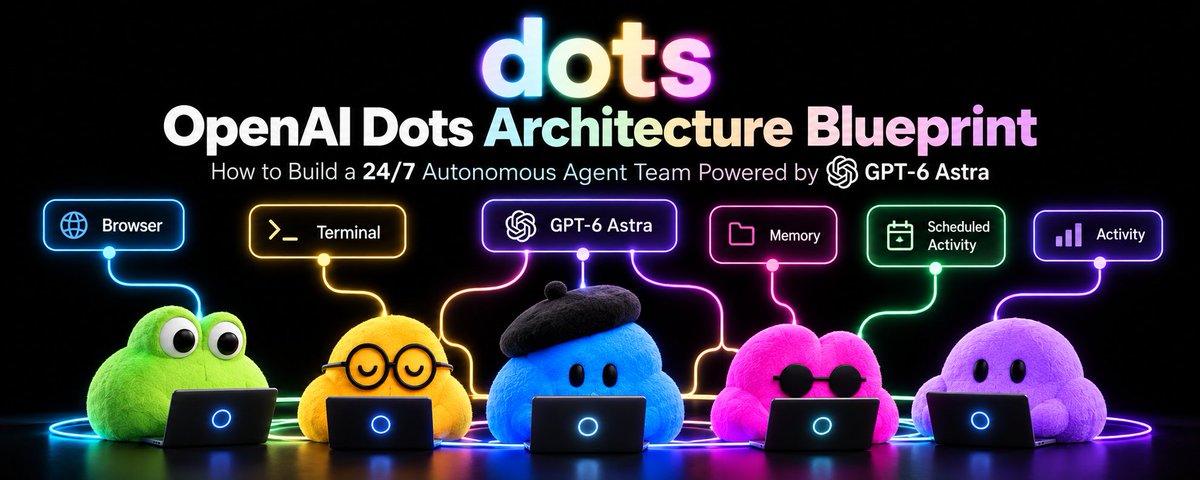
OpenAI Dots: How to Set Up an Always-On Agent Without Losing Control
OpenAI’s new agent gets its own cloud browser, so you sign in to your tools once and it stays signed in. Here’s how to set one up safely.
Dots launched at DevDay on Sep 29. Each one has its own cloud computer and keeps working after you close your laptop. You can schedule it: every weekday at 8:30 it pulls the data and has the brief waiting before you open yours.
It runs on GPT-6 Astra. OpenAI also released GPT-6.1 Sol, which it says gets close to Astra on coding and professional tasks at about one-fifth of Astra’s token price. The guide I read suggests Astra for the lead agent and Sol for the high-volume background work.
The rules that matter when you set one up:
One agent, one job. A “general helper” fails because nothing defines what it owns.
Permanent rules go in the role description. Today’s task goes in the chat.
Let it read and draft on its own. Anything that sends, spends or overwrites waits for your approval.
Rollout started with Pro and Business Premium in eligible markets, and OpenAI announced a $500 a month plan next to it. Check the price before you build a routine around it.
Per the guide, pausing the main agent does not stop its scheduled routines. Turn those off separately in the Scheduled tab.


This is a promotional announcement for a video. The author, Alex Finn, shows in 20 minutes how to build an automated online business using Grok Bot (an AI agent). According to the post's author, $1,100 immediately lands in Stripe as a result. The video was allegedly retweeted and approved by Musk, and the post itself is a Chinese translation of the original video.
It promises to teach three things:
1"Virtual CEO." You give the bot a name (for example, Timothy) and appoint it "director." It breaks down tasks and plans its work on its own, with no daily reminders needed.
2Daily automated checks (Routines). Every morning the bot collects fresh cases from across the web, finds and fixes bugs on the site, and monitors social media feedback around the clock.
3A zero-cost money loop. The site is hosted for free on Vercel, subscriber emails are sent through Resend, and Stripe collects donations. The agent becomes a "24/7 payment-collecting machine."

Grok Bot built me a completely autonomous business which has already generated $1,100
I think this is the future of the economy
Everyone's agents building and launching microbusinesses autonomously
In this video I walk you through step by step how to set up your own:
One bot. Zero knowledge of the topic. A full video on how SpaceX manages thousands of satellites and shares space safety data for free. Script, visuals, animation: all made by AI. 🚀

Just made "Explainer Video Bot"... It will help you understand any topic visually by making a video
It just made me an incredible video for me explaining how SpaceX safely manages the world's largest satellite constellation and shares its space-safety data with other satellite operators for FREE
The video explains everything in amazing detail, yet it's so easy to understand.....even for someone who knows absolutely nothing about Starlink
And the entire video was created by Grok Bot.......from the storytelling to the visuals and animations
I loved it so much that I turned it into a reusable template anyone can try
Here's the template:
x.ai/bot/eTLAqnD45kW3h-THwU8…

SpaceXSI: Grok Bot updated to version 0.70.2
Already added:
• Glean can now be connected as a tool: add its address, then sign in through your browser.
In development (not yet released):
• Service accounts for bots within a team.
• Uploading files to the agent's storage directly from chat.
• Running tools on your phone from the same account as on your Mac.
• Pausing the bot on your Mac when you step away, so it stops doing local work without you.
Other things that have appeared since the last update:
• Connecting Glean by entering its MCP URL.
• Confirming your spending with a passkey.
Note: Some of the features listed above may be finished and active, while others may not be. This list was generated by AI based on new flags and strings found in the code since the last release, so the stable version may differ. The official changelog does not yet list version 0.70.2.

1/
Anthropic just taught Claude to do two things agencies charge real money for.
Live dashboards from your data. And animated videos from your reports.
Here's what it means if you make money with AI 🧵
2/
Claude Dashboards:
→ connects to Snowflake, BigQuery, Databricks, Salesforce
→ you ask a question in plain language
→ you get a dashboard that updates as the data changes
And the key part: you can see the queries behind every number. Check them before showing a client.
3/
Claude Motion:
→ type /motion in the chat
→ feed it a quarterly report or a chart
→ get a short animation that exports to MP4
It's not a video model. Claude writes animation code, so any word, number or timing can be edited after the first version.
4/
Why this matters more than another "wow" model:
Businesses don't need a chat with AI. They need the things work runs on: reports, dashboards, presentations.
That used to cost hours of an analyst and a motion designer.
5/
Where the money could be (my hypotheses, not guarantees):
1Done-for-you analytics for small businesses: connect the data, set up the dashboard, charge a monthly retainer
2Video reports for founders: "your monthly numbers in 60 seconds"
3Packaging complex data for consultants and agencies
6/
The limits hype accounts won't mention:
• both features are in beta
• Dashboards is on paid plans only, Motion on Team and Enterprise only
• on Enterprise both are off by default until an admin enables them
• Anthropic hasn't published accuracy or reliability numbers
Verify the numbers before sending anything to a client.
7/
Bottom line: the value is shifting from "I can make a pretty report" to "I know which decision it should drive."
Whoever gets that first will take clients from people selling hours of work.
Follow for more on how to build income on this 👇
I’m imagining a crypto trading bot built with the latest Claude. But not another bot that blindly follows indicators.
An autonomous AI trading system designed to think in scenarios, detect opportunities, and execute strategies 24/7.
🧵 Inside the AI Crypto Hunter 👇
1. The AI Brain 🧠
Claude analyzes market conditions, compares scenarios, evaluates news, and challenges trading hypotheses.
2. The Market Scanner 📊
Hundreds of crypto pairs. Order book imbalances. CVD. Open Interest. Funding rates. Liquidations. Liquidity zones.
3. The Opportunity Hunter 🎯
Detects breakouts, liquidity sweeps, reversals, short squeezes, and emerging tokens showing unusual activity.
4. The Execution Engine ⚡
Automates entries, exits, position sizing, stop-losses, and take-profits while accounting for fees and slippage.
5. The Risk Guardian 🛡️
Limits exposure, controls leverage, monitors drawdowns, and can stop trading when conditions become dangerous.
6. Specialized AI Agents 🤖
Separate agents analyze price action, order flow, derivatives, news, and sentiment. Claude coordinates their findings.
7. Continuous Learning 🔄
Every trade becomes data. Strategies are tested, mistakes are analyzed, and changes are made only when evidence supports them.
The real objective?
Not predicting every candle. Not winning every trade.
Finding repeatable statistical edges, executing them efficiently, and managing risk over thousands of decisions.
Claude alone won’t make a bot profitable.
The real edge comes from combining AI reasoning, quantitative strategies, real-time data, execution quality, and disciplined risk management.
Would you trust an AI to manage your crypto trades autonomously? 👀
🤖 Made with AI

This feels unreal.
Today I spent almost the whole day on my phone with Grok Bot, and I got more done than I usually do sitting at my computer.
Here's what came out of it:
•Prepared Colab notebooks for Google EmbeddingGemma 2 and for running inference with LiquidAI's D1.
•Built Colab notebooks for fine-tuning open decision-making models, using Qwen3.5-4B and Gemma 4 E4B as the base.
•Published a Grok Bots page on my site, collecting all the templates I've shared before.
•Worked on a face-swap clip in MiniMax H3.
•Figured out what's eating up disk space on Windows and found how to free it up.
•Created a Security bot and instructed it to treat any external content as potentially hostile, especially anything that could touch my computers.
•Worked on my stock bot: set up scheduled market updates, news, and recommendations.
Grok: What It Can Do and Who It's For
Grok is an AI assistant from xAI, built into the X ecosystem. It answers questions, writes and edits text, explains complex topics in plain language, and helps with studying, logic, and everyday decisions.
Features
•Fresh data search across the internet and the X platform. Useful for news, trends, and fast-changing topics.
•Image analysis and image generation from a description.
•Code execution: calculations, data processing, charts.
•Long context: the model keeps track of the conversation and doesn't lose details.
•Multiple languages, including Russian.
Example Tasks
•Break down a news story together with people's reactions on X.
•Build a chart from uploaded data.
•Explain a complex topic step by step.
•Edit a text and suggest alternative tones.
Strengths
The main advantage is access to up-to-date sources. The model depends less on its training cutoff, so it handles topics where the picture changes quickly better. Its style is looser and more direct: it's more willing to point out uncertainty, disputed facts, and weak spots in an argument instead of falling back on vague wording.
Limitations
•Searching X brings freshness, but also noise: rumors, bots, biased opinions. Sources are worth verifying.
•Like any language model, Grok can make mistakes, so important conclusions should be double-checked.
•It won't help with dangerous or illegal activities.
Bottom Line
Grok is handy where speed and timeliness matter: from work tasks and studying to breaking down the news and brainstorming ideas. If you treat its answers critically, it's a strong everyday assistant.
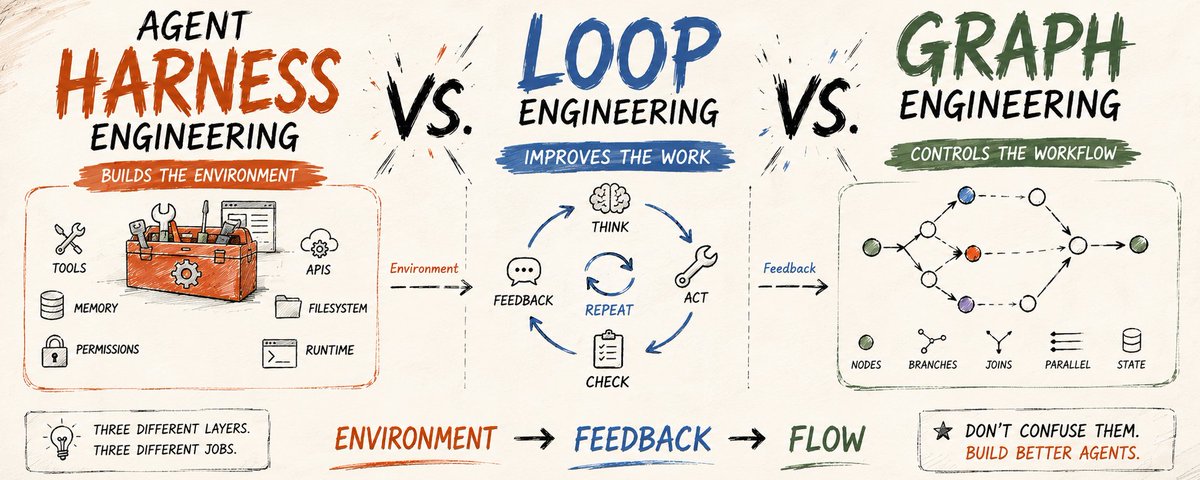
Harness, loop, and graph: the three agent layers everyone mixes up 🧵
When an agent breaks, don't jump straight to rewriting the prompt. First, figure out which layer is at fault:
Harness (environment). Does the agent lack the data it needs, lose progress between sessions, or have overly broad permissions? Fix the tools, permissions, memory, and checkpoints. The model isn't the problem here.
Loop (feedback). Is the first attempt almost right but unreliable? Add an external check: tests, schema validation, a reviewer. A loop runs on evidence, not on "the agent says it's done." Always set a retry limit and an escalation path to a human. "Keep trying until it works" is a budget leak.
Graph (flow). Several specialists, branching, parallel steps, approvals? Then you need explicit nodes and transitions. But don't draw the graph upfront.
The main rule: start with a simple harness and traces from real runs, then formalize what repeats. A 40-node graph for a task you don't yet understand makes the system brittle, not reliable.
Two more traps: don't let one model both write and grade its own work (shared blind spots), and don't stuff the harness with tools "just in case." The more tools, the more selection errors.
The nesting looks like this: the graph runs inside the harness, and loops live inside the graph.
🤖 Made with AI


"On Robinhood, the biggest moves don't happen by chance. They're made by those who see the next move before the crowd." ♟️🟢
The crowd reacts to the candle that already printed. The ones ahead of it did their homework earlier:
🟢 They read the setup, not the hype
🟢 They know their entry, their exit, and their risk before they click buy
🟢 They stay calm when the board gets loud
🟢 They treat every trade like a chess move: one step now, three steps in mind
Winning isn't about moving fast. It's about moving with a plan.
Which move are you making today? 👇
🤖 Made with AI


