

Digital Liberty advocates for free-market Internet, tech, telecom, & media policy, & a justice system that works for all Americans not a select few.
Joined February 2010
- Tweets26.6K
- Following1.4K
- Followers2.9K
- Likes9.1K


What are the policy implications of the public's attitude toward Data Centers?
Permitting reform and the Ratepayer Protection Act may be the key to winning over the public.
digitalliberty.net/data-cent…


Digital Liberty retweeted

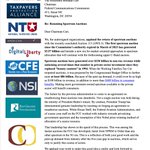
🧵Hearing concerning rumors that a draft USF reform bill in Congress would impose new taxes on broadband and mobile lines.
Hard to imagine the idea of raising consumer Internet prices getting meaningful bipartisan support with such strong opposition from conservative groups.

ATR and Digital Liberty Urge Congress to Oppose New Broadband Taxes atr.org/atr-and-digital-libe…

Digital Liberty retweeted

Listen to this short one from @Mike_Palicz and myself:
podcasts.apple.com/us/podcas…

Direct to device (D2D) technology means a new player will enter spectrum auctions – and potentially higher revenues for the foreseeable future.
digitalliberty.net/satellite…


Jensen Huang is right, though. AI will do many unpredictable things, but it will not exterminate the human race.
At least, the burden of proof should be on the doomers to explain to the rest of us how, exactly this is supposed to happen.
thefp.com/p/jensen-huang-may…

Someone didn't get what he wanted!

New York Post reports the FTC is investigating AI giants OpenAI, Anthropic and others and is "drafting civil investigative demands to force testimony from the leading firms’ executives"
FTC Chair Andrew Ferguson was at the meeting between Trump and AI execs at the White House yesterday nypost.com/2026/09/30/us-new…

Digital Liberty retweeted

JUST IN: Nvidia CEO Jensen Huang declares data centers are now called “superintelligence factories.”
Digital Liberty submitted comments opposing the FTC's personalized pricing proposal.
All prices were personalized for most of history. Eliminating the practice now with eliminate targeted discounts for price-sensitive consumers.
digitalliberty.net/digital-l…
This is a bit incoherent from the Trump Admin, no?
One might even say it completely undermines yesterday's summit.
The FTC needs to be reined in.


This morning at the @FCC open meeting, the Commission voted 2-1 to ensure the space economy is not subject to NEPA reviews.
The average environmental review process takes 4.5 years to complete. Technology moves much faster than this, and infrastructure needs to keep up.

September 2026 Open Commission Meeting xitter.cf/i/broadcasts/1aJbdEvoB…

Digital Liberty retweeted

Massive support for the FCC’s NEPA reforms! Nearly 50 organizations shared their support early & even more is pouring in. These reforms huge for builds in the U.S. & future space innovation!
🇺🇸👷🛜🚀


Great Job, Rob.
atr.org/democrat-ags-settle-…

Digital Liberty retweeted
The AI Doomers are the same people that proclaimed the end of the Internet during ‘net neutrality’ debates.


It’s almost like labs will produce what the market demands — and market demand is driven by what consumers want, not what some weird cult in Silicon Valley thinks is necessary to perfect men’s souls.

Last month I wrote about how we can build a positive and safe future for everyone: meta.com/thefutureisforevery…
Every lab has the responsibility and incentive to move at the pace required to train its models safely, and the ability to take its own actions to ensure that happens.
The reality is:
- People won't want to use agents that are misaligned with them and that don't do what they ask, so labs have a strong natural incentive to make their models more aligned.
There is a lot of debate about slowing progress on capabilities until alignment catches up. My view is that trust and alignment are quickly becoming the most important capabilities that will differentiate agents and models. Any lab that doesn't focus on alignment will fall behind.
- Labs face significant liability if their models cause harm, so they have a strong incentive to prevent this as well.
Meta delayed shipping Muse for several months to focus on safety and security. We didn't call for everyone else to do this before we would. We just did it as part of our day-to-day work because it was clearly the right thing for people and for us. I'm proud of the security foundations we've built.
- Engaging independent evaluators and advisors is industry best practice. MSL already does this today in several areas because it helps produce better work. Other labs can just do this too. In general, it would be helpful for there to be a larger and more diverse ecosystem of evaluators.
- Committing the significant majority of compute towards serving people rather than racing towards recursive self-improvement is one of the best ways to ensure we develop this technology safely. Meta has made this commitment and other labs can do this as well.
I believe the key to building a positive future for everyone is maintaining the right balance of power. This is within our power to do.

