

Intelligence on Iran's digital operations. Cyber, influence, sanctions evasion, network infrastructure. Washington, D.C.
Washington, D.C.
Joined April 2019
- Tweets123
- Following0
- Followers76
- Likes2



Users were counting other costs. Dataak logged 116 days of restrictions or outages in 15 months, and only 59% of Instagram shops have returned. Starlink was the most referenced actor in our 7,360 posts this month.
digimpactlab.substack.com/p/…
Iran’s shutdowns work because traffic runs through a few gateways the state controls. A Starlink terminal uses none of them. A grid cut would also stop banks, hospitals and water pumps, so the warning reads as a message to would-be buyers.
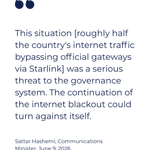
On September 30, Iran’s Deputy Minister of Communications, Mohammad Hafez Hakami, said if Starlink spreads, the state loses the ability to cut the internet in a crisis. It would have to cut the electricity instead.
Iran Digital Pulse, September 2026:
digimpactlab.substack.com/p/…

As one user put it: an Iranian doesn't fear war, an Iranian fears the internet being cut off.
Six months after the shutdown, that fear comes with a monthly bill.
digimpactlab.substack.com/p/…
Two tiers on one network. A VPN tax stacked on data already paid for. A communications minister facing public calls to resign over service that still doesn't work.
Add it up, and the outages start looking less like negligence and more like a pricing strategy.
Another user tied this month's price hikes to something much older: years of inflation and corruption Iranians already take for granted, now extended to their internet bills.
An Iranian user described what "having internet" costs now: pay for data, then pay again for a VPN, because international traffic burns three times the normal quota.
Iran's internet came back in May, but it came back different.
A government official says nobody can trace 12 trillion Tomans in VPN revenue, even though every purchase ran through bank cards on a state-run network. That's not a mystery. It's a choice.
digimpactlab.substack.com/p/…

Apple's review catches a filing that names a sanctioned bank, a subsidiary, a country. It has no way to catch one that names nothing, filed by someone whose only tie sits in a registry an ocean away.
digimpactlab.substack.com/p/…
The App Store filing traces to a personal developer account with no company name attached. Iran's Official Gazette names that account holder chairman of one of Bale's own operating entities, for a term covering the entire window the app was live.
The site linked in Bale's listing claimed the app is end to end encrypted. A technical audit from the Open Technology Fund's Security Lab found the opposite: Bale strips that encryption and shares the message key with its own server.
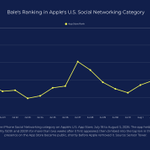
Sensor Tower's data shows what attention did to it. @balemessenger sat quietly around rank 150 to 200 in Social Networking for two weeks after it appeared, then climbed into the top ten the same days its presence went public. Apple pulled it days later.

The ownership chain is not a matter of inference. Bale is built and run by Sadad Informatics Corporation, a Bank Melli subsidiary. Under OFAC's fifty percent rule, that ownership alone makes Sadad blocked property.
Bank Melli Iran has been on the US Treasury's sanctions list since 2007. Its messenger spent eighteen days on Apple's App Store anyway.
Not because Apple missed the tie. Because the filing left nothing to find.
digimpactlab.substack.com/p/…

Iran has not reopened Instagram, Telegram, or WhatsApp. It built alternatives instead, a tacit admission messaging and commerce are one layer. The wall was a choice. What it now costs, on every side of it, is not.
open.substack.com/pub/digimp…
The panel that followed did not blame payments. Card to card transfers work. Processors function. The friction sits one layer up: sellers building storefronts behind a VPN, on platforms buyers can only reach the same way.
Instagram and WhatsApp have been blocked in Iran since September 2022. Telegram since 2018. Before the 2022 crackdown, fewer than 40% of Iranian internet users needed a circumvention tool online. Today that figure is 86%, and 93% among users under 30.
The gap is not an outside estimate. Pashootan Pourpezeshk, CEO of Padro, Iran's leading social commerce platform, told a Tehran fintech conference in July that platform blocking costs the market roughly 30 trillion Toman a year, about $160 million.
The regional picture, mapped: social commerce spending per person across seven markets in 2025. Saudi Arabia and the UAE run more than sixty times Iran's figure. Qatar clears $1,100 per person.

Iran's social commerce market generates $6.98 per person a year. Egypt, poorer by every conventional economic measure, generates $31.95, nearly six times as much. Income is not the reason.
open.substack.com/pub/digimp…
