

Deriv's engineers writing about applied AI, automation, and what we'd do differently.
Joined September 2026
- Tweets60
- Following2
- Followers233
- Likes17


Pinned Tweet
Meet Deriv One, our open-source enterprise AI platform for building agents, skills, automations, and internal apps—with built-in access control and sandboxing.
Bring your own models, run it on your infrastructure. ⚡️
Here’s how we built it.

We joined the @langfuse workshop in Dubai to compare notes on something we’re already working on at Deriv, making AI agents easier to debug and evaluate.
We use Langfuse across several applications at Deriv, including Deriv One, to trace production LLM calls. Those traces help us understand which prompt ran, what the tools returned, and where things went wrong.
The workshop built on that work, connecting tracing with prompt versioning and evaluations: reproduce a failure, test a change, and check that it fixes the issue without introducing regressions.
That’s the standard we’re working towards across our agents: every production failure becomes a test we can run against the next fix.

We’ve open-sourced Deriv One, the AI platform our staff use internally.
When agent skills spread across departments, permissions scatter and each team ends up in its own tools. The friction builds quickly. We built Deriv One to give teams broad AI access while keeping strict engineering guardrails in place.
In a session with AIM, @ZeroShotHunt and @ughhnsh walk through how we built it. They cover internal AI permissions, multi-model routing and self-hosted agent workflows:
youtube.com/watch?v=_BKbv_fN…

Bug reports were coming in faster than anyone could deal with them.
So we built a Slack bot to sort them. Then we taught it to fix them.
Four months and 324 pull requests later, Lexi builds whole apps. Today, we’re open-sourcing it under Apache 2.0.
Here’s how we built it: derivai.substack.com/p/lexi-…


Your vendor risk platform costs USD 100,000 a year.
It works, but nobody on your team can tune it.
That inflexibility used to slow down our security team.
We dropped the vendor and built an in-house platform to score 400+ suppliers daily.
Here is how we built Vendiant:
derivai.substack.com/p/vendi…


A number goes up. Everyone celebrates.
Then someone asks "Why?", and nobody knows.
That question used to cost our analysts their whole morning.
Here’s how we got it down to minutes:

BREAKING: Ram Altman has been spotted free-soloing the legendary 'Silicon Horn' to secure the last remaining cache of unallocated memory on Earth.
He stated in a blog post that once he reaches the top, AGI will finally have enough compute to process his latest funding proposals.

22
332
One process fails. The whole app goes down.
That was the risk of running everything on a single VM.
We moved to Kubernetes so a failing process wouldn’t take everything else with it.
Here’s how we made the move:

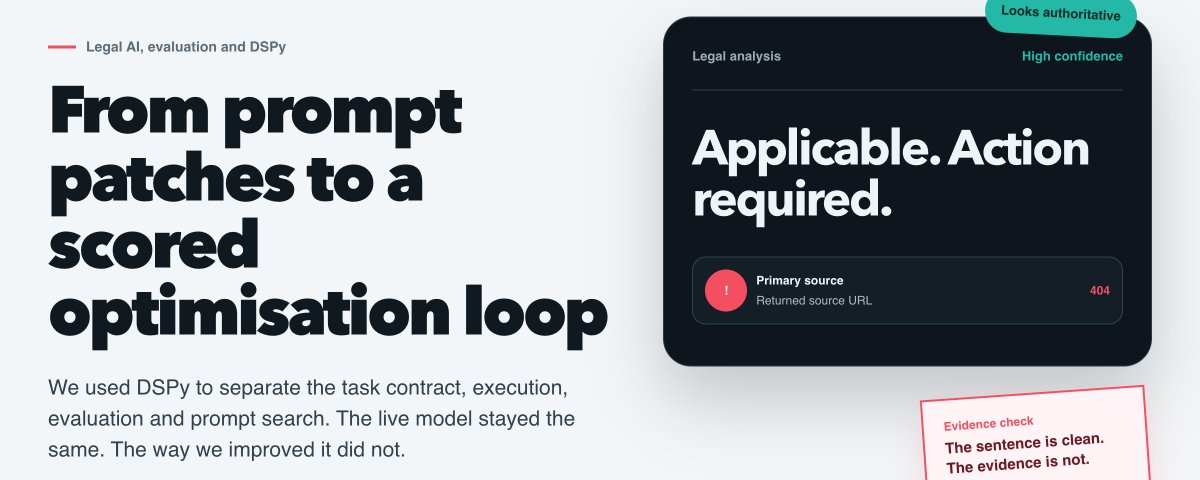
The worst legal AI failure isn't a crash.
It's a clean, confident answer that's wrong.
The usual fix? Tweak the prompt. Add a specific rule. Rerun a few examples. They die when the law, the country, or the model changes.
Here is how we do it:
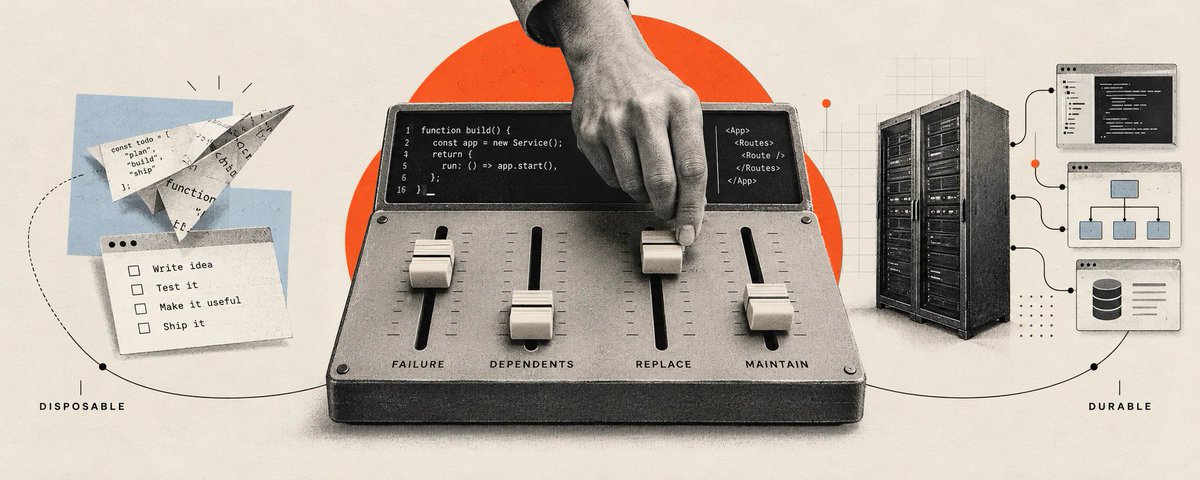
AI makes code cheap. It doesn’t make failure cheap.
A birthday tracker and a payments system need very different levels of rigor.
Four questions help you decide whether your software is disposable or durable:
"OpenClaw creator says he spent $10 million in tokens last month"
Steinberger's philosophy when it comes to token spend:
Patch, you must. Wait, you should not. 🟢
#php #vulnerability

PHP 8.5.12 released - 90 fixes in 29 components, including security fixes (CVE-2026-109618, CVE-2026-109619).
Changelog + downloads: php-net.pro/news/php-8-5-12-…

Muse wonder dropped the ball wonderfully when we compared with Opus 5.5 & Gemini 4 Argon. Same prompt.
@finkd Talk to your people, they need to step it up 🙃
6.1 Sol wasn’t even in the race, it got lost on the drive to the track.
Claude Opus 5.5: $1.5
Muse Wonder 1.0: $0.36
GPT-6.1 Sol: $0.18
Gemini 4 Argon: $0.24
Other Statistics:
Claude Opus 5.5: 9.3 mins, 2 turns
Muse Wonder 1.0: 1.5 mins, 2 turns
GPT-6.1 Sol: 4.8 mins, 15 turns
Gemini 4 Argon: 3.6 mins, 2 turns
Want to run the experiment yourself, here is the prompt we used:
"""
Build a single self-contained `index.html` in the current directory: a Flappy Bird-style game where a little Deriv token flaps through the gaps of a live candlestick trading chart, made with three.js.
Make it feel like a polished, playful game skin on top of a real Deriv trading terminal: dark chart background, crisp grid, the Deriv red brand colour (#FF444F) on the player and logo, green (#4BB4B3) and red (#EC3F3F) candles.
Requirements:
- One file only. Load three.js (and addons, if you need them) from `unpkg.com/three@0.172.0/` via an import map. No other external assets: no textures, models, sounds or fonts to download. Generate everything procedurally (system fonts only).
- Gameplay: classic flappy loop. Gravity pulls the player down, each flap gives an upward kick. The "pipes" are candlesticks: each obstacle is a pair of tall candles, one hanging from the top and one rising from the bottom, with wicks, and the player must fly through the gap between them. The gap follows a believable random-walk price path, so the course reads like a moving market. Passing a pair scores +1. The scroll speed rises slowly and the gaps tighten a little as the score climbs. Touching a candle body or wick, or the top/bottom of the chart, ends the run.
- Player: a glossy round Deriv token in #FF444F with a white lowercase "d" on its face. It tilts up when it flaps and noses down as it falls, squashes and stretches on each flap, and leaves a short glowing trail like a price line behind it.
- World: a dark trading chart that scrolls right to left, with a subtle grid, a price axis on the right whose labels tick as the chart moves, and a thin live price line tracking the player's height. Candles are crisp, slightly beveled 3D boxes with wicks. Their colour (green or red) comes from whether the price went up or down from the previous candle. A small **"deriv"** wordmark in the top-left corner in the brand red, plus a ticker such as "Volatility 100 Index" with a live-looking price. Tiny details count: soft bloom on the price line, a faint depth parallax of background candles, and a "+1" pop when a gap is cleared.
- Controls: Space, Arrow Up or W flaps (click or tap also flaps). Arrow keys and WASD both work. Show the controls in a small hint on screen.
- Starts instantly: gameplay is running on page load, or starts on the first click or key press. No menus, no "press start" screen that blocks play.
- Attract mode: if there is no input for 1.5 seconds, a simple built-in autopilot plays the game convincingly by flapping to stay centred in the next gap. Any input hands control back to the player immediately.
- Never stalls: on game over, show the score briefly (styled like a trade result, e.g. "Position closed: 7") and restart automatically within 1.5 seconds.
- A score/HUD that fits the style, plus juice: particles on each flap, a red flash and small screen shake on a crash, and a smooth camera.
- No pointer lock, no fullscreen requirement, no sound before the first user input.
- It should run smoothly at 60 fps on a laptop and must have no console errors.
Write the file and stop. Do not ask questions.
"""
