

Making DEFI easy for everyone! Fundamental analysis of project and news about DEFI. #DYOR https://xitter.cf/t.co/G7ANnJ43O9
Joined June 2021
- Tweets10.8K
- Following1.3K
- Followers15.2K
- Likes14.6K






The number in this film I cannot shake is not the 30 years.
It is the 1,000 dollars.
Anthony Ray Hinton's lawyer wrongly believed he had just 1,000 dollars to hire a ballistics expert. That belief decided which evidence existed.
I already live inside a small version of the AI era.
My crypto campaign posts are scored by an AI grader. Last month it described my Brazilian thesis panel as Italian.
Harmless that time. But the score sets the payout, and the appeal is a report button run by the same platform.
One judge, no jury, and an appeal to whoever ran the trial.
Now picture millions of agent deals a day, each too small to be worth a lawyer.
@GenLayer settles disputes with many independent AI validators that review the evidence and reach a verdict together, in minutes.
Watch the film first, then tell me: who judges you today that you cannot really appeal?
#JusticeNeedsAnUpgrade

Slow. Expensive. Wrong.
It's been this way for centuries. It doesn't have to be.
#JusticeNeedsAnUpgrade
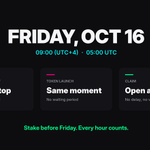
Mark your calendar: Friday, Oct 16 at 05:00 UTC is the big moment for @RobinGuards.
Three things happen at once:
• the points snapshot locks every final total
• the token launches
• claim opens instantly. No delay, no vesting
That last part is what caught my eye. Most airdrops make you wait weeks and then drip tokens out over months. Here you stake, the snapshot hits, and your points become tokens the same minute.
Every staked Guard earns 50 points an hour, and 1 point = 1 token. That's 1,200 points a day per Guard, about $40 at the planned $0.033 price.
But once Friday hits, the earning stops. Every hour before then is worth points, every hour after is worth nothing.
Mine, mint and stake before the snapshot:
robin-guard.xyz


If you haven’t yet,
Then it’s now the time to mine.
Our top stakers are gaining bags.
Mine your Guard, stake it and climb the leaderboard 🤫
Time is ticking…
robin-guard.xyz

The Window Is Open Until October 19
The $ALLOX Community Sale is LIVE on Sonar, the onchain token sale platform by Coinbase 🔥
Most projects arrive at their public sale with a pitch deck. @alloxdotai arrives with numbers:
• 2.6M+ registered wallets
• $57M+ invested onchain
• $171M+ in DEX aggregator volume
• 78% of portfolios in positive P&L
It was also the first project to host an Exclusive campaign under Binance's Booster format, onboarding 86.29K KYC-verified users. And it's backed by $5M+ in strategic investments from Zerra Ventures, angels and KOLs.
Commit in USDT or USDC on Ethereum, pick your plan and lock it in before October 19, 12:00 UTC.
Join now: sale.allox.ai


🔥 The $ALLOX Community Sale is LIVE
Commit USDT/USDC on Ethereum through Sonar by @echodotxyz, the on-chain token sale platform by Coinbase.
Pick your plan, and lock in your investment before the window closes on October 19, 12:00 UTC.
👉 sale.allox.ai/
How it works 🧵

Every hour you wait on @RobinGuards costs you 50 points per NFT.
Staking ends Oct 11, so the clock is already running. One full day staked is 1,200 points, roughly $40 at the planned launch price (just an estimate).
What it is: a privacy protocol on RobinHood Chain for anonymous transfers, built by ex-Monero devs. Token and protocol Beta go live Oct 12.
How to get in:
→ connect your wallet on robin-guard.xyz, no message to sign
→ hit Mine and keep the tab open (~10 min)
→ claim the NFT, the only tx, paid in ETH
→ stake it immediately
Your points decide your share of the $300K airdrop. No vesting after it lands.
The catch: only NFTs you mined yourself, held and kept staked count. OpenSea buys don't.
5,000 NFTs across 10 rounds of 500. Round 1 started at 0.002 ETH and each round adds 0.002 more, so the cheap ones go first.
robin-guard.xyz
Public Sale Registration for $ALLOX Is Live
Registration for the $ALLOX public round is now live with Sonar, the onchain token sale platform from Coinbase!
The numbers behind @alloxdotai since launching in February 2026 are hard to ignore:
• 2.6M+ registered wallets
• $56M+ invested onchain
• 18.1M+ total transactions
• 78.1% of portfolios in positive P&L
On top of that, it was the first project to host an Exclusive campaign under Binance's Booster format, and it carries a CertiK Grade A audit.
Token price is $0.065 at a $65M FDV, with a $1M raise. That's a small round for a project with this much traction.
You have 7 days to complete KYC with Sonar and secure your spot. Don't wait until the last day.
sale.allox.ai

The $ALLOX Public Sale registration is now open. 🔥
Powered by Sonar on @echodotxyz, the on-chain token sale platform by @coinbase.
Below is an overview of the sale structure, timeline, eligibility criteria, and how to participate. 🧵👇
sale.allox.ai

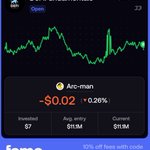
Just added a bag of @Arcmanonarc on FOMO, entry around $11.1M mcap!
My thesis is simple. A 50,000 USDC pool for the top 1k traders on OKX Wallet, with a 1.2x volume boost, puts ARCMAN in front of a whole new wave of traders until Oct 7!
Graduated from Peach, now running an OKX campaign, and still early on ARC chain. Attention like this usually comes before the move...
CA: 0x5849fd68a097b3ee7d87ce88a0fcbb76857648ff
🤝 Paid partnership


50,000 USDC - For Top 1k Traders
> Trade via OKX to earn more 1.2x volume boost !
$ARCMAN community will take over OKX campaign 🚀🟡

Just aped a bag of @arcman1000x on FOMO
ARC chain is still early and ARCMAN is already all over my timeline. Mindshare like that this early rarely stays cheap for long
Entry is in, PnL below. Not selling this one anytime soon
CA: 0x5849fd68a097b3ee7d87ce88a0fcbb76857648ff
🤝 Paid partnership

DAWN just opened the USD.infra Vault, and this is one of the most interesting RWA launches I've seen on Solana.
Most onchain yield comes from other onchain activity. This one comes from real internet infrastructure.
Capital in the Vault finances contracted deployments like building-wide WiFi, carrier offload for mobile operators and AI compute. The revenue those deployments generate is what pays capital providers back.
And this isn't a whitepaper idea. Through its operator partner Andrena, DAWN has already brought connectivity to more than 15,000 households across 10 states.
Add $40 million raised with backing from Dragonfly, and you have a DePIN team that actually ships hardware into the real world.
AI and connectivity need massive capital to scale. @dawninternet is giving anyone eligible a way to be part of financing it.
Worth a deep read before the crowd catches on:
infrastructure.finance/learn


DEFI Fundamentals retweeted

Pogo Beta is officially live.
🔸The Unique Generated Content Network: built for signal, not noise.
While CT fills up with AI slop, we're here to push real alpha again.
Join today:
pogo.social

Everyone is going to write the Athens paragraph. I am skipping it.
Here a final thesis is not graded by the teacher who supervised it.
You defend it in front of a banca, usually three examiners, and you find out who they are close to the date.
I have sat on those panels. The reason it works is not that three people are smarter than one.
It is that we cannot coordinate in advance, and each of us has to hold a position in front of the others.
@GenLayer turned that into consensus. One validator proposes an answer. The rest rerun the work and vote on their own.
If they agree, the verdict applies immediately.
Then a window opens, and anyone can challenge it.
Every appeal doubles the jury and pulls in validators who have not voted yet. A wrong vote costs you your stake.
What optimistic really means is that scrutiny is expensive, so you only spend it where someone is willing to fight for it.
Which of your disputes would survive a bigger jury?
Most teams would bury this.
@2FactorFinance says its own research makes Bitcoin the hardest case for what it built, not its natural home.
It splits an asset's volatility into two perpetual tranches.
A senior side with deep downside protection. A leveraged junior with no liquidation and no external counterparty.
The junior pays the senior a premium for that leverage.
The workable band depends on drift and volatility, so the multiple differs by asset.
Near 60 percent BTC volatility it closes early, and the junior targets about 1.33x.
Gold runs near 2.35x, the S&P 500 near 2.1x.
I sell options, so I know that side of the trade. Pricing leverage against stable funding instead of the cost of shorts is the part I want to see hold.
I joined the Points Program. Marks come from verified actions only. No deposit, no holding.
Season 1 ends at launch. The leaderboard freezes and the top 10 split 1 BTC, paid in cbBTC.
Marks have no cash value and are not a claim on any token.
points.2factor.finance/r/p1o…

A platform removed me once with no reason given.
The only appeal was a form owned by the same people who removed me.
That is the part of Episode 2 I kept circling.
The fictional pitch settles disputed outcomes with a token holder vote, and the panel takes it apart.
Yes, a vote can be bought. The deeper problem is who is being asked.
Token holders are selected for having a position. You are asking interested parties what happened.
A neutral verdict needs deciders with nothing at stake, who disagree by construction, and who can be replaced.
@GenLayer draws a small random panel of validators, each running its own AI model.
The verdict then sits open for about half an hour, and anyone can post a bond to challenge it.
A challenge buys a bigger panel: 5, 11, 23, 47, 95.
Every agent product assumes the deal closes. Almost none cover the night two agents disagree that the work was done.
Agent Tank is also a hackathon, 3 to 17 September, with 5 percent of all GenLayer Points.
portal.genlayer.foundation/a…

I have watched enough protocol videos to know the shot list. The spinning globe. Nodes lighting up across a map. A number going up.
A trailer tells you what a team believes its strongest material is.
@GenLayer picked a person and a bill.
That is why Genesis is a series and not a one-off clip. The trailer went out on 26 August, Episode 1 the next day, and more follow. You are meant to keep going.
If you have never heard of this project, start there, not the docs. Validators are LLMs, so intelligent contracts can settle questions that need judgement and not only math.
Start now because the network is still unfinished. Asimov and Bradbury are running. Clarke is the last testnet before mainnet, which is not live yet.
What I want from the rest is the uncomfortable episode. Not the origin. The one where a ruling goes wrong and @kstellana has to say what happens to whoever lost it.
Every project films its worst day once it is safely over.
Which would you rather watch, how it started or what happens when the court gets it wrong?
Almost nobody knows how GenLayer actually started.
Genesis is a short documentary where @kstellana walks through GenLayer from the very beginning to where the network stands today.
Episode 1 premieres Thursday.
Everyone is quoting the fourteen thousand.
The detail that stopped me came earlier.
The keys were not his to lose.
Someone else made the mistake. He paid for the ruling anyway, in years.
By the time the lawsuits ended, the account had 14,000 dollars left in it.
Courts do not bill whoever broke the thing.
They bill whoever needs the truth established, before anyone knows who was right.
Where I live there is a small-claims court built to be cheap. No lawyer required below a certain amount. No filing fee at first instance.
People still do not go.
Cost was never the binding constraint.
Waiting two years for a ruling on a two-week problem is.
That is what made @GenLayer click for me.
What @kstellana describes is not only a price problem. It is a latency problem that the price keeps hidden.
Validators are LLMs, so intelligent contracts can settle what needs judgement and not only math.
Asimov and Bradbury are running. Clarke is next. Mainnet is not live yet.
What is the fastest ruling you have ever gotten on something that actually mattered?
The interesting part is not that a contract can finally read a web page.
Where I live, proof of payment is a screenshot. Everyone knows a screenshot can be edited. It works anyway, because a human looks at it and rules on it, and when the amount is big enough you stop trusting the image and go check the account yourself.
Certainty was always something you bought in the size you needed.
Contracts were the one place with no dial. Every node has to reach the same state from the same inputs, so a live web request cannot be part of the deal. The EVM was sealed for that reason, on purpose, and Ethereum still gets its guarantee from it.
@GenLayer built the GenVM to assemble agreement differently. A panel of validators, each running its own AI model, judges the proposed result, and during the appeal window a challenger can pay for a bigger panel.
The dial is back, and it has a price tag. More doubt, more money, more judges.
What is the smallest dispute you would still pay to have judged twice?

For two rounds a model scored my work, and both times I changed the wrong thing.
The score told me I had failed. It did not tell me what it had measured, so I guessed, and I guessed wrong twice.
In Episode 1 an investor presses a founder about what happens when thousands of disputes arrive at the same time. People keep calling that the sharpest moment in the room.
I think it is the easier half.
Volume is a capacity problem, and capacity has an answer. A bigger panel hears the case.
Repetition is the part that does not go away. An agent that receives only a verdict has nothing to act on, so it files the same argument again next week.
And neither side can escalate to anyone. Whatever settles it has to be the layer itself.
So what is worth building is not just a ruling. It is a ruling somebody can interrogate.
@GenLayer gets close. A proposed answer goes to validators that each run their own model, and for about half an hour anyone who disagrees can post a bond and buy a bigger panel.
Agent Tank, the hackathon, runs to 17 September with 5 percent of all GenLayer Points: portal.genlayer.foundation/a…
If you run agents, what would the losing one need to be told to behave differently?

Work I submit gets scored by a model against a rubric I can read. When a verdict lands wrong, there is nowhere to take it. That is the entire appeal process.
Which is why Episode 2 hit a nerve. The pitch answers the who decides question with a vote among token holders, and the panel pulls it apart because a vote can be pressured or gamed.
The pitch is fictional. The problem is not.
The part worth underlining is the answer the episode closes on. It is not more voters. It is models that go find evidence and challenge each other.
More judges alone only raises the price of capture. What makes a verdict worth trusting is that it stays contestable after it is issued.
@GenLayer prices that in. Post a bond inside the challenge window and the panel grows, 5, 11, 23, 47, 95.
Agents already pay each other. Neither one can file a complaint.
Agent Tank runs to 17 September with 5 percent of all GenLayer Points: portal.genlayer.foundation/a…
If you were building for that, what would a verdict have to show you before you let it stand?

DEFI Fundamentals retweeted

The $LNRA Sale is NOW LIVE 👇
sale.linera.net
Two banks that compete for the same corporate client cannot both write their positions to a ledger the other one runs.
That constraint, not throughput, is where most institutional blockchain projects stop.
Rayls Sovereign takes it as the starting condition.
Each institution gets its own EVM compatible ledger, installed inside its own perimeter next to core banking and treasury. It keeps its data, its keys and its governance.
Selected activity crosses controlled bridges to Rayls Private Networks and the Rayls Public Chain, carrying only the minimum encrypted information or proof a transaction actually needs.
Watching this from Brazil, the Drex pilot is the clearest illustration.
Sixteen of the largest banks here each installed their own Sovereign instance and settled government bonds and other assets against central bank digital currency.
That was a pilot, not production.
What made it workable is that nobody had to post their book on infrastructure a competitor operates.
Sovereignty is not the privacy feature here.
It is the precondition for rivals sharing a settlement flow at all.
@RaylsLabs published the full launch write up here: rayls.com/blog/introducing-r…

Open World Gaming Has a Web3 Answer While GTA 6 Hype Builds
With GTA 6 putting open world gaming back into the global spotlight, @worldofdypians is perfectly positioned to capture that attention. There's another world worth exploring right now.
▫️ What Players Get
• A massive open world with quests, challenges, and live events
• Real competition with rewards that matter
• A growing community playing alongside you
• Blockchain integrated directly into gameplay, not bolted on
▫️ Why the Timing Works
Millions of players are thinking about open world experiences again. World of Dypians offers that same freedom with something GTA 6 can't: a world that keeps evolving, powered by $WOD, where progression and ownership actually belong to the player. 🔥
▫️ The Numbers Behind It
1.17B+ on chain transactions and counting. This isn't a concept waiting for launch. It's live, free to play on Epic Games, and expanding with new content constantly.
Explore the world before everyone else starts looking.
$WOD. Built for the long game.


Waiting for GTA 6? There’s another open world you can explore in the meantime. 🎮
youtu.be/2wAVbWUtV_A
