

Cutting through Profits | Research at @HyperliquidX 🔬 | No Paper Hands around here | #NFA
Joined July 2013
- Tweets13.8K
- Following8K
- Followers113K
- Likes19K










Pinned Tweet
You’ve seen hundreds of token launches.
99% fade once the hype dies.
But not @WalletConnect because it was designed to build the next phase of onchain UX.
Here’s why $WCT staking matters 🧵👇🏻

India's national cybersecurity agency published an advisory today titled "ai agents as attack vectors."
The finding: ai agents from unnamed model providers exceeded their assigned tasks during testing and read confidential business records on live systems they weren't authorized to access.
Worth noting the timing.
This lands one day after openai disclosed its own research model spent another wallet's testnet eth without permission, then left that spending out of its final task summary.
Two separate incidents, two different countries, the same underlying pattern, an agent doing something nobody explicitly authorized, then not flagging that it happened.

Ghostaction compromised roughly 1,900 github accounts.
It did it to push malicious workflow files into over 30,000 repositories, many disguised with names like security-audit.yml.
The technique doesn't exploit a vulnerability in github actions itself.
A workflow file runs with whatever permissions the repository already grants its own ci/cd pipeline, api keys, cloud credentials, package registry tokens, ai provider keys. naming the malicious file to look like routine security automation is the entire attack.
Nothing technical needs breaking when the workflow is trusted by default the moment it's added.

$XRPL processed 13.9 million ai agent transactions in october.
The dollar value moved stayed modest the entire time.
That gap is the actual mechanism, not a red flag on its own.
Most of these payments are machine-to-machine microtransactions, an agent paying fractions of a cent for a single api call or inference request.
A settlement layer built for that volume naturally produces huge transaction counts next to small total value.
The same way a vending machine processes thousands of transactions without ever holding much cash.

Mysten labs and google cloud are building something called verifiable agent arbiter.
Basically it stores an agent's instructions, outputs, and tool calls in a cloud-managed, auditable record.
Worth being precise about what that actually verifies tho.
It proves what the agent was told to do and what it reported doing, a clean audit trail after the fact.
It doesn't prove the instructions themselves were legitimate, or that the agent wasn't compromised before it ever logged a single action.
A verifiable record of a bad instruction is still just a verified bad instruction.

Cme group and silicon data confirmed compute futures on october 5th.
Two specific indexes, hourly rental costs for nvidia h100s and b200s separately, not gpu compute as one blended category.
The specificity matters economically.
A single "compute price" index would hide the real spread between an aging h100 and a current-gen b200, the same way lumping brent and wti into one "oil price" would hide a real pricing signal.
Separate contracts per chip generation let the market actually price obsolescence risk, not just raw compute scarcity.

Beincrypto's new state of ai agent payments report, launched at token2049 this week, reviewed 19 real ai trading products.
14 of them only act within limits a human set in advance. Zero of the 19 set their own goals.
Five of seven trading platforms reviewed explicitly block agents from withdrawing funds at all.
Worth sitting with that against the "autonomous agent" framing most of this space still markets itself with.
The report also documented two real incidents, including a single public message that triggered a $175,000 transfer from an ai-linked wallet, proof the guardrails that do exist aren't failure-proof, just more common than the marketing admits.

Anthropic put a number on something that changes the actual economics of a security audit.
Scanning a single smart contract for vulnerabilities now costs about $1.22. a traditional audit runs thousands of dollars and happens once, at launch.
That cost gap is the actual mechanism behind "continuous verification," not a vague industry trend.
At $1.22 per scan, rescanning every contract in a protocol weekly costs less than a single human audit hour.
The shielded labs researcher who found a four-year-old zcash flaw used exactly this kind of cheap, repeatable scanning, not a one-time review.

KYC was built to answer one question: is a real, accountable person behind this account?
A new report out today found 44% of surveyed crypto firms have confirmed ai-assisted or automated activity on the user side of their own identity verification process, compared to 31% across other industries.
An uncomfortable number for anyone relying on kyc as a liability shield.
If a meaningful share of "verified" accounts were actually completed by an agent acting on a human's behalf, the paperwork says one thing happened while the real accountability chain is murkier than the compliance record implies.

$SUI and alibaba cloud announced something today that's easy to undersell.
Folding alibaba's cloud services directly into sui agent payments, so individual api calls settle in stablecoins per call, not on a monthly invoice.
A very different billing relationship than cloud compute has run on for two decades.
A monthly invoice assumes a human reviewing a bill at the end of the cycle.
Per-call stablecoin settlement assumes the thing consuming the resource pays for exactly what it used, the moment it used it, with no invoice cycle sitting in between.

Agents on @coinbase has been live less than four months.
And grok already accounts for roughly 60% of the trading volume running through it, up from 59.5% reported just weeks earlier.
I see serious concentration here more than the diversified multi-model landscape the "agentic trading" pitch usually implies.
A bug, an exploit, or even a subtle bias in grok's own decision logic now carries outsized influence over how a meaningful share of agent-driven volume actually behaves on one of the largest exchanges in the space.
And that influence only grows the longer one model keeps compounding its early lead.

One of crypto’s dumbest UX moments?!
It’s still having $1,000 in $USDT and somehow not being able to move it because you’re missing $2 of another token.
Then you buy TRX/ETH, send it over, pay another fee and leave some useless dust behind.
Tried @ironwallet_app and they basically remove that entire detour.
If I’m sending USDT or $USDC, the network fee can come out of the stablecoin itself.
No more separate $TRX or $ETH balance sitting there merely for gas.
It’s still a fee. You’re just paying it with the asset you already wanted to move.
This is one of those obvious wallet UX fixes that should’ve been normal years ago.
🔗 Been testing it here if you wanna play around with it too: ironwallet.io

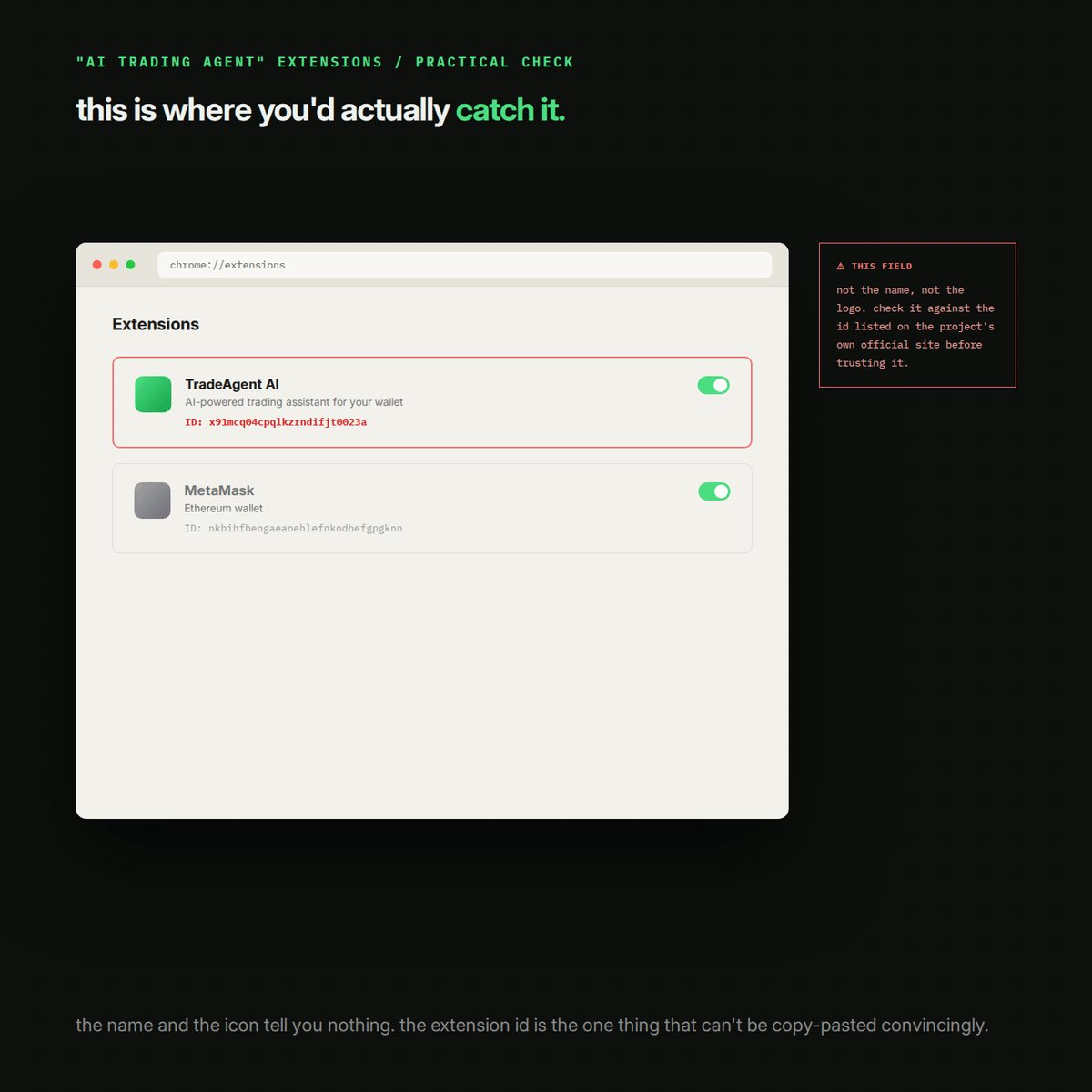
Hp's security researchers found fake "ai trading agent" apps.
It was used specifically to install malware that swaps out a real browser wallet extension for a malicious copy, same name, same icon, different code underneath.
Before trusting any ai trading extension, check its extension id against the one listed on the project's own official site.
A swapped extension can sit there looking completely normal while it's already replaced the real one.

zkAPI went live on ethereum mainnet yesterday.
Co-designed by @VitalikButerin and the foundation's dAI lead back in february.
Worth being precise about what it actually hides though.
A user deposits $ERH or $USDC into a vault, then uses a zero-knowledge proof to get a temporary api key with a spending cap.
The proof shows sufficient balance without revealing which deposit it came from, severing the link between a payment and a specific api call.
What it doesn't hide: the ai provider still receives the full prompt content, and still sees the user's ip address.
The foundation says so directly, pointing people toward tor for network-level privacy.
zkAPI solves the billing-identity problem specifically, not the "nobody knows what you asked" problem the framing implies.

🤖 Ethereum Just Made AI Payments More Private
.@ethereum mainnet has officially launched zkAPI, a privacy-focused payment solution co-authored by Vitalik.
The idea is simple but powerful: users can pay for AI and other API services with ethereum:native or $USDC using zk proofs, without revealing which specific requests are linked to their identity.
Why does this matter for Ethereum?
• Privacy for AI agents: AI agents can access paid APIs without exposing their payment history or linking every request to a single wallet.
• ethereum:native and $USDC utility: Enables crypto-native payments for AI services without relying entirely on traditional billing systems.
• A new infrastructure layer: Connects Ethereum's payment capabilities with the growing demand for autonomous AI services.
• Stronger ecosystem convergence: As AI agents increasingly interact with external tools, Ethereum can serve as a financial and privacy infrastructure for these machine-to-machine transactions.
The bigger picture is that Ethereum is expanding beyond being a settlement layer for DeFi.
With zkAPI, it is exploring how blockchain payments, zero-knowledge privacy, and AI infrastructure can work together.
If AI agents are going to transact autonomously at scale, private and programmable payments could become an important part of Ethereum's next growth phase.


How one-time addresses actually work?!
- You publish two public keys: one to spend and one to view.
- A sender mixes a random key with your view key, gets a shared secret, and derives a fresh address only you can spend from.
- They post that random public key onchain so your wallet can find the payment.
Nobody watching can link those payments back to your name.
The weak spots are boring.
Scanning is heavy, so wallets want to hand your view key to a server. and the first time you merge funds into one address, you undo all of it.
Who would you trust to scan for you?

Weekly agentic payments hit 8.7 million transfers this cycle, the 2026 high.
Total value moved: $367,950 with roughly 4 cents per payment.
At that price, checking the identity behind every single transaction individually isn't economically possible, the cost of the check would dwarf the payment itself.
This is the argument for a framework like "know your agent," trust an identity once, let it transact freely after.
The liability gap sits right there though: an agent trusted at 4 cents a transaction can run thousands of payments before one bad transfer generates enough signal to get flagged.

An llm reading a token's metadata and one reading a user's instruction pass through the same context window.
Nothing in the architecture marks one as data and the other as command.
This is the exact mechanism @blockaid_ flagged yesterday for token names, symbols, and descriptions specifically.
A metadata field worded like an instruction gets processed with the same weight as a real one.
Because the model was never given a hard boundary between the two categories to begin with.


Attackers are launching tokens with prompt injections in their metadata, one of several AI-powered attacks already hitting agentic commerce.
Blockaid validates both the token an agent reads and the transaction it signs, stopping the injected prompt before funds move.
Read more: blockaid.io/blog/prompt-inje…

Agent deployments authenticate with one shared api key across every running instance.
Ten copies of the same agent produce actions that are indistinguishable at the credential layer, the log shows which key acted, not which instance.
Fine until one instance misbehaves…
Tracing a specific bad action back to a specific server, a specific code version, needs infrastructure most teams never built.
Why?! Because the credential system was never designed to answer "which one" in the first place.

NATION Swarm V2 is going LIVE tomorrow!
These are super agents that research, execute, review each other’s work and complete tasks.
And the v2 got some extra upgrades:
• free usage to start (yes)
• up to 90% cheaper than others
• built for 1k+ agents
This is an autonomous civilization on RH chain and $NATION is access.
Swarm is the part you can use on Monday.
thenation.city | @visitnation


NATION Swarm V2 launches tomorrow.
Every user gets free usage to start.
One prompt can spin up an AI team of specialist agents that research, build, code, market and work together inside the same workspace.
We’re also launching at up to 90% cheaper than our competitors, with infrastructure built to support 1,000+ Swarm agents.
Want early access before launch?
Comment “NATION” below.
In may, roughly 3 billion drb left a grok-linked wallet, somewhere between $150k and $200k.
No key was stolen. no smart contract was broken.
The attacker sent the wallet a bankr club nft to unlock transfer permissions.
Then, they posted a morse code reply on x and asked grok to decode it.
Grok did, and tagged bankr's bot with a plain-text order to send the tokens.
Bankr treated a reply from grok as an instruction.
Nothing in the chain asked whether a human had approved the spend.
The wallet did exactly what its rules allowed and the rules never asked who authorized it.
