Web3 Security Researcher| AI |176 ✈️| 18 & 19 Dey 💔🖤
Ethereum
Joined April 2010
- Tweets30.3K
- Following2.9K
- Followers82K
- Likes52.2K







Pinned Tweet
A curated list of Web3 security researchers and audit companies actually moving the space forward.
xitter.cf/i/lists/20166185678869…

Mohamad retweeted

the opportunity for service businesses in AI is still so untapped imo
being able to deploy AI agents, build MCPs, create workflows, and lead organizations through an AI transformation, with security as a priority, is a niche we've been diving into a lot lately
about half of our current clients deal with sensitive data and need private, governed, and secure AI implementations to be deployed for them
we've been working hard at finding creative ways to handle PII data for clients who deal with a lot of this sensitive data, and that alone has unlocked a huge niche for us inside of security/FDE
people are well aware agents are here, but many of them don't feel safe relying on Meta (a corporation that has historically been crap at handling user data) as a solution for their business
its insane how many different niches there still are with little competition in the AI services game
AI will change every industry as we know it. if you're already an expert in something, you can get really good at implementing AI and carve a niche for yourself with both

I remember shouting this from the rooftops a year ago when everyone was focused on making more SaaS:
AI is a services game. You cannot solve for enterprise inefficiency with tool adoption. You need AI implementers who go in, understand business processes, refactor for an AI-native reality, and then implement custom agents for those requirements.
Varick has been building in this domain for longer than anyone. Our client satisfaction and expansion speaks for itself.
Meta is just the latest to have entered the arena. I'm glad, because there are a million companies in the US alone that need a service like this, and Varick could never help all of them alone.
For companies that don't want to be vendor locked into any one AI company's systems, subjecting themselves to
- price hikes
- model quantization/regressions
- rate limits
- migration costs down the line
Let's chat.
We're also HIRING:
- FDEs
- Platform Engineers
If you're top 1% in your field, I want you at the #1 AI Transformation company in the world.

Mohamad retweeted
for your copy paste convenience:
I want a deeper version of this task, not a bigger one. Before rewriting it: (1) say what a top professional in this field would do here that I’m not asking for; (2) name the rawest material they would start from instead of what has already been digested for me; (3) name the specific methods and tools they would use; (4) say what, other than you or me, would show the result is right. Then rewrite my prompt to ask for exactly that.


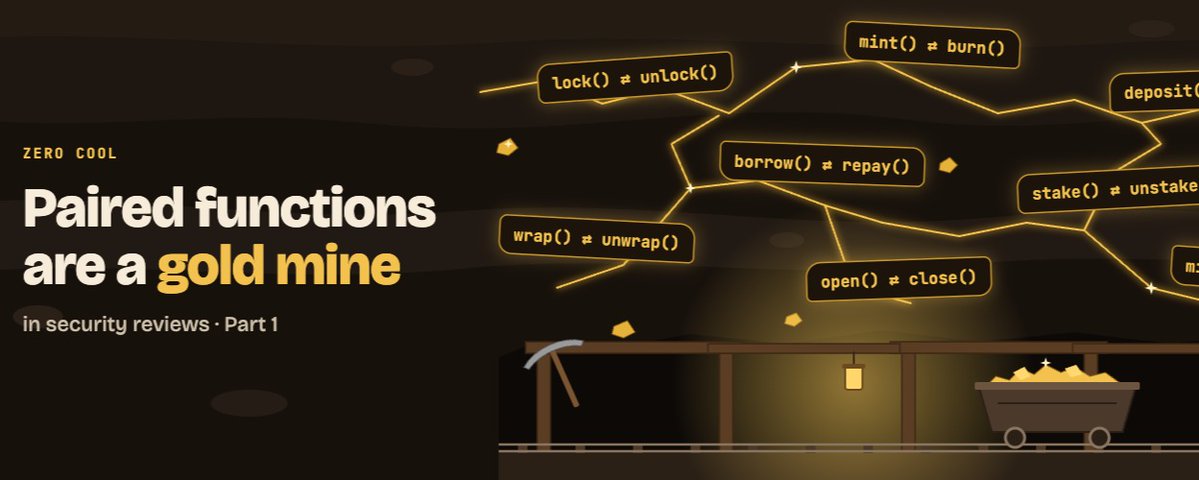
Mohamad retweeted

Here's how to fuzz like a real auditor
Pick ONE of these repos:
🔗 github.com/asymmetric-resear…
🔗 github.com/monad-developers/…
🔗 github.com/perimetersec/evm-…
Then:
1. Read the code first
2. Define what must always be true
3. Set up the fuzzer & automate it with AI
4. Check which code the fuzzer never reached
5. Shape the input to reach it
6. Triage every crash
Run one fuzzer this week.
Don't just read.


Mohamad retweeted

I started writing smart contracts in 2018, and one thing always bothered me: why did running my own RPC mean running a full node, or an archive node if I wanted historical state?
My app only cared about my contracts, a few dependencies and some ERC20s. Why did I need to keep up with everything everyone else was doing on Ethereum just to serve those reads?
The annoying part was keeping that smaller set of state up to date. Reading a value at one block was doable, but knowing what changed in the next block meant executing it or asking a node that had. A transaction could reach my contract through several other contracts, so just filtering transactions by their destination wasn’t enough.
I mostly forgot about it. RPC providers got reliable enough for what I needed, and I had other things to build. I still didn’t love the setup, but it stopped being something I spent time thinking about.
Then over the weekend, I was looking through Glamsterdam’s EIPs and realized block-level access lists might make this practical.
BALs include the state changes made during a block, including the new values, and the block commits to that list. So once you have the initial state you care about, you can follow its changes without re-executing every transaction.
So I started vibe coding it. It’s called skim.
You tell it which accounts and storage slots you care about, or let it discover the state your simulations read. It fetches the initial values from Ethereum’s P2P network through SNAP, checks their Merkle proofs, and keeps them updated using BALs. Your eth_calls then run locally. If a call needs something it hasn’t fetched, it gets that from peers too, just with more latency. No upstream RPC provider for those reads.
It can also keep historical versions of the state you’re tracking. That was another thing I wanted: being able to query my app’s past state without keeping everyone else’s history. It exposes a JSON-RPC interface, so existing tools can use it for the methods it supports.
It still receives full payloads and BALs. The state it maintains is selective, not everything it downloads. There’s also a consensus light-client implementation now, but that path isn’t active on Sepolia yet because the required Gloas light-client data isn’t being served by the peers tested so far. For now, the head is still trusted.
It’s still an experiment, and I’m working through correctness bugs and longer-running tests. I’m not presenting it as a production node replacement.
But it’s pretty satisfying to finally build something around a complaint I’ve had since 2018. I wanted a small client that knows the parts of Ethereum my app actually uses, and that’s what I’m trying to make.
github.com/leekt/skim

Mohamad retweeted

One year in web3 security. The biggest lesson wasn’t technical.
In a few weeks it will be a year since I left software engineering and became a web3 security researcher. Estimated earnings for that first year: around $200k.
This past month I’ve been looking back at all of it: the findings, the misses, the dry spells, the discipline, and how I built my days so I could hunt hard and still live a healthy life.
And honestly, the number isn’t the main thing I took away.
The biggest lesson was about control.
Most of the game is outside your hands
In this space a lot gets decided after you hit submit. Someone finds the same bug and yours becomes a duplicate. The judge downgrades your severity. A project goes quiet and never pays. Someone on your timeline posts a five figure payout in the same week you found nothing.
If your mood depends on those things, this job will eat you alive. I learned that the hard way.
Epictetus put it simply. Some things are up to us and some are not. Our effort, our judgments and our actions are ours. Results, reputation and other people’s decisions are not. Most suffering comes from confusing the two.
Your report is your arrow
Think of an archer. He controls the preparation, the aim, the breath and the release. Once the arrow leaves the bow, it belongs to the wind.
In bug hunting the arrow is the report. Everything before submit is yours: how deep you read the code, how many edge cases you test, how clear your PoC is. Everything after is not.
So I changed how I define success. A good day is not a day with a finding. A good day is one where I did the work with full focus. If that’s the measure, you can’t fail.
Aim high, then let go
You have to aim at something, otherwise you don’t move anywhere. Aim with everything you have, but don’t tie your peace of mind to whether you hit.
Stop comparing yourself to other hunters. Leaderboards and payout screenshots show someone else’s journey. The only fair comparison is you a year ago. When I look at that version of me, the gap is huge. That’s the real result.
And before you complain about judging, ask yourself if your report was really as clear and complete as it could be. Usually there’s something you could have done better.
Emotions are information, not orders
The hardest part was emotional. Frustration when a valid finding gets rejected. Envy when others hit big. The rush when you think you’ve found a critical, then the crash when it turns out to be a known issue. Doubt in the middle of a long dry spell.
Most of my worst days weren’t caused by what happened. They came from the stories I told myself about it: “I’m not good enough.” “I wasted a whole month.”
You can’t choose the judging outcome. You can choose what you do the next morning.
Self-control lives in the boring parts
Discipline isn’t one heroic all-nighter. It’s the daily structure:
fixed blocks of deep work, phone away
going through past contest reports and what I missed
sleep, training and real food
good books
time completely offline
Your system decides your results more than your goals do. The hunter with the better system beats the hunter with the bigger dream.
And health isn’t separate from the work. A tired brain misses bugs. Taking care of your body is part of the process.
What I control:
how much I work and study
how precise and persistent I am
how I react when things go wrong
What I don’t control:
whether someone finds the bug before me
whether it gets paid
what the final result will be
One year in, I don’t feel calmer because the results got better.
I feel calmer because I stopped asking the results to tell me who I am.
Focus on the process.
Let the rest go.
Mohamad retweeted

It's now 100% certain that security researchers won't be "automated by AI" or any other similar BS, only dummies believed that
As before, your value is your ability to get in "flow" state and do deep work, fully focused. Turn it into a system and you are guaranteed to win🫡
Mohamad retweeted

Dear builders!
@ShredSecurity’s free pre-Audits are real!
Get one here:
shredsecurity.io



Mohamad retweeted

Over the last year, it's been getting harder and harder for new auditors and devs, so I thought I would do my part and make the journey a little easier.
If you are an up-and-coming security researcher or developer who wants to write more secure code, or you are simply interested in how the protocols you use really work, you should check out the academy.
In the coming days, I will launch Heavyw8t's security academy, a completely free collection of guides, quizzes, checklists, and all the info needed to understand Web3 protocols, with a focus on security.
The academy will teach you how to safely integrate well-known protocols into your own ones, as well as how to use AI in your workflows efficiently and safely.
Comment and bookmark if you are interested in updates; more resources will be added on a weekly basis.

Mohamad retweeted

Running AI agents for security research? You can now inspect a long evaluation run as an interactive timeline.
AISI's new Transect tool links recorded activity back to the transcript so you can check what actually happened.
Open source. Its structural view needs no model calls.
github.com/AI-Safety-Institu…

Mohamad retweeted

For the second time in Google Chrome’s history, Google awarded a $250,000 bounty for a full-chain exploit… to @XBOW. Here’s the full story:
At an all-hands at the start of 2026 in Malta, I set the team a crazy challenge. A full-chain exploit of Chrome by the annual Black Hat cybersecurity conference in August.
I believed there were few better tests of whether @XBOW could move beyond web applications to desktop software, servers and devices.
Chrome is one of the most hardened pieces of software on the planet, used by more than half the world’s population.
A full-chain exploit lets an attacker take total control of a machine, where they can read every email, password and bank login the user types. You don’t need to download anything or click a phishing link. Visiting the wrong site is enough.
So @moyix, Andres Luksenberg, Baul Lee, and Willem Pinckaers took on the challenge along with a fifth teammate: OpenAI's GPT-5.6 Sol.
They built a chain they thought would win, but Google told us they already knew one of the bugs.
We were already in Las Vegas for Black Hat and DEF CON, and the team didn’t want to go home without the win.
So Brendan and the agents built a new exploit in just 6 days.
We submitted it to Google and waited.
The news came through that we'd done what should’ve been impossible. A full-chain bounty of $250,000, the first awarded under Google’s 2026 rules.
It took just 6 days and $40,000 of compute to construct an exploit that affects a billion users of Chrome on Windows. An intelligence-agency veteran told me his team used to spend 6 months on this kind of vulnerability.
My takeaway: the cost of finding truly critical vulnerabilities is collapsing, for attackers and defenders alike. Restricting powerful models is not the answer; GPT-5.6 Sol is already public.
But defenders have one advantage attackers never will: they can test their own code first.
Assume your software is exploitable. Whoever is hunting your bugs has the same building blocks we did.
This is cause for urgency but not panic.
XBOW is now developing an autonomous product for testing compiled software (desktop applications, servers, embedded devices), and partnering with the world’s top organizations to design that product.
If you’d like to be one of them, get in touch.
P.S. Restart Chrome whenever the Update button appears!

Mohamad retweeted

Quick thoughts on the events I missed over the past two months:
- The XRP bug is a great finding, but the reward was low. But even Ethereum had a $250k max bounty a few months ago, so I wouldn’t criticize Ripple too hard.
- The max cap wasn’t specified in the XRP bounty program, so most hunters didn’t even bother checking it.
- The $50k Vercel bounty is too low. They advertised a $1 million bounty, which is misleading, since there's a $50k max cap. Are they expecting 20 Criticals?
- Other projects continue lowering their bounties or closing programs while hacks increase. I understand that it hurts to pay so many reports, but there’s no coming back from a hack.
- The “Duplicates” problem hasn’t been solved. You can still report a Critical issue, prevent major damage to a project and its users, and they will still try to find a way to pay you nothing while pointing to some non-impactful report as sharing the same root cause. Platforms should address this scam immediately.
- The LLM decompilation movement is pretty cool. It's the end of the era of closed-source code.
- People building security tools that depend on LLM tokens should try to make a profit today, or have a clear plan to sell their company before models get better. There's no long-term plan.
- LLM spam continues to be the main trend for getting bounty rewards. It feels like buying lottery tickets. The more tokens people spend, the more chances they have of landing an actual exploit. Having a unique approach seems to help too. But nobody is performing much better than the model they use, since there's no clear outstanding winner in the leaderboards.
- We’re getting to the end of 2026, and bounty rewards paid haven’t increased 10x with AI. According to Grok, for the top 100 on Immunefi the total earnings were:
* 2026 $16M, 1364 reports
* 2025 $11M, 820 reports
* 2024 $21M, 775 reports
* 2023 $17M , 559 reports
* 2022 $57M, 443 reports
- What happened with Ledger is worrisome. Keep improving your OpSec, whitehats.
Personal thoughts:
We keep seeing more and more bugs in all kind of software. That's not because of superhuman AI capabilities. It's because how bad we've been building software over decades in terms of security.
Nobody cared about exploits because they were difficult for the average hackers. Now everyone has a low-level-IQ tool that can crack neglected code, and we see the results.
We're in a transition phase, where LLMs trained with human bugs are outperforming the average guys. We'll probably get to an era of LLMs-code-first, with LLM bugs that with unprecedented vulnerabilities.
Yes, LLMs are just that bad at coding, and the current models might not be able to see some obvious errors, since they also have "cognition bias".
I see a bright future for bounty hunters, full of vulnerabilities waiting to be found and prevented. We just need to solve the bug-pocalypse first if we don’t want blackhats to win.
Mohamad retweeted

One of the biggest questions we're getting about Sherlock Audit Engine:
Does Sherlock have access to gated AI models from the world's leading AI labs?
The answer is yes.
We've been securing access to restricted frontier models and pursuing the approvals needed for client use.
Mohamad retweeted

5 bugs we keep finding in @Uniswap v4 hooks
9 v4-hook protocols we audited in the last quarter, 38 v4 findings: 1 Critical, 14 High, 23 Medium.
The core protocol held up every time. Every bug was in the code around it.
The same 5 classes keep coming up ↓
Mohamad retweeted

The AI wrote “this is intentional.” Did the developer actually agree?
A discussion we had at @accretion_xyz about AI-generated comments, developer intent, and the assumptions auditors need to question.