

Book insights worth spreading.
Joined June 2023
- Tweets5.7K
- Following319
- Followers780
- Likes2.3K






Pinned Tweet
This is how I turn books into thinking tools.
Every book decomposed into its atomic ideas — structured, linked, and ready to think with.
Full walkthrough below

Dostoevsky was a believer.
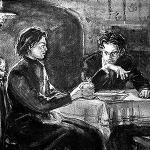
Yet he wrote the strongest case against God I've ever read, in one scene of The Brothers Karamazov.
New animated video, hand-drawn:
deepread.com/videos?v=qN-uQc…

Try it yourself.
Three levels: hard, middle, easy. The cards adjust to you, not the other way round.
Free, no sign-up:
deepread.com/flashcards#try

How we build them, in 2 minutes:
we take the book apart into its questions, key ideas and highlights, then build the cards from those notes.
youtu.be/S6r3UkU3Bww
We’re turning book highlights into flashcards that are actually fun:
• every card starts with a real argument
• stuck? “Help me” steps down to an easier card
• every answer ends with a quote from the book
Don’t just read. Learn it, with spaced repetition.
"It isn't simply how much time you spend paying attention to information that determines what you retain..
..but, crucially, how you think about that information while you pay attention to it."
— Scott Young, Ultralearning
deepread.com/ultralearning/


Pernah gak kamu selesai baca buku, ngerasa paham betul, tapi begitu tutup buku langsung blank?
Atau sebaliknya, pas lagi belajar pusing dan ngebul rasanya, tapi pas selesai ilmunya malah lebih nyerap?
Kemarin, aku belajar konsep Active Engagement pas baca buku How We Learn karya Stanislas Dehaene, ahli neurosains yang udah meneliti otak manusia selama 3 dekade lebih.
Dia bilang, belajar yang lancar tanpa hambatan itu malah bikin otak kita cepat lupa. Kok bisa?
A thread 🧵 by Narasi Visual

We built a machine that fills minds and mistook the filling for the flourishing.
"We do not have to know everything about something in order to understand it; too many facts are often as much of an obstacle to understanding as too few."
— Mortimer J. Adler, Charles Van Doren, How to Read a Book
deepread.com/how-to-read-a-b…

"You will find, as you read the poem out loud, that the very act of speaking the words forces you to understand them better."
— Mortimer J. Adler, Charles Van Doren, How to Read a Book

This is Ryan Griffin.
He's a barber who gives a $2 discount to kids if they read a book aloud at his barbershops in Michigan while he gives them haircuts in order to encourage their love of reading.

Slop is what prose looks like when misunderstanding costs nothing

Aviation solved AI slop in 1986.
Karpathy is telling people to ask their LLM to write in ASD-STE100, a controlled language built for aircraft maintenance manuals. I went down the rabbit hole on where this spec comes from, and the backstory makes the hack even better.
Back in the late 1970s, European airlines were handing English manuals to mechanics around the world who mostly didn't speak English as a first language. One ambiguous sentence in a fuel line procedure can get people killed. So the industry built a version of English where ambiguity is banned at the dictionary level.
The spec allows roughly 900 approved words. Each word gets one meaning and one part of speech. "Close" can only be a verb, because "close the door" and "the close door" can't be allowed to coexist in a repair manual. "Follow" only means to come after. If you want obey, you write obey.
Procedural sentences max out at 20 words. One instruction per sentence. Active voice only. Around 1,200 common words are explicitly banned, each with a mandated replacement. You don't "commence pumping." You start the pump.
English has about 170,000 words in current use. Aviation decided mechanics get 900, and planes became safer to maintain because of it.
Now flip it to LLMs. Models hedge and synonym-cycle because the training data rewards sounding fluent. STE is 40 years of accumulated rules for stripping exactly that out, written by people whose readers would die if a sentence could be read two ways. It might be the strongest anti-slop prompt in existence, and it's a free PDF.
"It is an inherent property of intelligence that it can jump out of the task which it is performing, and survey what it has done"
— Douglas R. Hofstadter, Gödel, Escher, Bach

"A mind not agitated by good questions cannot appreciate the significance of even the best answers. It is easy enough to learn the answers. But to develop actively inquisitive minds, alive with real questions, profound questions—that is another story."
— Mortimer J. Adler, Charles Van Doren, How to Read a Book
deepread.com/how-to-read-a-b…

Elon’s advice to 20-year-olds on surviving the AI era:
Get as broad-based an education as possible: arts, sciences, engineering, and wide general knowledge.
Why?
AI and robots will fulfill almost any request immediately.The edge won’t be doing the work. It will be knowing what to ask for. The broader your knowledge, the better your questions.
(source: CGTN)
"reading fiction is [...] that elusive state in which the distance between the self and the universe shrinks."

Whatever book you pick up, it’s likely to make you feel better—maybe even a whole lot better. “In a secular age, I suspect that reading fiction is one of the few remaining paths to transcendence, that elusive state in which the distance between the self and the universe shrinks,” Ceridwen Dovey writes, in “Can Reading Make You Happier?,” which was published in 2015. Dive into the research behind the therapeutic effect of books: newyorkermag.visitlink.me/Wv…

The Brothers Karamazov, by Fyodor Dostoevsky
Without God, is everything permitted?
Dostoevsky's grand opus in >800 pages. We boil it down to 14 key quotes (see link below).
I hand-picked one key quote for every key scene. To me, they're the essence of the book.
Their shortest fragments, like "Above all, don't lie to yourself…", let you walk back through the novel and rebuild it in your mind.
deepread.com/the-brothers-ka…

Read Alex's backstory before you hit play. Otherwise you'll spend 30+ minutes wondering what this is even about, only to find out the story is absolutely worth your time. Thank me later.

This is one of the craziest and most fascinating podcasts I've ever listened to.
Here's the backstory:
Millions of children are struggling to learn how to read.
But the problem isn't kids–it's how kids are being taught.
In the 2000s, schools stopped using phonics (sounding out words) for a new reading system called three-cuing (guessing unfamiliar words using context clues).
But that new system turned out to be based on false data.
Researchers tried to show it was ineffective, but politics and publishers got in the way and delayed changes in our reading system for decades.
One publisher made over $1 billion selling books to schools on a reading system that didn't work.
Now, 20-years later, schools are finally reversing course and going back to teaching phonics. But so much damage has already been done.
The podcast is called "Sold a Story" and it dives into the science, history, profits, and politics behind the reading wars.
If you're an educator, parent, or teacher, you have to listen to this podcast.

School turned reading into the one leisure activity that comes with a grade.

The real reason children no longer enjoy reading.” Mary Wakefield has a theory in the latest Spectator. Instead of screen addiction, she blames school curricula which teach “to the test” rather than reading for enjoyment. Children are so busy analysing brief extracts, they can’t enjoy the book as a whole.
I read incessantly as a child, including illicitly when I was supposed to be sleeping. Not “great literature”, it was Dr Dolittle, Biggles, Bulldog Drummond, Just William, Arthur Ransome, Percy F Westerman. It would certainly have included Harry Potter if he’d been around then. I don’t believe I ever had my “comprehension” tested. I just loved reading.
Is Mary Wakefield right?


