

𝗔 𝗯𝗹𝗼𝗰𝗸𝗰𝗵𝗮𝗶𝗻-𝗯𝗮𝘀𝗲𝗱 𝗶𝗻𝗶𝘁𝗶𝗮𝘁𝗶𝘃𝗲 𝘁𝗼 𝘀𝘂𝗽𝗽𝗼𝗿𝘁 online and open experimentation.
World
Joined February 2025
- Tweets311
- Following5
- Followers76
- Likes1.3K







Pinned Tweet
𝘓𝘢𝘣𝘴 𝘸𝘪𝘵𝘩𝘰𝘶𝘵 𝘣𝘰𝘳𝘥𝘦𝘳𝘴.
𝘚𝘤𝘪𝘦𝘯𝘤𝘦 𝘸𝘪𝘵𝘩𝘰𝘶𝘵 𝘭𝘪𝘮𝘪𝘵𝘴.
𝘋𝘦𝘤𝘦𝘯𝘵𝘳𝘢𝘓𝘢𝘣𝘴 𝘪𝘴 𝘣𝘶𝘪𝘭𝘥𝘪𝘯𝘨 𝘵𝘩𝘢𝘵 𝘧𝘶𝘵𝘶𝘳𝘦.
𝘙𝘦𝘢𝘥𝘺 𝘵𝘰 𝘫𝘰𝘪𝘯 𝘶𝘴?
#DeSci #OpenScience
A farewell to X. From now on, our updates move exclusively to LinkedIn, the platform that best fits DecentraLabs' academic and professional nature. Our recent silence wasn't inactivity: we've been developing new lines of work. The project is alive and evolving. See you there!


We are pleased to announce that Dr. Luis de la Torre will be speaking at the Zug Institute for Blockchain Research (ZIBR) public talk series next Tuesday, April 15th, 2026.
🎙️ "𝗖𝗮𝗻 𝗖𝗿𝘆𝗽𝘁𝗼 𝗥𝗲𝗯𝘂𝗶𝗹𝗱 𝘁𝗵𝗲 𝗦𝗰𝗶𝗲𝗻𝘁𝗶𝗳𝗶𝗰 𝗥𝗲𝘀𝗲𝗮𝗿𝗰𝗵 𝗣𝗿𝗼𝗰𝗲𝘀𝘀 𝗮𝗻𝗱 𝗣𝗿𝗼𝘁𝗲𝗰𝘁 𝗜𝗻𝘁𝗲𝗹𝗹𝗲𝗰𝘁𝘂𝗮𝗹 𝗔𝘀𝘀𝗲𝘁𝘀?"
He will present DecentraLabs, a project working at the intersection of Decentralised Science (DeSci), blockchain technology, and crypto-economics to enable shared access to scientific laboratories on a global scale.
He'll be joined by Dr. Vicki Lemieux, founder of Blockchain@UBC, who will present Clio-X: an open-source initiative helping cultural heritage institutions leverage AI for research without compromising privacy or data sovereignty.
Together, they'll go well beyond the conceptual: the real-world experience of negotiating with funders, industry partners, and stakeholder organisations to bring decentralised science to life.
📅 Tuesday, April 15th, 2026 · 16:30 – 18:00
📍 Zug Institute for Blockchain Research · Dammstrasse 16, Zug (CH)
🌐 Language: English
🎟️ Free admission. More info below!
If you're in or around Zug and care about the future of open science, decentralised intellectual property, or blockchain beyond finance, this one's for you!
#DeSci #Zug

𝗚𝗿𝗲𝗮𝘁 𝗹𝗮𝗯𝘀 𝘀𝗵𝗼𝘂𝗹𝗱𝗻'𝘁 𝗱𝗶𝘀𝗮𝗽𝗽𝗲𝗮𝗿 𝗷𝘂𝘀𝘁 𝗯𝗲𝗰𝗮𝘂𝘀𝗲 𝘁𝗵𝗲𝗿𝗲'𝘀 𝗻𝗼 𝘀𝘂𝘀𝘁𝗮𝗶𝗻𝗮𝗯𝗹𝗲 𝗺𝗼𝗱𝗲𝗹 𝘁𝗼 𝗸𝗲𝗲𝗽 𝘁𝗵𝗲𝗺 𝗮𝗹𝗶𝘃𝗲
Universities and research institutions have been building online laboratories for over two decades. Remote labs, virtual labs, hybrid setups: the technology exists, the demand is real, and the benefits are well documented: broader access, reduced costs, better use of existing equipment, and continuity when physical access isn't possible.
And yet, most of these labs never reach beyond the walls of the institution that built them. When they do get shared externally, they're usually offered for free, with no clear model to sustain them long-term. Without a return on the effort, maintenance becomes a burden, interest fades, and what started as a valuable resource ends up underused or abandoned.
That's the problem we're working on with DecentraLabs.
Our approach is to give online labs a decentralized infrastructure where institutions can list and share their labs through a transparent marketplace, users can discover and reserve access to them from anywhere in the world, and the whole system runs on smart contracts, with no central authority and no intermediaries making decisions for everyone else. Access is managed on-chain, payments are handled through the $LAB token, and the incentive structure is designed so that contributing labs is genuinely worth it, not just a favour you do for the community until the funding runs out.
We're still building, but the foundation is already there. Online laboratories deserve a sustainable, interoperable, and open ecosystem, and we think blockchain is a big part of how we get there.
If you work with online labs, run one, or are thinking about how your institution could be part of this, we'd love to hear from you!
#EdTech #DeSci
🤖 Made with AI

DecentraLabs retweeted
𝗗𝗲𝗰𝗲𝗻𝘁𝗿𝗮𝗟𝗮𝗯𝘀 𝗲𝗻 𝗙𝗼𝗿𝗼 𝗧𝗿𝗮𝗻𝘀𝗳𝗶𝗲𝗿𝗲 𝟮𝟬𝟮𝟲
Hace unas semanas participamos en @ForoTransfiere 2026, uno de los principales encuentros en España dedicados a la innovación y la transferencia tecnológica.
Durante el evento tuvimos la oportunidad de hablar sobre DecentraLabs en el panel: “𝘐𝘯𝘯𝘰𝘷𝘢𝘳 𝘥𝘦𝘴𝘥𝘦 𝘦𝘭 𝘣𝘰𝘳𝘥𝘦: 𝘋𝘦𝘤𝘦𝘯𝘵𝘳𝘢𝘓𝘢𝘣𝘴, 𝘔á𝘭𝘢𝘨𝘢 𝘺 𝘔𝘦𝘭𝘪𝘭𝘭𝘢 𝘤𝘰𝘮𝘰 𝘯𝘰𝘥𝘰𝘴 𝘦𝘴𝘵𝘳𝘢𝘵é𝘨𝘪𝘤𝘰𝘴 𝘥𝘦𝘭 𝘧𝘶𝘵𝘶𝘳𝘰 𝘵𝘦𝘤𝘯𝘰𝘭ó𝘨𝘪𝘤𝘰 𝘦𝘶𝘳𝘰𝘱𝘦𝘰”, organizado por Melilla Digital Hub.
En la sesión, nuestro líder de proyecto Luis de la Torre compartió la experiencia de DecentraLabs y cómo una línea de investigación nacida en el ámbito universitario puede evolucionar hacia una iniciativa de transferencia tecnológica con proyección internacional, conectando investigación, instituciones públicas y nuevas infraestructuras digitales.
Esta iniciativa trabaja precisamente en ese ámbito, desarrollando una infraestructura digital para gestionar y compartir laboratorios físicos, sistemas experimentales y equipamiento tecnológico entre instituciones, facilitando su acceso remoto y su uso coordinado.
El panel contó además con la participación de Juan Luis Ramos Villalón, Jesús Martínez García, Miguel Marín Cobos y Roberto Medina Bujalance, generando una conversación muy interesante sobre innovación, colaboración institucional y desarrollo tecnológico.
Fue una jornada muy completa que nos permitió presentar el proyecto, intercambiar ideas y establecer contactos muy interesantes con distintos actores del ecosistema de innovación.
¡Seguimos trabajando para continuar desarrollando y consolidando DecentraLabs!
#EdTech #CienciayTecnología
𝗗𝗲𝗰𝗲𝗻𝘁𝗿𝗮𝗟𝗮𝗯𝘀 𝗲𝗻 𝗧𝗿𝗮𝗻𝘀𝗳𝗶𝗲𝗿𝗲
Del 24 al 26 de febrero, DecentraLabs estará presente en @ForoTransfiere 2026 dentro del espacio de @UNEDMelilla.
El 24 de febrero, de 17:10 a 17:55 en Ágora, participaremos en el panel:
“Innovar desde el borde: DecentraLabs, Málaga y Melilla como nodos estratégicos del futuro tecnológico europeo.”
La sesión abordará cómo un proyecto nacido en el ámbito universitario puede estructurarse como iniciativa de transferencia tecnológica, conectando investigación, colaboración institucional y desarrollo de infraestructuras digitales con proyección internacional.
Durante el evento también se mostrará el marketplace de DecentraLabs en el stand.
El proyecto se basa en una infraestructura digital que permite gestionar y compartir laboratorios físicos, sistemas experimentales y equipamiento tecnológico de forma estructurada, segura y escalable, manteniendo el control en cada institución.
Si representas a una universidad, centro tecnológico o institución interesada en nuevas formas de compartir y estructurar infraestructuras de laboratorio, estaremos encantados de conversar.
#EdTech #TransferenciaTecnológica

DecentraLabs retweeted
𝗢𝗻𝗹𝗶𝗻𝗲 𝗮𝗻𝗱 𝗿𝗲𝗺𝗼𝘁𝗲 𝗹𝗮𝗯𝘀 𝗮𝘀 𝗮𝗻 𝗲𝘅𝘁𝗲𝗻𝘀𝗶𝗼𝗻 𝗼𝗳 𝗽𝗵𝘆𝘀𝗶𝗰𝗮𝗹 𝗹𝗮𝗯𝗼𝗿𝗮𝘁𝗼𝗿𝗶𝗲𝘀
Online and remote labs are designed to extend the reach and usability of physical laboratories, not to replace them. These self-driving labs allow students, educators, and researchers to work with real laboratory equipment beyond constraints of time, location, or availability, while keeping experimentation firmly grounded in the physical world.
Used properly, online and remote labs allow institutions to:
🌍 𝗘𝘅𝗽𝗮𝗻𝗱 𝗔𝗰𝗰𝗲𝘀𝘀:
Overcome geographical and mobility barriers, bringing quality lab experiences to anyone, from anywhere.
🔄 𝗘𝘅𝗽𝗲𝗿𝗶𝗺𝗲𝗻𝘁 𝗪𝗶𝘁𝗵𝗼𝘂𝘁 𝗟𝗶𝗺𝗶𝘁𝘀:
Freely repeat experiments, facilitating deeper understanding and fostering innovation through trial and error.
🌐 𝗖𝗼𝗻𝗻𝗲𝗰𝘁 𝗴𝗹𝗼𝗯𝗮𝗹𝗹𝘆:
Collaborate and share lab resources seamlessly with researchers, educators, and students worldwide, fostering global scientific communities.
🛰️ 𝗔𝗰𝗰𝗲𝘀𝘀 𝘀𝗽𝗲𝗰𝗶𝗮𝗹𝗶𝘇𝗲𝗱 𝗲𝗾𝘂𝗶𝗽𝗺𝗲𝗻𝘁:
Remotely use sophisticated, rare, or expensive lab setups unavailable in your own institution.
🔎 𝗘𝗻𝗮𝗯𝗹𝗲 𝗰𝗼𝗻𝘁𝗶𝗻𝘂𝗼𝘂𝘀 𝗿𝗲𝘀𝗲𝗮𝗿𝗰𝗵:
Remotely monitor and collect data continuously, enabling lab automation scenarios without requiring constant physical presence.
📈 𝗜𝗻𝗰𝗿𝗲𝗮𝘀𝗲 𝗽𝗿𝗼𝗱𝘂𝗰𝘁𝗶𝘃𝗶𝘁𝘆:
Run preliminary tests remotely, ensuring your valuable in-person lab time is dedicated to more advanced activities.
DecentraLabs is focused on the infrastructure layer that makes this shareable at scale, secure reservations, access control, and auditable usage, so online and remote labs can be published and reused across organisations with less operational friction.
The objective is straightforward: help institutions and researchers use their laboratories more efficiently, share them responsibly, and broaden access to hands-on experimentation without compromising rigor or control.
#EdTech #DeSci

DecentraLabs retweeted
Today we would like to share a recognition that confirms we are moving in the right direction. The emerging technologies publication @ObserBlockchain has published an article presenting the vision and potential of DecentraLabs, our platform for sharing physical laboratories and experimental equipment with blockchain-based traceability and transparency.
The article outlines our technological approach and operating model, describing how smart contracts and a decentralized marketplace support verifiable reservations and access to laboratory resources for universities and research centers.
For us, this kind of visibility in specialized media covering blockchain innovation is valuable because it signals to the community, potential collaborators, and actors within the academic ecosystem that this is a project under active development, with concrete milestones that can translate into tangible benefits for education and research.
We would like to thank 𝘖𝘣𝘴𝘦𝘳𝘷𝘢𝘵𝘰𝘳𝘪𝘰 𝘉𝘭𝘰𝘤𝘬𝘤𝘩𝘢𝘪𝘯 for the space they dedicated to us and for telling our story with rigor. We continue to push DecentraLabs forward with a clear focus on sustainability, openness, and practical usefulness for the scientific and educational community.
Read the full article below!
#Blockchain #STEM

DecentraLabs retweeted
Laboratory infrastructure is expensive to build and maintain, and only a limited number of institutions can afford to operate it at scale.
What’s missing is a practical way to share that capacity beyond the home institution, without turning it into extra admin work, messy scheduling, or unclear responsibilities.
That’s where online and remote labs can actually make a difference, when access and coordination are designed to work across institutions.
#EdTech #OpenEducation
Today we would like to share a recognition that confirms we are moving in the right direction. The emerging technologies publication @ObserBlockchain has published an article presenting the vision and potential of DecentraLabs, our platform for sharing physical laboratories and experimental equipment with blockchain-based traceability and transparency.
The article outlines our technological approach and operating model, describing how smart contracts and a decentralized marketplace support verifiable reservations and access to laboratory resources for universities and research centers.
For us, this kind of visibility in specialized media covering blockchain innovation is valuable because it signals to the community, potential collaborators, and actors within the academic ecosystem that this is a project under active development, with concrete milestones that can translate into tangible benefits for education and research.
We would like to thank 𝘖𝘣𝘴𝘦𝘳𝘷𝘢𝘵𝘰𝘳𝘪𝘰 𝘉𝘭𝘰𝘤𝘬𝘤𝘩𝘢𝘪𝘯 for the space they dedicated to us and for telling our story with rigor. We continue to push DecentraLabs forward with a clear focus on sustainability, openness, and practical usefulness for the scientific and educational community.
Read the full article below!
#Blockchain #STEM

𝗢𝗻𝗹𝗶𝗻𝗲 𝗮𝗻𝗱 𝗿𝗲𝗺𝗼𝘁𝗲 𝗹𝗮𝗯𝘀 𝗮𝘀 𝗮𝗻 𝗲𝘅𝘁𝗲𝗻𝘀𝗶𝗼𝗻 𝗼𝗳 𝗽𝗵𝘆𝘀𝗶𝗰𝗮𝗹 𝗹𝗮𝗯𝗼𝗿𝗮𝘁𝗼𝗿𝗶𝗲𝘀
Online and remote labs are designed to extend the reach and usability of physical laboratories, not to replace them. These self-driving labs allow students, educators, and researchers to work with real laboratory equipment beyond constraints of time, location, or availability, while keeping experimentation firmly grounded in the physical world.
Used properly, online and remote labs allow institutions to:
🌍 𝗘𝘅𝗽𝗮𝗻𝗱 𝗔𝗰𝗰𝗲𝘀𝘀:
Overcome geographical and mobility barriers, bringing quality lab experiences to anyone, from anywhere.
🔄 𝗘𝘅𝗽𝗲𝗿𝗶𝗺𝗲𝗻𝘁 𝗪𝗶𝘁𝗵𝗼𝘂𝘁 𝗟𝗶𝗺𝗶𝘁𝘀:
Freely repeat experiments, facilitating deeper understanding and fostering innovation through trial and error.
🌐 𝗖𝗼𝗻𝗻𝗲𝗰𝘁 𝗴𝗹𝗼𝗯𝗮𝗹𝗹𝘆:
Collaborate and share lab resources seamlessly with researchers, educators, and students worldwide, fostering global scientific communities.
🛰️ 𝗔𝗰𝗰𝗲𝘀𝘀 𝘀𝗽𝗲𝗰𝗶𝗮𝗹𝗶𝘇𝗲𝗱 𝗲𝗾𝘂𝗶𝗽𝗺𝗲𝗻𝘁:
Remotely use sophisticated, rare, or expensive lab setups unavailable in your own institution.
🔎 𝗘𝗻𝗮𝗯𝗹𝗲 𝗰𝗼𝗻𝘁𝗶𝗻𝘂𝗼𝘂𝘀 𝗿𝗲𝘀𝗲𝗮𝗿𝗰𝗵:
Remotely monitor and collect data continuously, enabling lab automation scenarios without requiring constant physical presence.
📈 𝗜𝗻𝗰𝗿𝗲𝗮𝘀𝗲 𝗽𝗿𝗼𝗱𝘂𝗰𝘁𝗶𝘃𝗶𝘁𝘆:
Run preliminary tests remotely, ensuring your valuable in-person lab time is dedicated to more advanced activities.
DecentraLabs is focused on the infrastructure layer that makes this shareable at scale, secure reservations, access control, and auditable usage, so online and remote labs can be published and reused across organisations with less operational friction.
The objective is straightforward: help institutions and researchers use their laboratories more efficiently, share them responsibly, and broaden access to hands-on experimentation without compromising rigor or control.
#EdTech #DeSci
DecentraLabs retweeted
𝗗𝗲𝗰𝗲𝗻𝘁𝗿𝗮𝗟𝗮𝗯𝘀 𝗽𝗮𝘀𝘀𝗲𝘀 𝗶𝘁𝘀 𝗲𝘅𝘁𝗲𝗿𝗻𝗮𝗹 𝘀𝗲𝗰𝘂𝗿𝗶𝘁𝘆 𝗮𝘂𝗱𝗶𝘁
Our smart contracts have successfully completed an external review carried out by Intellium Technology Inc. The audit examined the full contract suite that powers our marketplace, evaluating core components such as reservations, providers, token logic, and access control.
The results are very positive, confirming the robustness of the architecture and providing a clear set of improvements. Most of the recommendations were already implemented by the time we received the report, and the remaining points are being addressed to reinforce security and reliability as the platform grows.
This milestone strengthens the foundations of DecentraLabs as we continue advancing the platform and preparing the next stages of development.
#DePIN #Blockchain

DecentraLabs retweeted
𝗨𝗻𝗱𝗲𝗿𝘀𝘁𝗮𝗻𝗱𝗶𝗻𝗴 𝘁𝗵𝗲 𝗿𝗼𝗹𝗲 𝗼𝗳 𝘀𝗺𝗮𝗿𝘁 𝗰𝗼𝗻𝘁𝗿𝗮𝗰𝘁𝘀 𝗶𝗻 𝗱𝗶𝗴𝗶𝘁𝗮𝗹 𝘀𝘆𝘀𝘁𝗲𝗺𝘀
Smart contracts are programs deployed on a blockchain that execute specific actions when predefined conditions are met. They operate through verifiable rules rather than intermediaries, providing a predictable and consistent way to automate processes across distributed environments.
Their usefulness becomes clear in systems where coordination, access control, and traceability are central requirements. Instead of relying on manual procedures or institutional oversight, a smart contract ensures that each step is carried out exactly as defined, and that every action is recorded on a tamper-resistant ledger.
This makes them well suited for digital infrastructures that need to manage permissions, transactions, or interactions between different components. A process that depends on clear logic can be expressed as code, and once deployed, the contract enforces the rules without ambiguity and without additional intervention. As a result, the system reduces the need for manual coordination and ensures that each action is executed as intended.
Smart contracts also support the integration of different modules within the same ecosystem. Functions such as identity management, resource allocation, licensing, tokenized payments, or data validation can interact reliably because each contract exposes defined interfaces and behavior. This modular approach contributes to scalability and interoperability, especially in systems that need to grow or connect across institutions.
Their applications extend well beyond finance. Smart contracts are increasingly used in identity frameworks, auditability tools, collaborative research environments, IoT systems, and infrastructures where transparent governance is important. In these contexts, they help reduce operational friction while strengthening accountability.
In DecentraLabs, smart contracts support this approach by coordinating how online and remote laboratory resources are shared across institutions. This includes a reservation model we developed specifically for time-based access, along with modules for permissions, provider configuration, and on-chain auditability. Together, they illustrate how these mechanisms can automate interactions in distributed technical systems.
#EdTech #SmartContracts

DecentraLabs retweeted
𝗔𝗱𝘃𝗮𝗻𝗰𝗶𝗻𝗴 𝗼𝘂𝗿 𝗽𝗶𝗹𝗼𝘁 𝗽𝗵𝗮𝘀𝗲 𝘄𝗶𝘁𝗵 𝗮 𝗻𝗲𝘄 𝗮𝗱𝗱𝗶𝘁𝗶𝗼𝗻: 𝘁𝗵𝗲 𝗦𝗲𝗿𝘃𝗼 𝗦𝗽𝗲𝗲𝗱 𝗥𝗧
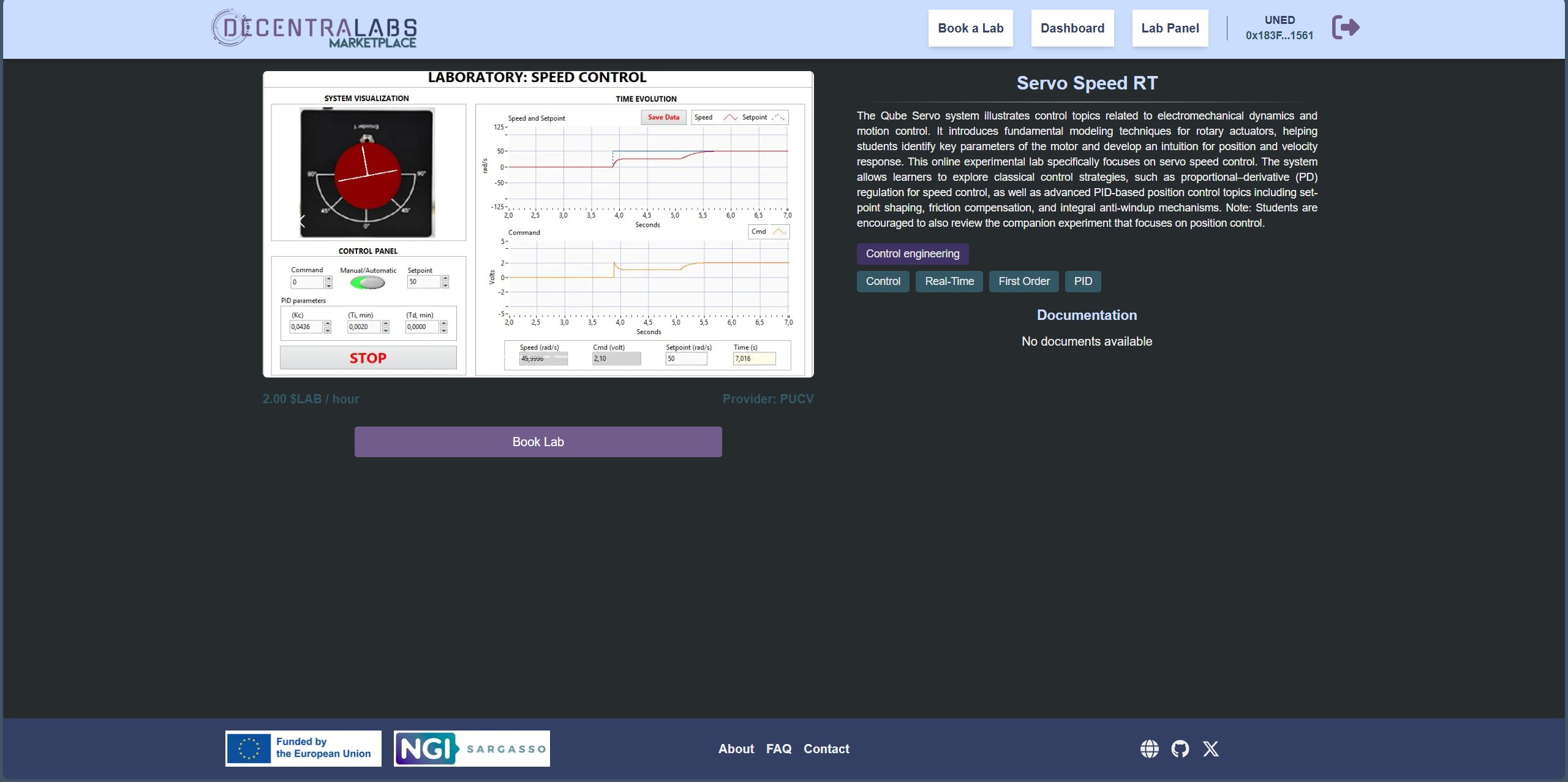
DecentraLabs is entering a stage where more hardware based experiments are being incorporated into the pilot phase, allowing us to examine how different types of laboratory systems behave within a decentralized framework. One of the newest additions is the Servo Speed RT, developed by the Pontificia Universidad Católica de Valparaíso (PUCV) using the Qube Servo 2 platform by @Quanser, a rotary motion control system that offers real time interaction with electromechanical dynamics. The experiment has been implemented in @labview, which provides the real time interface that users operate through the online access point.
The Servo Speed RT focuses on the behavior of a DC motor equipped with sensing and actuation elements that make it suitable for studying the fundamentals of motion control. Through the online interface, users can monitor speed, command signals, and setpoint evolution while the system reacts in real time to their input. This makes it possible to observe how the motor responds when its operating conditions or controller settings are modified.
The experiment allows for practical exploration of proportional derivative regulation, a classical approach used for speed control in rotary actuators. By adjusting the controller gains, users can examine how stability, responsiveness, and disturbance rejection depend on the tuning strategy. The laboratory also provides opportunities to study modeling concepts such as inertia, friction, and the relationship between electrical and mechanical dynamics, which influence how the system performs under different operating regimes.
Working with a real electromechanical system helps clarify the difference between theoretical predictions and physical behavior, particularly when noise, nonlinearities, or saturation effects appear in the closed loop response. For learners and researchers in control engineering and mechatronics, the Servo Speed RT offers a direct way to build intuition about transient and steady state behavior in speed controlled systems.
As the pilot network grows, providers who operate online or remote laboratories can already begin registering their resources in the marketplace to prepare for upcoming integration steps. The incorporation of experiments such as the Servo Speed RT strengthens the foundation for open, transparent, and globally accessible scientific infrastructure, which is one of the core objectives of DecentraLabs.
#EdTech #DePIN
DecentraLabs retweeted
𝗧𝗮𝗹𝗸𝗶𝗻𝗴 𝘄𝗶𝘁𝗵 𝗡𝗚𝗜 𝗦𝗮𝗿𝗴𝗮𝘀𝘀𝗼 𝗮𝗯𝗼𝘂𝘁 𝘁𝗵𝗲 𝗗𝗲𝗰𝗲𝗻𝘁𝗿𝗮𝗟𝗮𝗯𝘀 𝗷𝗼𝘂𝗿𝗻𝗲𝘆
An interview with NGI Sargasso is now available, focused on the DecentraLabs journey and the work carried out during the project.
The conversation covers different aspects of the project’s evolution, including the challenges faced along the way, how they were approached, and how the platform has matured, among many other topics.
It is a chance to hear the project discussed calmly, with perspective, and in the context in which it was developed.
#EdTech #DeSci
DecentraLabs retweeted
𝗦𝘁𝗮𝗿𝘁𝗶𝗻𝗴 𝟮𝟬𝟮𝟲 𝘄𝗶𝘁𝗵 𝗮 𝗻𝗲𝘄 𝗽𝗿𝗼𝗷𝗲𝗰𝘁
With the new year, we officially started a new chapter at DecentraLabs.
On January 1st, we kicked off the project “NixOS-Based Gateway for Remote Laboratories”, funded by the Vietsch Foundation.
Over the next months, we’ll be working on turning a complex and often fragile setup into something reproducible, maintainable, and easy to deploy for universities and research institutions.
The goal is straightforward: make it much simpler to publish and share online and remote labs.
By packaging the full DecentraLabs remote access stack into a reproducible NixOS environment, institutions will be able to deploy a functional gateway in minutes instead of weeks.
During this phase, we’ll be delivering:
• Open-source NixOS modules and Docker images
• Clear, bilingual documentation and tutorials (EN/ES)
• Two pilot deployments, starting with UNED and a second European university via eduGAIN
• Workshops and technical dissemination through RedIRIS and GÉANT communities
This project is a key step toward lowering the technical barrier for new lab providers and making shared laboratory infrastructure more sustainable in practice, not just in theory.
We’re grateful to the Vietsch Foundation for supporting this work and excited to get started.
#EdTech #NixOS
