

CMDR HPU • NIST Center for Marine Debris Research Here to answer vital questions about plastic debris
Waimanalo, Oahu
Joined August 2021
- Tweets98
- Following139
- Followers183
- Likes44

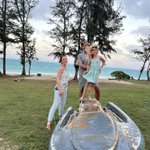





Morning buoys!
⠀
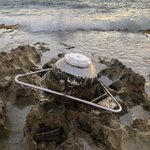
A pulse of marine debris washed ashore on Kaimalino beach. Thanks to Hank from Makanakai Marine Services the beach is now free of the debris!

Center for Marine Debris Research retweeted

#SeaGrant announces $27M for #marinedebris removal and prevention projects throughout the U.S.!
Learn how these projects will bring #science together with #communities for solutions that work: bit.ly/SG-27M-marinedebris
#EarthDay #EarthMonthNOAA

ALT Image of Papahānaumokuākea Marine Debris Project staff removing marine debris from the shorelines of Kuaihelani (Midway Atoll) by Andy Sullivan-Haskins | PMDP.
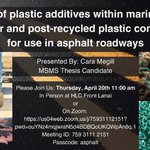
Join us Thursday, April 20th at 11:00am to watch Cara’s thesis defense! She will be talking about the “Analysis of plastic additives within marine derelict fishing gear and post-recycled plastic compatibilized for use in asphalt roadways.”
You can watch in person or virtually!

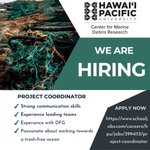
We are hiring one full-time Project Coordinator!
schooljobs.com/careers/hpu/j…

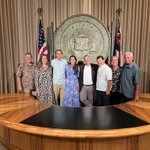
CMDR and PMDP had the honor of serving as subject matter experts in a meeting with Governor Dr. Josh Green, Her Excellency Ilana Victorya Seid, the Ambassador of Palau to the United Nations, and others to discuss the grand challenges of removing and recycling marine debris.

To date we have sold 123 polymer 1.0 kits! This kit contains 22 polymers that are typically found in the environment and a USB thumb drive with FTIR and DSC data.
⠀
All users are invited to a network to grow collaborations and ask other users about their research with the kit!

Center for Marine Debris Research retweeted

Kick your week off strong! We have some amazing opportunities to join us @pmdphawaii for the 2023 field season! Check them out ASAP at the link 👇, recruitment closes February 19th!
jobs.jobvite.com/ibsscorp/jo…

Center for Marine Debris Research retweeted

#MarineDebris continues to be a problem for island communities across the Pacific, but several dedicated organizations and ocean stewards are working to remove derelict fishing gear, clean up typhoon debris, and reduce single-use plastic waste. Learn more: blog.marinedebris.noaa.gov/m…

ALT A large pick up truck and a colorful large derelict net is pictured on a beach before being hauled off.

ALT Two volunteers bend over to pick up plastic debris along a rocky beach.

ALT Debris, including rope, plastic bottles, and various pieces of plastic, are strewn across a rocky coastline.

ALT Two volunteers work together to cut and remove a derelict fishing net off a rocky shoreline.
Center for Marine Debris Research retweeted
Our partner @debrisresearch is leading a new derelict fishing gear bounty program that provides commercial fishers the opportunity to trade gear they find at sea for money. Learn more: marinedebris.noaa.gov/remova… #HIMarineDebris

Thanks MyKailua for sharing the reported marine debris boat!
⠀
Yesterday evening, Makanakai Marine Services was able to remove it off Waimanalo beach with the help of our CMDR members and it has been brought to our net shed for data collection!


Filtration time 🥼
⠀
We have officially started filtering the water collected from the moisture induced stress tester (MIST) for plastic particle analysis!
⠀
#CMDR #researchers #researchteam #womeninscience #environmentalscience


Welcome back Cameron Souza, our new Project Coordinator for our DFG net bounty project!
⠀
Cameron worked with us about 1.5 years ago as an HPU student helping us with our degradation study. We are excited for you to once again join our team!


We are excited to announce that we are a recipient of the NOAA 2022 Marine Debris Removal award! We will be using it to remove derelict fishing gear around the Hawaiian Islands. marinedebris.noaa.gov/noaa-m…
Two job postings in one day?!
⠀
CMDR is also looking for a Research Scientist to lead plastic additive chemistry research. ⠀
⠀
If interested, apply now!
schooljobs.com/careers/hpu/j…

We are hiring!
⠀
CMDR is seeking a full-time Project Coordinator to join our team!
⠀
If interested, apply at schooljobs.com/careers/hpu/j…

APEC recently published a report on the outcomes of the workshop they held last year. The goal of this workshop was to bring people together from all fields to talk about the challenges of microplastic and nanoplastic marine debris.
apec.org/publications/2022/0…
Conference season! 📊📈
⠀
Many of our members are currently attending and presenting at the 7th International Marine Debris Conference in Busan, Korea!

Center for Marine Debris Research retweeted

A 🧵on a new paper from our @PICES_MarineSci working group on #plasticpollution sciencedirect.com/science/ar…
Plastic pollution in the North Pacific is severe, home to the Great Pacific Garbage Patches, but how do we understand, track, and mitigate plastic in the marine food web?
Many scientists, including our very own Dr. Jennifer Lynch and Dr. David Hyrenbach, took part in a study that aimed to identify key marine species for monitoring plastic pollution in the North Pacific. sciencedirect.com/science/ar…