

Bible Scholar | Award-winning Author | Speaker | Educator /// Wrote a book: From Babel to AI - https://xitter.cf/t.co/8twCkmmaAT
Joined June 2011
- Tweets672
- Following38
- Followers330
- Likes975


What concerns me in this conversation is how readily Christian voices are treating the public display of death as a demonstration of faithfulness to God.
What the murderer did was horrific. The victims’ lives were sacred. Their families deserve care & love, and justice matters immensely. None of that requires us to declare that the offender’s humanity has expired. The imago Dei isn’t a reward for good behavior. A person can commit unspeakable evil and still bear the image of God. That’s precisely why Christian moral reasoning is demanding…accountability and human dignity remain obligations at the same time.
Gen. 9:6 grounds its sanction against murder in that image. Israel’s law includes communal executions and a deterrent purpose. I know those texts by heart. The question is how Christians interpret and apply them within the whole canon, in light of Jesus Christ. Citing a biblical penalty doesn’t complete the argument for broadcasting an execution.
God takes no pleasure in the death of the wicked, but desires repentance and life (Ezek. 33:11). Jesus commands us to love our enemies, pray for our persecutors, and practice mercy because our Father is merciful (Matt. 5:44; Luke 6:35–36). Those commands have to shape our response to the guilty, including people whose actions horrify us.
Romans 13 does give the state a responsibility to administer justice. It doesn’t relieve the church of its responsibility to bear faithful witness to Jesus. Christians can disagree about capital punishment while still asking whether turning an execution into a public spectacle forms people in mercy, sober judgment, and reverence for human life.
Wrapping it in an American flag or putting a sermon on it doesn’t answer that question, and invoking Jesus’ name carries a responsibility to represent his character faithfully.
Our faith centers on a crucified and risen Savior. His innocence distinguishes his death from the punishment of a murderer. His command to love our enemies, nevertheless, reaches the guilty. As long as a person lives, repentance remains possible.
I’m most concerned about what we’re teaching people to love, what we’re teaching people to applaud, and whose character the watching world sees when we call it Christian.

A chisel serves the sculptor's purpose. It does not give the sculptor purpose.
That distinction, which Aristotle and Aquinas treated as obvious, is the one our moment is quietly losing. Classical metaphysics understood tools as participants in human intention, ordered toward ends the toolmaker chooses. Aquinas would grant that instruments can act as true secondary causes, but responsibility never migrates into the instrument. The order runs one direction.
AI is starting to reverse it. I call this instrumental inversion: a tool built to extend human agency begins reshaping the agent, until creators and users start serving as tools of their own creations.
Notice, this is claim about human formation, not machine sentience. The system changes human behavior by teaching us what counts as wise, as caring, as scholarship, as true. It only needs to sit between us and our judgment long enough. Research becomes retrieval. Interpretation becomes synthesis. Discernment becomes selection. The question "what is true?" degrades into "what performs?"
Heidegger gave the deeper structure a name: Gestell, enframing, the disposition under which everything shows up as standing-reserve, sortable and extractable, including persons. A person becomes a profile. A story becomes a pattern. A future becomes a probability. Levinas describes that cost: an imagination trained to receive profiles before faces loses the habit of moral encounter, even though the face still speaks.
Here, the analysis has to become theological, because the oldest name for a made thing that begins to command its maker is an idol. Augustine saw the mechanism sixteen centuries early: created things are for use, ordered toward what alone is to be enjoyed. When the instrument is enjoyed and the image of God is used, the order of love has collapsed.
That collapse is not new; the architecture is.
I presented this argument at Princeton Theological Seminary. Full lecture (only 10m at 2x): youtube.com/watch?v=8_T_gLky…

I AM NO MAN
by Dawn Lewis Sutherland
I am no man.
I am Deborah,
beneath the palm,
summoning generals and judging Israel
while the warriors waited for courage.
I am no man.
I am Rahab,
hiding spies beneath flax,
staking my future on the God of Israel
while kings trembled behind their walls.
I am no man.
I am Tamar,
refusing to let injustice write the final chapter,
bearing a scarlet thread that would one day
be woven into the lineage of Messiah.
I am no man.
I am Ruth,
the foreigner gleaning at the edges,
whose faithfulness became a genealogy,
whose devotion became a kingdom.
I am no man.
I am Esther,
standing in the silence before a throne,
risking death that others might live,
discovering that courage is often dressed as surrender.
I am no man.
I am Mary,
a young girl from Nazareth,
entrusted with the impossible,
carrying the Word, Himself.
I am no man.
I am Mary of Bethany,
seated at the feet of the Rabbi,
learning where others said I should serve,
choosing the better portion,
and hearing no rebuke from Jesus.
I am no man.
I am the Samaritan woman,
drawing water at noon,
leaving my jar behind,
becoming the first evangelist:
"Come and see."
I am no man.
I am Phoebe,
servant of the church,
patron of the saints,
bearing a letter that would shape generations.
I am no man.
I am Priscilla,
opening the Scriptures,
teaching with wisdom,
helping others find the way of God.
I am no man.
I am Junia,
known among the apostles,
remembered when others tried to forget,
my name surviving every attempt at erasure.
I am no man.
I am Mary Magdalene,
standing where others fled,
weeping before an empty tomb,
hearing my name spoken by the risen Christ.
I am no man.
I am Joanna.
I am Salome.
I am the women who came while it was still dark.
I am the women entrusted with the dawn.
The first Easter sermon
was not delivered from a pulpit,
but placed in the mouths of women
by Jesus, Himself.
"Go and tell them."
I am no man.
I am every daughter
upon whom the Spirit has been poured.
I am every voice
the world was certain God would never choose.
I am every witness
called from the margins to the center.
I am every vessel
through whom the Kingdom arrives unexpectedly.
I am no man.
And yet the God who formed man from dust
and woman from his side
has never required maleness
to bear His image,
to speak His truth,
to proclaim His resurrection,
or to carry His presence into the world.
I am no man.
I am a woman.
And Christ called me anyway.
#SBC #SBC2026 @SBCExecComm @SBCMeeting
#LordoftheRings #tolkien
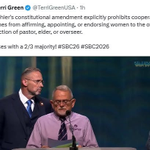
Tolkien inspired and written in response to the constitutional amendment vote that occurred at the Southern Baptist Convention's (SBC) Annual meeting today (06/10/2026) The action wasn't just a title prohibition... "affirm, appoint, or endorse a woman serving in the office or function of a pastor/elder/overseer, specifically preaching to the assembled congregation."

I have updated my website with 2026 conferences where I’ve been invited to present. The first of which is right here at home: Liberty University’s Conference for Teaching Excellence (CTE) opening on January 14th. I have two presentations. One is an academic paper titled “Patience as Pedagogy,” and the other is a video presentation titled “Fostering Peace and Belonging in Digital Learning.” Both come from a deep concern for teaching that forms people, not just outcomes, especially in digital spaces.
The conference is open to Liberty Educators, can count toward CECs, and outside educators have been and can be Invited! I will make both the paper & presentation available on my website after the conference is open.
I hope you’ll check out all 2026 upcoming events and consider joining me! You can also see past presentations there.
dawnsutherland.org/events/
Grateful for the conversations these spaces make possible.
#TeachingAsFormation #PatientPedagogy #WholePersonLearning #TeachingWithCare #DigitalLearning

I sat. I waited. I wrote. 💔
On Death & Cancel Culture
Killing one man,
Silencing another.
Neither is truth.
Neither is better.
Death is no triumph.
Silence has no gain.
All is wrought from a culture of pain.
We clap for graves,
Cheer for falls from grace,
When vengeance condemns,
We’re all erased.
Cancel ….in any way,
Pretends that justice is made,
while revenge just sits, and
sharpens her blade.
None are immune, only delayed.
Broken…proud…elated…true,
We all march toward the same tomb,
Forgetting, erasing,
the very silence that devours the room.
The same silence that pierced one man’s neck,
worked to defeat another man’s breath.
And, still ahe works to break those of us left.
She dresses as power,
She postures as just,
but silence is silence,
and ashes are dust.
In every erosion,
a celebration of death,
lies the broken-hearted
preparing for theft…
of life, liberty, and the pursuit.
To cheer and not grieve is to let vengeance loose.
This is not about sides,
left or right,
not about loss, cancel culture, or national pride.
It is to know we are all human in the end:
Each breath a gift,
not ours to erase,
not ours to profane,
not ours to praise
the death of those who don’t agree,
nor to shout into silence
the ones who think differently.
When we celebrate death
or sanctify silence,
we trade away our dignity,
we surrender to violence.
And, in that forgetting,
in singing that unholy tune,
you lose the very heart
of what God meant to be you.
#CharlieKirk #JimmyKimmel
Honored to have presented at the Tyndale Fellowship Annual Conference in Derbyshire this month under the Philosophy of Religion group. My talk, From Babel to AI: Technology, Human Dignity, and Theological Ethics, explored how artificial intelligence and transhumanism are reshaping the moral and metaphysical ground beneath our feet.
The core argument is simple but demanding. The modern technological imagination is not neutral; it is forming a new ontology of personhood, identity, and community. I engaged voices such as Jacques Ellul, Bonhoeffer, Moltmann, and Aquinas to examine how the covenantal vision of the imago Dei confronts algorithmic priesthoods and synthetic liturgies.
This recording offers a condensed version of the full manuscript, focusing on what matters most: whether these systems will serve communion or fracture it, and whether the church will remember what it means to be human.
📽️ Watch the full presentation here: youtu.be/kWvoBv997zs?si=riWP…
📄 For those interested in the full academic manuscript: dawnsutherland.org/wp-conten…
#AIandTheology #ImagoDei #TyndaleFellowship #Transhumanism #TheologicalEthics #JacquesEllul #Bonhoeffer #PhilosophyOfReligion

This is Clava Cairns, an ancient Bronze Age burial complex located near Inverness in the Scottish Highlands.
Built around 2000 BCE, the site includes three cairns, each surrounded by standing stones and aligned with the winter solstice sunset.
Some stones are carved with mysterious cup marks, ancient symbols whose meanings are still debated.
Were they maps, memories, or prayers? No one knows for sure.
Likely used for elite burials and ritual observance, these cairns reflect a world attuned to time, light, and memory.
Walking this passage means stepping into an ancient longing. These people were not only remembering the dead; they were searching for meaning woven into the fabric of creation.
Even before Scripture, the human heart was already searching for God.
#ClavaCairns #ScottishHighlands #ScotlandHistory #AncientRitual #ImagoDei #FromBabeltoAI #BronzeAgeScotland #ArchaeologistAtHeart


That’s a wrap! Literally, one of the best conferences I’ve ever attended! I learned so much & met some of the best people. Thanks Tyndale Fellowship & @LibertyU for an amazing experience! #FromBabeltoAI #PhilosophyofReligion #BrilliantMinds

Thanks for the spotlight @SBLsite! #TheologicalEthics #PhilosophyofReligion #FromBabeltoAI
a.co/d/fW389OO


Conference leg two is underway… #PhilosophyofReligion #TyndaleFellowship2025

Dr. Dawn Lewis Sutherland retweeted

✍️ “Her silence was never emptiness; it was a protest too holy to be heard by hardened hearts.” —Dawn Sutherland Dawn’s story exposes how control disguised as faith harms women—and how Jesus set her free from bad theology.👉 Read: zurl.co/fltMa #Mutuality
