
Developer of OrthoFinder and https://xitter.cf/t.co/pWdIdp8atF, interested in phylogenomics and all things trees. Former postdoc in the @Steve__Kelly lab.
- Tweets145
- Following353
- Followers612
- Likes92
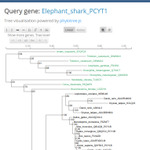

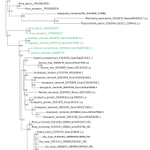

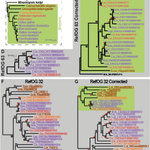
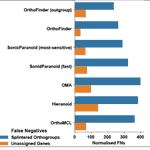
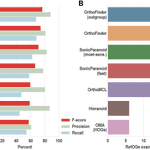
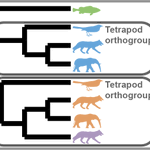


ALT Schematic of SHOOT. It generates a database of phylogenies. A sequence can then be queried against the multiple sequence alignments, and placed on a tree


ALT Propidium iodide stained buds of Physcomitrium patens WT and also a variety of developmental mutants that fail to establish and/or maintain 3D growth.


ALT Structural evolution of mammalian X and avian Z sex chromosomes. The reptilian, avian, and mammalian sex chromosomes syntenic network across 17 representative vertebrate genomes (two reptile, five eutherian mammal, three marsupial, two monotremes, and five avian). The plot was generated by the GENESPACE function plot_riparian. Genomes are ordered vertically to maximize synteny between sequential pairwise genomes. Chromosomes are ordered horizontally to maximize synteny with the human chromosomes [X, Y, 1-22]. Regions containing syntenic orthogroup members to the mammalian X (gold) or avian Z (blue) chromosomes are highlighted. Take-homes: (1) sand lizard Z chromsomes is related to mammalian X, but not avian Z, (2) the budgie Z chromosome has a neo-autosomal fusion absent in all other birds, (3) monotreme X chromomes (which are weird) are non-syntenic with mammalian X, but partially related to the avian Z.


