









David retweeted

Ledger is investigating reports of loss of funds from users in South East Asia who purchased products from a reseller named CryptoBillis. As a precaution, and pending the results of our investigation, we have asked CryptoBilis to pause all sales and shipments of Ledger devices. We recommend Ledger users who purchased from this reseller in the last 90 days to not initiate set up if you have not done so yet. If you have set up your Ledger device, consider moving assets to a new Ledger signer (with new seed). We will continue to inform customers of updates as the investigation progresses.
Reach out to Ledger customer support through official channels with any questions: support.ledger.com/


David retweeted

The vault opens soon.
See you inside.
jup.ag/earn/join

David retweeted

🌎 dear world,
we are beyond humbled by the amount of traffic world.xyz has seen today
it was enough to literally overload the site
out of precaution, we have temporarily taken down the site in order to get fixes in place
💰 all funds are safe!
we are working rapidly to give you the best experience trading possible
the stimmy will resume in force
you're gonna love what happens next
we will communicate here with updates
i love you


David retweeted

⚛️Now that the spam war is over, can we talk about the real upgrade Bitcoin needs?
BIP-110 is dead. 2.53% miner support. Two blocks mined. Stalled. The most decisive governance rejection since SegWit2x. Good. Restricting valid, fee-paying transactions because some people don't like what's stored in them was never a serious proposal.
But BIP-110's failure should not become the excuse to do nothing. Bitcoin does need an update. A real one.
The post-quantum migration is not optional.
Not because a quantum computer capable of breaking secp256k1 is imminent. It's not. Google's Willow has 105 qubits. A cryptographically relevant attack needs millions. But every year, the estimated cost drops. Google's 2025 paper showed a 20x reduction in estimated resources to factor RSA-2048. NIST is deprecating classical public-key cryptography by 2030. The entire security industry is migrating. Bitcoin is not.
For a system whose value proposition is "don't trust, verify," the erosion of trust in the underlying cryptography is existential. You don't need a working quantum computer for that. You just need time.
Four questions that need answers:
1️⃣ Which algorithm? Three NIST-standardized candidates: Falcon (~666-byte signatures, best size, complex to implement securely because of Floating Point Arithmetic), ML-DSA (~2,420 bytes, simplest, 35x larger than ECDSA), SLH-DSA (~7,856 bytes, most conservative, impractical at scale). No perfect choice. But there's a promising alternative: Blockstream Research's SHRINCS and SHRIMPS, hash-based schemes designed specifically for Bitcoin's constraints. The parameters are more practical but they come with other constraints: they are stateful.
2️⃣ What about throughput? A Bitcoin block fits ~2,800 ECDSA transactions. With Falcon: ~1,200. With ML-DSA: ~350. Even the best case cuts throughput by half. The most likely NIST default cuts it by 90%. Hash-based schemes like SHRINCS soften the blow (324 bytes is only ~5x ECDSA), but the stateless fallback path is still several kilobytes. This reshapes Bitcoin's entire fee economy no matter what.
3️⃣ What happens to coins that don't move? ~35% of all BTC (~7.1M coins) already have exposed public keys on-chain. Including Satoshi's ~1.1M BTC. BIP-361 proposes freezing unmigrated coins after a 5-year window, with a ZK-proof recovery path for BIP-39 wallets (which doesn't cover Satoshi's coins for instance). This will be more contentious than the block size war. But doing nothing means those 7.1M BTC become a honeypot for the first entity that builds a CRQC.
4️⃣ Timeline? Core developers estimate a full migration takes 5 to 10 years from activation. No activation date is set. If it slips to 2030, Phase B lands around 2035, right when NIST disallows classical crypto entirely. There is almost no margin left. The window is not the day a quantum computer appears. The window is already open. We're using cryptography to create trust in the security of our systems. With the Quantum threat, this trust is already eroded.
BIP-110 showed Bitcoin can reject a bad idea. Now let's see how fast it can adopt a necessary one.
Stay safe.

David retweeted
The only runway that matters.
The Solana Ecosystem Call, hosted by @solbrotherspod. Get your front row seat, this Thursday 2PM UTC.
Because, Solana wears it best.
David retweeted
We're comfortable being called hybrid or "not DeFi enough."
If it means surviving the next black swan, we'll take it.
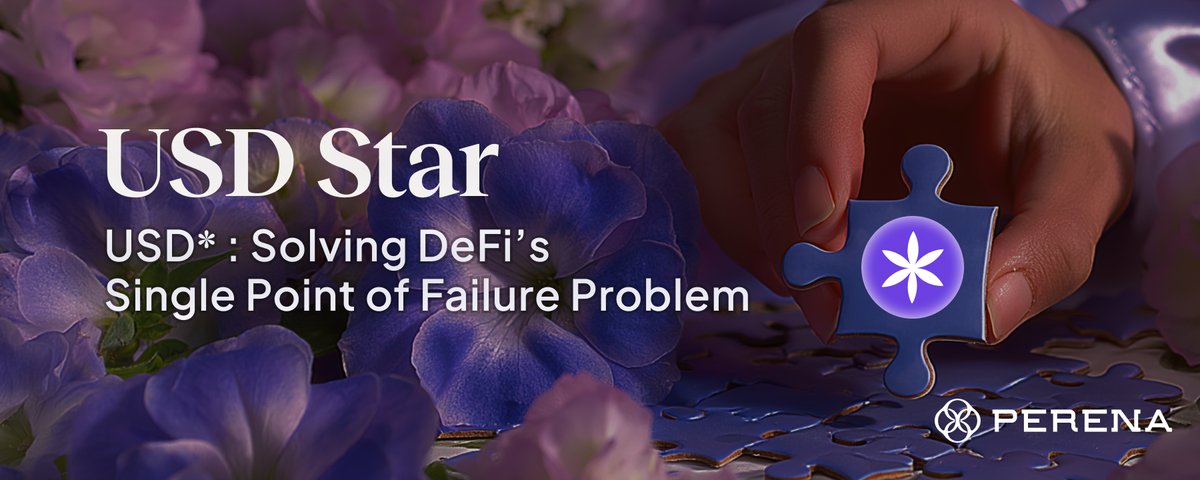
This article covers the single point of failure problem in Defi, and how USD* is designed to diversify.
---
Current underlyings:
Structured credit via @blackopal_fi (23.59%)
RWA via @HastraFi and @onrefinance (48%)
Delta-neutral via @ConcreteXYZ (23.56%)
DeFi lending via @project0 (5.67%)
If one underperforms, others compensate.
---
Formalizing our Due Diligence Process:
Every allocation goes through Investment Committee sign-off.
Security audits before deployment.
Multi-sig custody across layers.
Concentration limits are enforced daily.
Daily, Monthly and Quarterly reviews.

David retweeted

Today has been an extraordinarily difficult day for Drift. I’m incredibly grateful for the outpouring of support from the community.
This is a brief incident report ahead of a full postmortem in the coming days for one of the most sophisticated and novel exploits we’ve seen in crypto.
Drift has been working around the clock with partners, exchanges, and security firms to understand what happened and respond quickly.

Earlier today, a malicious actor gained unauthorized access to Drift Protocol through a novel attack involving durable nonces, resulting in a rapid takeover of Drift’s Security Council administrative powers.
This was a highly sophisticated operation that appears to have involved multi-week preparation and staged execution, including the use of durable nonce accounts to pre-sign transactions that delayed execution.
David retweeted

P-Token, SIMD-266, has been approved 🎉🎉🎉
This change will drastically reduce token transfer costs and in turn increase the capacity of the network
ETA to mainnet - April
David retweeted

The basic argument for @Solana:
- you can build a real scale business on chain, last month apps earned 4x more than the network itself
- apps own the users, there’s no centralized distribution point
- therefore, the most talented & ambitious startup founders eventually find themselves building on Solana because the ceiling for them is as high as possible
- this leads to intense competition to win on every app vector or infra piece, you see this materialize in fights over trading and block building and pAMMs for example
- the net of intense competition is a much faster half life on product iteration & invention, eg the apps get better much faster
- users have better experiences on Solana as a result, which fuels network retention


David retweeted

over the past few weeks, there have been many (fair) questions from the community about $JUP & Jupuary
now, we have a comprehensive plan to address the core concerns, and we're ready to share the approach with you.
come to the JUP Rally on Friday at 3:30pm UTC to learn more 🫡