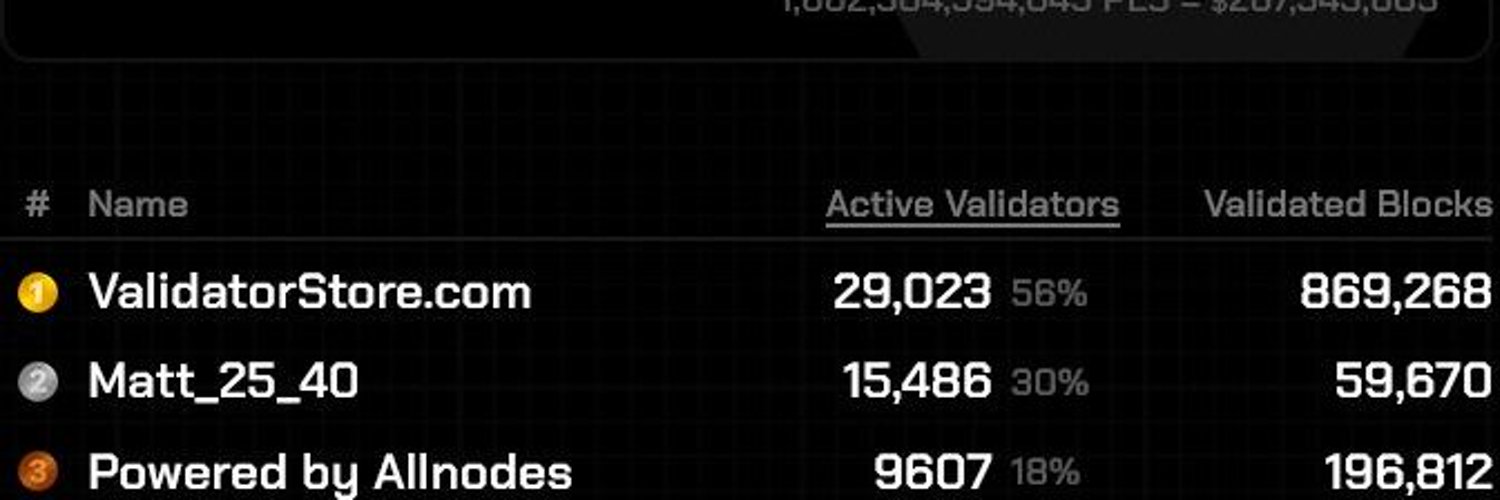

#1 https://xitter.cf/t.co/oEZmfGuINc Validator - https://xitter.cf/t.co/j0sVrfXv5j Proprietor - https://xitter.cf/t.co/AY9ncY4iJW
Hexico
Joined December 2008
- Tweets11.8K
- Following1.2K
- Followers14.4K
- Likes119K




Pinned Tweet
PulseChain agent wallets are live.
I open-sourced an MCP server that gives your preferred AI agent their own encrypted wallet on PulseChain.
Agents can:
• create a wallet
• check balances
• send/recieve PLS and other coins
• make swaps on DEXs
• review and create smart contracts
• do market research
• and what ever you ask it basically
WARNING:
fund it with only what you’re willing to lose, agents make mistakes too
Built for Grok / Cursor / Claude / Codex
Now your AI agents can actually use PulseChain.
GitHub link in the reply below, have your agent review it and then install it for you.
David Feder retweeted

We seen some crazy block fees paid over the past 15hrs!
Top block to a Vouch Validator 38,659,661 PLS 👀


David Feder retweeted

Richard Heart created the world's first time-deposit outside the control of the banking cartel & for that reason alone he was arrested.
David Feder retweeted

I don't recommend anyone scramble to move their funds to new wallets today. But we should take the risks to cryptography from AI-accelerated math seriously, and minimize our exposure to not just quantum-vulnerable cryptography, but also potentially AI-vulnerable cryptography.
The core new area of risk from this viewpoint is, unfortunately, ML-DSA / FHE / lattices.
(and it's also another reason, along with quantum, why ECDSA might fall even faster than expected, hence the "fresh address" recommendation)
So far most people have been in the mode of thinking "elliptic curves broken, hashes safe, lattices safe". But there is a good chance that the concrete security of lattices will take serious hits from the next two years of AI math.
The basic threat model is: factoring is something that naively takes 2^(n/2) time, but over decades smart people have found and optimized number field sieves, and degraded that to 2^O(n^(1/3)), which is why RSA keys and signatures need to be ~400 bytes (and not 64 bytes). What if there are skeletons in the closet like that, both for elliptic curves and lattices, that we are simply not smart enough to discover - but bots soon will be?
This is a major part of the reason why for the past year ethereum's lean roadmap has been going in the "hash-only" direction: no lattices, no ML-DSA, no Falcon, no lattice-based commitments inside ZK proofs, etc. Signatures in lean ethereum are all hash-based, either WOTS or SPHINCS-.
For signatures and proofs, we already know how to go hash-only. The bigger challenge is for *public-key encryption* - and this goes far beyond blockchains. Secure communication, anonymizing protocols, lots of things need public-key encryption.
And unfortunately there are long-standing mathematical theorems showing why public-key encryption cannot be done with hashes alone. You have to have some kind of trapdoor object that has at least one form of usable "structure" - either group theory (incl. isogenies) or lattices or code-based or potentially in the future even more newfangled and spooky things (local mixing?). But for anything that has structure, you should assume that AI will make at least some progress in breaking that structure. Here, one reasonable inference is that if you want to make something plausibly long-term secure, multiply the key sizes by 10.
To me that's a very plausible world and something not at all extreme to predict. If AI will bring us 50 years of math in 2 years, then that 50 years of math may very plausibly include a "naive factoring -> GNFS" level of improvement to our ability to break lattices. In that world, lattices will still exist, but they will have to be significantly bigger to guarantee the same level of safety.
And at those new larger sizes, hash-based constructions will beat lattice-based constructions on concrete efficiency in every use case where hash-based constructions are possible at all.
Theoretically, of course it's possible that hashes are broken too (eg. P = NP would imply that). But I think P = NP is very unlikely. And intuitively, it's much more likely that a mathematical object has exactly no exploitable structure (like hashes are intended to), than that a mathematical object has exactly ~3 forms of exploitable structure (for elliptic curves: associativity, Schoof, pairings) and not some secret fourth form of structure we have not yet discovered that greatly degrades its security (for elliptic curves, ECDLP and pairing security). Similar for LWE, SVP, RLWE and the zoo of lattice problems.
For this reason, we do not yet see any reason to worry and start padding the byte size of hashes (if we start to worry more, we would pad the round count first before doing anything to the byte size).
Concrete TLDR, my own personal views:
* Hash-based > lattice-based, in those situations where hash-based is possible at all
* For anything lattice-based, be much more paranoid on param sizes. Remember that blockchains are only a small portion of the cryptography story; this point goes far beyond blockchains and applies to eg. access to websites, secure messaging, Tor / VPNs ...
* For privacy protocols, strongly favor NOT putting encrypted notes onchain. Instead, send them offchain through some third-party mechanism.
* If it's not difficult for you, keeping your funds in addresses which have not yet been used to make a transaction is a good idea. If it's easy for you, do it. **But be careful about migrations; I personally have lost more money in botched migrations than I have lost in all hacks combined**.
* For multisig wallets, doing confirmations offchain is better than onchain, because this way the signatures of signer wallets do not get exposed to the public, so if ECDSA falls to AI much faster than expected, at least the multisig "gracefully degrades" to a 1-of-1 where the 1 is whoever was gathering the signatures - a much better place to be than "anyone can take the money"
firefly.social/post/x/210783…

David Feder retweeted
⚡️ VOUCH HAS BUILT A FULL MEV STACK
For the past few months we've been building the open infrastructure that allows operators across the stack to participate in MEV on Pulsechain.
This is live now!
🧵 Here's what we built and why ↓

David Feder retweeted

Ethereum, Solana, Don't open up your metamask for a while, and if it's open, close it. Their infra got hacked. Which means the chances of someone pushing an evil update are probably higher.
I tell everyone how to do things better, but they don't listen, lol. Auto-updates are a huge security risk.
This is why the software at PulseChain, PulseX, HEX, is software you can download and not worry about it autoupdating on you.
Hopefully metamask gets it all sorted, but even if they do, autoupdate will still always be a threat to you.
Just looking out for you all out there.


David Feder retweeted

They want to steal your freedom. The Clarity Act is not your friend!
Some say, “we need regulation”, forget, regulation & rules only stop good actors. Bad actors will always do bad things.
Don’t regulate your freedoms away.
Crypto is meant to be a place of financial freedom!
David Feder retweeted

We've rolled out a major upgrade across our public RPC endpoints — @PulsechainCom (mainnet + testnet) and Ethereum. Same URLs, same methods you use — now faster and more resilient:
David Feder retweeted
.@adam3us called me a "scammer and con-artist."
His Bitcoin sidechain just got hacked for $320 million of BTC. How's that bag of dicks taste Adam? Adam is CEO/cofounder of blockstream btw.
P.S. PulseChain is better than your trash. Loser, lol.
Also, shout out @Excellion, @NickSzabo4 & other Blockstream hoes. Lol. Kneel.
P.P.S Magnanimus in victory.
BTW, some large portion of Bitcoin has despised blockstream for many many reasons for a very long time. It's probably the majority opinion if I had to guess. A cancer upon $BTC.


Your agent can now actually use PulseChain with you.
v1.0.7 of my free PulseChain MCP and agent wallet is out. Research mode is the default so it doesn’t touch a wallet unless you ask. The wallet comes empty, you'll need to send some PLS to your agents wallet address before the agent can use it.
Works with Grok, Cursor, Claude. Testnet PulseX support has just been added for devs.
If you already have an agent, this is the easiest way to let it check the chain, pairs, and HEX without you pasting explorers all day.
If you already run a PulseChain node at home this plugs in nicely. Same box can feed your agent.
Research only by default. Fund the agent wallet only if you want it to spend.
github.com/DavidFeder/pulsec…


David Feder retweeted
valdash.g4mm4.io was lagging a little in indexing. Released version v0.0.95 should be good now.

David Feder retweeted
The RPCs and websites I run, which are free for @PulsechainCom users, had about 36 hours of downtime a few days ago because of a service provider issue. 2 years of uptime, no service has zero downtime
g4mm4.io/endpoints-and-resou…
I apologize for the disruption; it's been resolved
I'm still building ValCloud, the new way to solo stake PulseChain. Your keys. Your 32M PLS. Your consensus rewards. I just run the machines.
Public access soon. #PulseChain

I'm working on a new product for PulseChain to democratize PLS staking.
ValCloud — self-service validator hosting without running your own node:
• Keys stay local • Only encrypted keystores are uploaded • I host the validators/hardware • You keep your stake + consensus rewards • Unstake whenever you want
No liquid staking token. No derivative wrapper. No hardware needed.
You basically get free PLS coins daily if you've got the 32 million PLS minimum.
Still in development / private testing. Public access coming soon.
#PulseChain
If you like running your own stuff at home, this box is for you.
Same machine I ship for PulseChain validators also makes a solid home RPC. 64GB RAM, 4TB. Run your own node so you’re not reliant on a public endpoint. Or give Grok a real local computer for builds and MCP.
🤖 Made with AI
$3000 all-in, shipping included. Fully loaded and tested NUC, portable monitor, keyboard, Ubuntu USB.
validatorstore.com
🤖 Made with AI

David Feder retweeted

When DexScreener breaks, Hexologist.com keeps reading PulseChain/Hex/PulseX prices straight from the blockchain.
Direct on-chain pricing.
Built different.