

@DaveLindell
Account based inUnited States!
About this account
- Account based in
- United States
- Connected via
- United States Android App
X says this location may be affected by a proxy or VPN.
Account-level information from X, not a live location or the device used for a specific post.
Assistant Professor @UofTCompSci Faculty Affiliate @VectorInst
Toronto, ON
Joined June 2012
- Tweets314
- Following399
- Followers2.2K
- Likes750


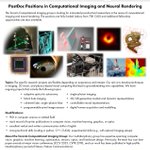


It's amazing how much you can scale up the output resolution and speed of image generation models without any re-training.
The trick here is to leverage the more local behavior of attention in later diffusion steps to accelerate attention within diffusion transformers.

📢🚀 Excited to share
AReA: Adaptive Receptive-Field Attention for Efficient High-Resolution Diffusion Transformers
Training-free, up to 6× the native resolution, up to 3.2× faster.
📄Paper: arxiv.org/abs/2610.17227
🌐Webpage: rajabi2001.github.io/area
🤗HF: huggingface.co/papers/2610.1…
David Lindell retweeted

Robots making rapid progress in "learning to learn"

David Lindell retweeted

(1/n) Watch our robot search a box and find textured balls, entirely without vision!
Over the past few months, it’s been incredibly fun to work on bringing touch into our Direct Video-Action (DVA) model. Here’s how our video model is “seeing” through touch 🧵
We gave our robots a sense of touch!
Excited to finally share this work with @AndrewEJXie, @leooeld, and the @rhoda_ai team!
Some technical details on the tactile sensor and robot policy: 🧵
5/
By combining the tactile sensor with our Direct Video-Action model, we created a robot that searches for, identifies, and grasps objects (even without vision).
Full writeup: rhoda.ai/research/giving-rob…

6/
Also check out Roland Johansson's work: without tactile feedback humans have a lot of trouble with even simple tasks like picking up a match.
It really seems like robots ought to have a sense of touch!
youtube.com/watch?v=0LfJ3M3K…
There is a lot to appreciate in these demos—recovery from errors, the length and complexity of the demonstrations, and targeting actual, real-world tasks.
Great to see more robot demonstrations from @RhodaAI — recovery behavior, challenging customer use cases, and reliable autonomous operation over extended periods of time.
David Lindell retweeted

Excited to share that ProxyPose has been accepted to NeurIPS 2026! 🎉
We track the 6-DoF motion of any query pixel using video-to-video translation. Grateful to @taubnerfelix @pooja_ravioli @kyroskutulakos @DaveLindell for making this happen!
Details: ruihangzhang97.github.io/pro…

Introducing 📢📢ProxyPose📢📢
✨Track 6-DoF motion of any query pixel via video-to-video translation
📰ArXiv: arxiv.org/abs/2607.06555
💻Code: github.com/ruihangzhang97/pr…
🌐Webpage: ruihangzhang97.github.io/pro…
David Lindell retweeted

At Rhoda, we care deeply about the science of pre-training for robotics.
In one of the most rigorous studies of its kind, over thousands of trials and hundreds of hours of robot evaluations, we show how scaling web-video pre-training leads to better real-world robot performance.
Fantastic overview and analysis from @tongzhou_mu and @RhodaAI on how video model pre-training affects robot performance! One takeaway is that improved video generation quality after pre-training correlates directly with better robot task performance after post-training.

Does scaling pre-training on general web video improve a complex manipulation task in real deployment?
We scale model size and pre-training compute, and test on one industrial task.
Yes. The better a pre-trained model predicts web video, the better its post-trained policy. 🧵

ALT Seven pre-trained video-model checkpoints on one chart. Task performance on a real robot (at-speed completion rate: every requirement met within 100 s, 0 to 100%) rises with pre-training quality (DINO FD on held-out web video, log scale, axis reversed so better is to the right). XS, S, M, L are model sizes. The four M points are one model at 0.08×, 0.18×, 0.37× and 1× of its pre-training compute.
David Lindell retweeted

I’m incredibly excited to introduce @VeedaAI , which I co-founded with my incredible longtime collaborators @ZGojcic and @HuanLing6 .
We started Veeda because we believe robotics will reshape the world—changing how we move people and goods, how we manufacture and build, and how we operate in the physical world.
We also firmly believe that the scaling moment for Physical AI will come from robots learning through interaction with the world.
Just like humans learn from interaction with their environments by trying, failing and trying again, until we succeed. And just like the capabilities of LLMs were truly unlocked when they started training in interactive environments and not only on vast amounts of internet text.
For Physical AI, the central challenge is making this kind of interactive learning possible at scale. The real world is simply not a practical training ground for robots to learn through trial and error. It is unsafe, expensive, and time-consuming. To scale interactive learning, robots will need to learn in simulated reality.
At Veeda, our sole mission is to build simulated reality for Physical AI. Our conviction is that this will become the critical infrastructure layer for all areas of robotics.
As envisioned in pop culture, this means building “the Matrix” for Physical AI, where, through a virtual embodiment, robot intelligence can interact with an entirely virtual world in a million possible ways, learning from its own mistakes.
We believe that World Models are the foundational technology that can make this possible. These generative models learn from massive amounts of sensor and physical-world data to reach the quality, diversity, and physical realism of the simulated reality that robots require.
I could not be more excited to take on this challenge and build this transformative technology alongside an extraordinary team of engineers and researchers who have spent years working on some of the hardest problems across simulation, generative AI, 3D, robotics, and embodied intelligence.
Together with our investors at @khoslaventures and @radicalvcfund , we intend to push the frontier of this technology and build the foundational infrastructure for interactive robotics learning and evaluation at scale.
Come build this future with us.
And to roboticists, help us understand what you need, we’re building this for you.
veeda.ai

Many photographs have motion blur, whether from hand shake or movement in the captured scene. Post-training a video model allows us to turn a motion-blurred image into a video sequence that is consistent with the recorded blur. Your blurry photos are worth more than you think!

🌟We introduce a method for revisiting historical photos and bringing them to life. Specifically, our model generates video from motion-blurred images.
📢 Blur2Vid (Transactions on Graphics, SIGGRAPH Asia 2025)
Webpage: blur2vid.github.io
Paper: arxiv.org/abs/2512.19817
David Lindell retweeted

My talk on "Generative Rephotography with Video Models" is public at youtube.com/watch?v=t1jlQYqk…
I discuss our SIGGRAPH Asia 2025 papers on leveraging video models to get more out of your blurry images.
Enjoy!

ProxyPose uses video-to-video translation for 6-DoF tracking! A pre-trained video model solves the hardest part of the problem by generating an easily tracked "proxy" object that follows the motion of a query surface region. Then, tracking the proxy object is trivial with OpenCV.
Introducing 📢📢ProxyPose📢📢
✨Track 6-DoF motion of any query pixel via video-to-video translation
📰ArXiv: arxiv.org/abs/2607.06555
💻Code: github.com/ruihangzhang97/pr…
🌐Webpage: ruihangzhang97.github.io/pro…
Conventional coherent lidars are typically difficult to implement and don't recover polarization information. We designed a new type of coherent lidar using an off-the-shelf optical modem, commonly used in telecommunications, to recover depth, velocity, and polarization!

🚀Excited to share our Optica work! New lidar system simultaneously recovers location, speed, and material properties! (🔗dongyu-du.github.io/project/…)
Thanks to all collaborators @AndrewEJXie, Parsa Mirdehghan, Brandon Buscaino,@SeungHwanBaek8, Kiriakos Kutulakos, and @DaveLindell

Congratulations, @KellyKZhu! It was great to work with Kelly during her MSc, and I'm excited for her to start her PhD at CMU. See here for all of Kelly's work, and more exciting things to come soon: kellyzhu.ca/

Seeing research come to life 👀
Kelly Zhu, MSc graduate in computer science, works across AI, robotics and computer vision — and shares what comes next ↓
uoft.me/cs6