
https://xitter.cf/t.co/23QqK2rab7. Tournament Analysis, Comps, Stats, Builders, Simulators, Pro Hacks and 20+ TFT features.
Joined December 2023
- Tweets763
- Following206
- Followers7.3K
- Likes374
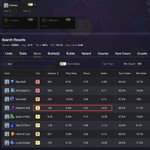
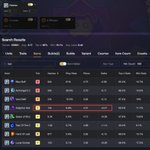


DataTFT S Tier Recommend——Solar Karma(Used to be Yunara)
-After three days of high-level testing on the CN Super Server, we believe Solar Karma has fully reached S-tier strength.
-With 7 Riftbeast in the meta, Karma is much easier to 3★.
-Hitting 3★ Karma + multiple items early can already create a strong winstreak in Stage 3.
-After reaching Level 6, keep rolling and use Blossom Wisp to reach five 3★ units, while still keeping enough economy to go Level 7 at any time.
-Component usage is very balanced, so your 2nd and 3rd augments can comfortably be item-focused.
-Feed either Yunara /Leblanc as 2nd carry in Stage 4. 3 Carry can help you win the game with top 3 secure.

It may not be as good as 7 Riftbeast but this is Super Server we talking about. The game experience of playing this comp is completely different from any other reroll comps.


DataTFT 18.4b Comp Speedrun
-Riftbeast has very solid data, whether you’re rerolling Pebbles or Cinderling.
-The old Solar Yunara comp used to require a Level 6 rolldown, but using Karma as the early-game bridge makes the comp much stronger now. Its performance on the CN Super Server is close to S Tier.
-Eclipse Aphelios performs extremely well when you have a Lunar Emblem.
-Azir is still clearly the best 3-cost carry in the current meta with 3 comps in S&A Tier


datatft.com/yundian
-See what comps are being played today
-Compare today’s meta with previous days
-Track how the environment changes throughout the qualification period

As a product manager who has worked in the tech industry for over 10 years, I find it quiet difficult to understand how an issue that affects such core user experience could make it into production.
If the necessary regression testing was not done before release, that points to a fundamental gap in the release process. If it was done and the issue still wasn’t caught, then the test coverage and release criteria need to be reviewed.
149’s criticism strikes me as very fair — if anything, it’s already quite restrained. I’m concerned that what this incident has exposed may only be one part of a deeper quality management problem.

As one of the original Riot defenders during pbe, asking people to give Riot time to transition to the new engine, this is really saddening to see.
Obviously, I have no idea what actually goes on at Riot, nor am I knowledgeable enough about software engineering to understand how an engine switch affects the development process, etc. But I can't help but wonder: how hard is it actually for the game to go through a basic QA process?
18.3 B-patch – "Inadvertent rollback"
18.4 patch – "Critical bugs and rollback"
Major Polymorph – Disabled when the simple fix would be to just make it do what its description says.
Bramble Vest – 3.5 AVP on its Radiant version for four patches without raising any eyebrows.
Nidalee and Brambleback – Both had the same bug where their armor ignore inversely scaled with AP, yet when Brambleback was fixed, Nidalee remained bugged for another patch.
And there are many more examples of miscommunication and obvious mistakes that made it into live patches, many of which could have been easily caught through basic QA.
Many of you may know me or follow me because of the Set 15 Rammus pissing doc. Obviously, since then, I have grown as both a person and a player.
What I am about to share are my observations, criticisms, and questions directed at the TFT team, coming from a player who, like many others, shares a passion for TFT and wants to see the game in its best possible state.
The following discussions will be lengthy, so bear with me.
1. QA
How have there been two instances of inadvertent rollbacks within the first four patches of the set? It feels like even a simple check to ensure that the numbers matched the intended changes could have prevented these issues.
Yet here we are, just days before Trials, an event where players hope to see their hard work finally pay off, with a game that doesn't even have a functioning ranked queue.
I would like to ask for greater transparency regarding the QA process. How are mistakes like these slipping through testing and making it onto live servers? What measures are currently in place to prevent them, and why have they seemingly failed on multiple occasions?
I understand that mistakes are inevitable in game development, and I don't expect every patch to be perfect. However, repeated issues of this nature raise legitimate concerns about the effectiveness of the current QA process. I believe the community deserves an explanation, as well as greater accountability and clearer steps toward preventing similar mistakes in the future.
2. The New Client
I know I've previously advocated for giving the team time to adjust to the new client during PBE, and I still stand by what I said back then. However, at what point do we consider pulling the plug and putting it back in the oven?
Obviously, as an outside observer, I have no idea what the costs in terms of manpower and resources would be to revert to the old League client, where we all played as eight kaisas with ghost. However, being told to "bear with us" every single patch, while game breaking bugs continue to pile up to the point where players have seemingly given up complaining about them, raises the question: is this really the right direction for the game?
I understand that the team wants Vegas to be played on the brand-new client, and I can appreciate the ambition behind that goal. However, in my opinion, having a functional older product is far better than pushing forward with a newer one plagued by game-breaking issues that make the game less about skill and more about how well players can navigate or avoid bugs.
Whether it's neutral rounds disappearing, games failing to load, or units simply refusing to cast, these issues directly undermine the competitive integrity of TFT.
I'm not suggesting that reverting to the old client is necessarily a simple or even feasible solution. However, I do think it's fair to question whether continuing to push forward with the current client, despite its ongoing issues, is genuinely in the best interest of the game and its competitive players.
3. Player Count and the Long Term Health of TFT
Due to the myriad of issues this set has faced, whether it's balancing, bugs, lag, or problems with the new client, many high-level players I know, myself included, have gradually lost motivation to play the game.
I would imagine this problem could be even more significant among casual players, who generally aren't as committed to improving at the game as competitive players are, and therefore have fewer reasons to stick around when the experience becomes frustrating.
With the public reception of the last five sets seemingly being largely negative, with the exception of Set 16, I can't help but worry about the long-term health of TFT. While I don't have access to the actual player count or revenue figures, I'm concerned that the game could be heading toward a downward spiral that may eventually become difficult to recover from.
Fewer players could mean less revenue, which could lead to reduced investment in the game, further worsening the player experience and driving even more players away. It's a cycle that, once started, can be incredibly difficult to reverse.
I genuinely love TFT, and the last thing I want is to see a game that I've invested so much time and passion into slowly fizzle out.
4. Balancing Through Numbers
I remember Mortdog mentioning in one of his walk the dogs that the developers don't have a "magical calculator" that can simply tell them the correct numbers for balancing (not trying to throw him under the bus here), and I've always wondered: why not?
At its core, TFT is a game built around numbers: AD, AP, attack speed, whatever. While I understand that balancing a game as complex as TFT involves far more than just comparing raw stats, I strongly believe that a more systematic, mathematical approach to evaluating the relative value of different traits, units, and mechanics could help prevent many of the balancing issues we regularly encounter.
For example, I've seen Chinese Bilibili creators break down the numbers behind 6 Juggernaut this set and demonstrate just how overstatted it is relative to what one might expect from a 6-piece trait. My question is: why can't similar analyses be conducted internally before a patch goes live?
I'm not suggesting that a mathematical model could perfectly predict the strength of every composition. Obviously, factors such as unit synergy, positioning, itemization, and the broader meta introduce complexities that can't be fully captured by raw numbers alone. However, surely there is value in establishing a quantitative baseline for what a unit or trait should reasonably provide at a given investment level.
The most recent patch is a particularly frustrating example. Many players were already aware of how strong 6 Juggernaut was, yet the trait went untouched. As a result, its play rate surged, significantly shaping the meta, with Amumu reaching a play rate of over 3.7, one of the highest numbers I've seen for a 4 cost.
This raises a broader question about the team's balancing methodology. How much of the process relies on mathematical modeling and internal simulations, as opposed to live performance data and subjective evaluations? Because to put it bluntly and quoting other players, it feels like the team is "using ai to balance the game".
Once again, I genuinely believe TFT is one of the greatest games ever created, but seeing it in such a broken state saddens me and makes me deeply concerned about its future. For the first time since I started playing, I've taken a set-long break, and I sincerely hope TFT can make a strong comeback in time for Vegas.

【2/2】During the run
-Stop ends the timer and records the run
-Reset returns to the pre-timer state, so you can repeat the exact same setup
-Full Salvage history is shown at the bottom
Simple way to practice Salvager Wisp and improve your speed.
datatft.com/rolldown/salvage

【2/2】During the run
-Stop ends the timer and records the run
-Reset returns to the pre-timer state, so you can repeat the exact same setup
-Your full Salvage history is shown at the bottom
Simple way to practice Salvager Wisp and improve your speed.
datatft.com/rolldown/salvage


To prove that Yunara is not BS, I played 7 games with Yunara reroll out of 11 total games in a row.
2132333...
I even played it 2 times with augment like Cluttered Mind...
FAKE LP lol


More links:
All in one datatft.com/comp/rank#16284-…
Builder datatft.com/simulator/DAi3Bt…
Comp Tier datatft.com/comp/rank
AVG 3- if you make everything right. I would say its quite playable and strong in 18.2. A tier for sure
bilibili.com/video/BV1XBY26B…

