

Enhance Salesforce, Genesys, Okta, Microsoft 365, Teams and customer apps with secure document and message exchange.
Morristown, New Jersey
Joined June 2009
- Tweets10.5K
- Following1.2K
- Followers1.3K
- Likes265
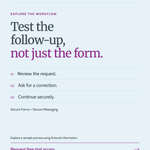





For #CybersecurityAwarenessMonth: follow a sensitive request beyond “Submit.” Where does the data go, who can access it, and do follow-ups stay secure? datamotion.com/free-trial/

Direct vs. FHIR? Wrong question.
Better questions: ✅ Who's exchanging data? ✅ How is trust established? ✅ What happens next? Read more: dminfo.link/4ytFk6Z
#CybersecurityAwarenessMonth #HealthIT

Our address has changed. Our focus hasn't.
Organizations still need to exchange documents, forms, messages, and data securely, compliantly, and efficiently.
Learn more: datamotion.com
🤖 Made with AI

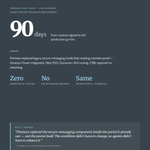
What members noticed during Premera's secure messaging migration:
Nothing.
✅ Zero downtime
✅ No CSR retraining
✅ Same member portal
✅ Live in 90 days
That's what happens when secure exchange fits the workflow instead of disrupting it: dminfo.link/4iCtBi6

A global wealth manager avoided a multimillion-dollar rip-and-replace by replacing only the end-of-life component, migrating 2TB of history, and handling 10,000 messages on day one. dminfo.link/4hgmVUu

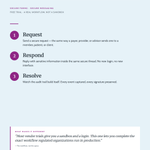
Most vendor “trials” are a sandbox and a login. You get a demo tenant, a test recipient, and a walkthrough that ends before any audit.
Ours is a workflow.
➡️ Request
➡️ Respond
➡️ Resolve
Run it end-to-end. Request your trial now: bit.ly/4ix3uJl

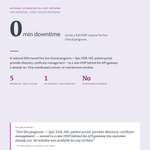
One coordinated cutover across all five programs?
No maintenance window?
Existing API gateway had to stay in place?
No problem.
Read case study: datamotion.com/case-study/na…

The debate that keeps buyers stuck is standards-vs-standards. The real question is workflow fit.
Full argument from our VP Product & Partnerships, Andrew McKenna: datamotion.com/direct-vs-fhi…

Payer-to-payer continuity of care → Direct today, FHIR-based APIs where they're live.
Cross-organization network exchange → TEFCA/QHIN plus Direct as the delivery rail.
EHR-embedded clinician workflow → EHR-native surfaces plus Direct behind the scenes.
Referrals & transitions of care → Direct. Push, closed-loop, HIPAA-covered, no portal.
Patient access & consumer apps → FHIR. Pull, on-demand, standardized APIs.
Discharge & post-acute handoff → Direct with FHIR adjunct where the receiver supports it.
Which interoperability standard should we win on?" is the wrong question.
"Which exchange model fits this workflow?" is the right one.
Six common healthcare workflows, and the model that actually fits each one. ↓
Secure delivery is table stakes. The real value is in the workflow around it.
Coming soon: why secure messaging drives productivity, why Direct vs. FHIR is the wrong question, and a hands-on trial built around a real secure request workflow.
The DataMotion Secure Forms + Secure Messaging Free Trial is now open to a limited number of participants.
Build a secure form from a prompt or PDF, collect sensitive information, request corrections, and continue the conversation securely.
Request access bit.ly/4wIPlvR

Both publications, linked below:
CyberDB: bit.ly/4fe5C6K
CyberPress: bit.ly/44JGAWY

Secure comms has to do more than protect the message. For healthcare and financial services, it also has to support compliance, preserve trust, and fit into daily workflows.
We were recently included in two cybersecurity articles on email encryption and HIPAA/FINRA compliance.

Secure communication works better when it stays inside the workflow.
Less context rebuilding.
Less switching between systems.
Less effort to keep work moving.
The value isn’t only that the message is protected.
It’s that operating the process becomes easier.

Standard security checks miss a key point: how will it work in practice? If secure communication doesn't integrate seamlessly into existing workflows, hidden costs like low adoption and slow resolution emerge. Beyond security and compliance, workflow fit determines scalability.

This Memorial Day, we remember the men and women who made the ultimate sacrifice in service to the United States. We honor their sacrifice, their lives, and the families who carry their memory forward.
Secure communication doesn’t usually fail because the message is unprotected.
It fails when the workflow around it can’t scale.
More users. More systems. More handoffs. More manual work.
That’s how broken workflows start costing you.
Secure work has to stay inside the workflow.

