

The Center for Data Innovation conducts independent research and formulates public policies to enable data-driven innovation in the public and private sector.
Washington, DC
Joined October 2011
- Tweets34.9K
- Following4.2K
- Followers13.8K
- Likes1.5K






AI model security should become a core pillar of U.S. cyber defense.
Congress and the administration should combine targeted laws with technical investment and allied cooperation to counter adversarial distillation without isolating U.S. innovators.
Read the full strategy:
vist.ly/5p3wd

Stay ahead of the curve. ⚡
Our free weekly newsletter breaks down the biggest developments at the intersection of data, tech, and public policy—plus expert analysis, interviews, and standout datasets and visualizations.
🔗 Sign up:
vist.ly/5n2x2

Center for Data Innovation retweeted

🚨 Growing opposition to data centers is putting billions in investment and millions of jobs at risk.
In 2026 alone, local opposition has reportedly led to the cancellation of $260 billion in planned U.S. data center investments...🧵

ALT Text about data center opposition with a woman on the right.
Center for Data Innovation retweeted
AI & predictive analytics have the potential to transform how policymakers anticipate emerging challenges & make informed decisions. 🔎
At the 2026 STEPI Intelligence Dialogue in Seoul, South Korea, ITIF President @Castrotech discussed how these technologies can strengthen science & technology policymaking.

ALT Man in suit speaking at a conference with a nameplate reading Daniel Castro.

ALT Two men in suits discussing on stage with digital display behind them.

ALT Three men in suits participating in a panel discussion.

ALT Panelists seated on stage at the 'Intelligence Beyond Information Network' conference.
AI adoption requires both technical skills and domain expertise.
Universities should prepare students not only to build AI systems, but also to evaluate and deploy them in organizational, legal, and policy settings.
Read how programs are evolving👇
vist.ly/5nqyf

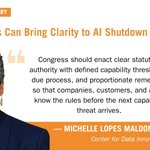
A global AI shutdown can backfire if users simply move to foreign or open-weight models that U.S. authorities cannot patch or monitor.
Congress should require evidence of a real security benefit before restricting U.S. models.
Read the full analysis👇
vist.ly/5nj9m

Europe has about 5% of global AI compute capacity, versus roughly 75% for the U.S.
Open models offer Europe a path to AI leadership that depends less on concentrating massive compute and capital.
Read more in our analysis ⤵️
vist.ly/5neuf

Center for Data Innovation retweeted
Introducing ITIF’s EU Kids Act Bulletin—a new biweekly Substack tracking the latest EU regulatory developments on child online safety. 🇪🇺🚸
As negotiations over the KIDS ACT move forward, stay informed with timely policy updates, analysis, and insights into what these developments mean for the future of the Internet.
Subscribe here⤵️
vist.ly/5ndbs
U.S. policymakers should encourage AI experimentation, spread best practices, and invest in workforce training.
The bigger economic risk is underusing a technology that can raise productivity and strengthen competitiveness.
Read more👇
vist.ly/5ndt7

More capable AI doesn't necessarily mean less safe AI.
Advanced systems could also improve threat detection, follow constraints more reliably, and help researchers identify vulnerabilities.
Progress and safety can reinforce each other👇
vist.ly/5n97f

Congress is considering legislation that would let the government order AI shutdowns during emergencies.
But developers already have tools to intervene. Policymakers should ask what additional protection a mandate would provide.
Explore the debate👇
vist.ly/5n7yb

Center for Data Innovation retweeted

Have you kept up with the latest on how the EU plans to protect children online?
Our new fortnightly Substack from @ITIFdc tracks the latest developments in EU policy on child online safety—and what they mean for the future of the Internet, digital freedom, and online safety.

As negotiations over the KIDS ACT get underway, we'll be publishing a fortnightly round-up of regulatory developments and policy analyses.
Subscribe below – and give us a heads-up if you have analyses we should feature in the next edition!
eukidsact.substack.com/p/eu-…
Center for Data Innovation retweeted

As negotiations over the KIDS ACT get underway, we'll be publishing a fortnightly round-up of regulatory developments and policy analyses.
Subscribe below – and give us a heads-up if you have analyses we should feature in the next edition!
eukidsact.substack.com/p/eu-…
Concerns about data centers driving up electricity costs are legitimate. But stopping construction isn't the only answer.
Policymakers can establish rules that fairly allocate infrastructure costs while allowing investment.
Read more👇
vist.ly/5n43s

Europe is unlikely to outspend the United States or China in building the most powerful closed AI models.
Its best opportunity may be to lead in open AI, where customization, collaboration, and efficiency matter more. 👇
vist.ly/5mqur
An Anthropic researcher estimates a greater than 10% chance of AI causing human extinction within a decade.
But no empirical model supports such a precise probability. AI safety policy should reflect evidence, not speculation.
Explore the argument ⤵️
vist.ly/5mprz
Machine learning can help breeders predict crop performance under changing climate conditions.
In our 5Qs series, Sebastian Schultheiss, CEO of Computomics, explains how combining genetic and environmental data can improve breeding decisions.
Read the interview👇
vist.ly/5mm44

A government-mandated AI kill switch may sound like a straightforward safeguard against rogue AI agents.
But it could introduce new cybersecurity risks without solving the underlying problem of controlling autonomous systems.
Read why👇
vist.ly/5mkb3
Data centers can create jobs, generate investment, and expand economic opportunities, just as clean energy projects do.
Democrats should recognize these benefits while ensuring local communities share in them.
We explain the parallels ⤵️
vist.ly/5mis5
AI model theft can cross borders and jurisdictions, limiting the reach of U.S. sanctions.
The United States should work with allies such as the UK, Japan, Canada, and France to establish common norms against state-backed theft.
Learn why international coordination matters👇
vist.ly/5mdua
