

Part time small speculator
Joined July 2023
- Tweets3K
- Following1.1K
- Followers1.7K
- Likes2.3K





Dary retweeted

This is burnout, and if you want to survive as a trader, you must learn to recognize it.
True burnout is not just being overworked, nor is it something you can push through. It is a feedback loop that occurs when your body experiences intense, prolonged stress.
Stress is part of life, and under normal conditions you can recover from it easily. In fact, many dimensions of human performance - strength, endurance, mental acuity - actually require stress in order to grow.
However, growth in response to stress can only happen when the stress is manageable and offset by periods of recovery. When the stress is extreme and constant, the body fails to adapt and enters a downward spiral.
As stress accumulates, several things happen physiologically:
- sleep is disrupted
- hormones become dysregulated
- mental performance degrades
- heart rate variability falls
- inflammation rises and immune function declines
The problem is that each of these effects also *reduces your ability to withstand and recover from stress.* So you enter a vicious cycle where recovery becomes impossible and performance steadily deteriorates.
The experience @agapestride describes here is exactly what it feels like to burn out from trading. And if you find yourself in this situation, the most important thing you can do is *recognize what has happened.*
You are not dumber than you used to be. You are not more indecisive. You are not more impulsive, fearful, or greedy. You are simply physiologically impaired by severe, chronic stress.
When you notice the signs of burnout, you must prioritize recovery above all else:
- cut your risk
- stop looking at charts
- get off social media
- play sports or start running
- spend time with friends and family
- go hiking or traveling
- take lots of hot baths
As much as it feels like the best time to make generational wealth is RIGHT NOW, the market will always be here. So take a break and don't come back until you know your body can handle it.

Dary retweeted

TL;DR for people who don't know cryptography:
Every Bitcoin wallet has a public key and a private key.
Your private key lets you spend your BTC, so it's known only to you.
Your public key is used for receiving btc. BTC relies on elliptic-curve cryptography to protect private keys.
Public key can be visible when transacting, because with today's math, deriving private key from public key is effectively impossible.
Drake is worried AI could discover a mathematical shortcut that changes that.
If that happens, anyone whose public key is already exposed (early btc transactions exposed it) could have their coins stolen.
That's why he's telling people to move funds to fresh addresses whose public keys are still hidden, and rotate addresses after spending.
Interestingly, most of Satoshi's BTC already has its public keys exposed, so it will be the first target for the attack :)

Today I call upon the blockchain industry to calmly begin planning for "bunker mode". My personal recommendation is to set in motion a controlled mass migration of assets to fresh addresses, i.e. addresses whose pubkeys remain hidden behind a hash.
Holders, starting with large and sophisticated ones, should consider moving the bulk of their funds to addresses that have never signed a transaction. And when they do sign one, they should also move remaining funds to a new address (possibly generated from the same seed phrase).
Don't rush. While I believe there is cause for action a rushed migration would do more harm than good. Don't panic either. Moving assets to protected addresses is a simple, preventative step which does not require new cryptography or new wallets.
IMO it is now reasonable to brace for the possibility that ECDSA breaks before qday, in the worst case in months not years. By "break" I mean fast private key recovery (e.g. in one week) on available hardware (e.g. a large GPU cluster).
Recent days have been humbling for human mathematical intuition. Long-held, unquestioned hypotheses have fallen. This includes the n log(n) bound for integer multiplication and the 3SUM conjecture. In hindsight, May's unexpected disproof of the Erdős unit distance conjecture was our warning shot.
Yesterday's OpenAI drop made it clear that mathematical superintelligence is upon us. They say there are weeks where decades happen. We are about to live through weeks where centuries of mathematical progress happen. Could our magic 64-byte ECDSA signatures be too good to be true? Was it just security through obscurity all this time?
Elliptic curves feel especially vulnerable to superintelligence. Curves carry rich structure, with room for fancy tricks like Schoof, Frobenius, pairings. (By contrast, hashes are designed to minimise algebraic structure.)
Separately, as Ewin Tang can attest, an efficient quantum algorithm sometimes foreshadows an efficient classical one. We should be open to the possibility of a classical counterpart to Shor that breaks elliptic curves and RSA at once.
Also noteworthy is the striking under-representation of cryptographic breakthroughs among the 722 mathematical results OpenAI published. I've witnessed first-hand the US government censoring academic quantum cryptanalysis results. Backroom interventionism is my base case.
I urge large, sophisticated actors to lead by example. Project11's "risq list" (bitcoin-risq-list.projecteleven[.]com) is a great tracker of exposed BTC pubkeys. Binance, Bitbank, Robinhood, Bitfinex, and Tether have an opportunity to harden their cold storage. Next month I'll address institutions in London in a live Q&A (forum.ethereuminstitutional[.]org/london-2026).
Again, please do not rush. Wallets holding under 50 BTC enjoy partial cover from "Satoshi's shield", i.e. his 20K exposed addresses that hold 50 BTC each. Load-bearing signers like oracles and L2 security councils should consider rotating ECDSA pubkeys with every signed message and/or multi-signing with a hash-based schemes like SPHINCS.
Exiting bunker mode safely will require post-AI cryptography. My inclination is to go all-in on hash-based cryptography and avoid structured mathematical assumptions entirely, whether from curves, lattices, or isogenies. A single battle-tested hash (e.g. from the SHA or BLAKE families) yields plausible post-AI security.
The Ethereum roadmap on strawmap[.]org fully embraces hash-based cryptography with end-to-end formal verification as a response to the quantum threat. Those timelines must now be revisited and accelerated in light of mathematical superintelligence. I'll be pushing for maximum defensive acceleration.
Dary retweeted

Salah satu "legend" di @narrativelabsid berhasil cook challenge wallet dia sendiri dari $1k ke $7k dalam 6 hari.
Bukan dari call gue. Bukan dari watchlist siapa-siapa.
Ini persis yang gue mau dari NL: member yang bisa nemu play-nya sendiri, bukan yang nungguin call.
shout out GOAT @Dary_eth


Dary retweeted

I just launched $AUVRA on @orbiodotso
Auvra gives AI an objective, budget + permissions and lets you execute across leading LLMs from one workspace.
$AUVRA activity help build the agent’s $ORBIO stake + AI compute balance.
Ticker: $AUVRA
CA: 0x648a16f7de1fb2030e8cf2facc05abc318e1657b


$AUVRA just went live on @orbiodotso launchpad and it’s already cooking. 🔥
$250+ generated through the fee flywheel, $27K ATH, currently sitting around $17.4K MC.
and the interesting part isn’t just the chart.
every trade helps feed the agent.

Dary retweeted

how to scan a ca for free before you get farmed
gmgn shows the candle your grok bot does the next thing
the play:
paste a ca into fomo scan > get a fomo card > pass or watch
what you need to know:
- this is a grok bot desk. onchain + ct in one card
- card blocks: safety, tape, whales, kol dumps, smart wallets, lore, verdict
- researches only. never trades. never says buy
- adding it copies the recipe to your grok bot. your wallet stays out of it
- pass = skip. watch = second look. neither is a size
how to set it up:
> go to: x.ai/bot/xXP68XCi64BRxiwR1GM…
- add to grok bot. accept the third party terms
- connect the minimum. browser is enough. no exchange. no wallet extension
- paste the ca from your fomo / gmgn feed. one token per run
- read the card top to bottom. verdict last, not first
- if a source is missing, treat that block as unknown. do not invent it
how you actually use the card:
- safety first. mint / freeze / bundle still on = pass
- tape next. snipers + one wallet print = pass
- kol dumps. if the caller already sold, you are the exit
- smart wallets still in != green light. check if they are adding or distributing
- lore is context. reused ticker + same art as a dead coin is a pass
- only two legal endings: pass or watch
what not to do:
- don’t ask it to ape, size, or market buy
- don’t connect a funded wallet to “make the scan better”
- don’t treat watch as a call
- don’t run a ticker with no ca and trust the guess
paste ca + fomo card != buy button
bookmark this & dyor. official template only. no card is a guarantee if the token is 4 minutes old and half the data is missing

Dary retweeted

$HUNCH was $8k when @0xileri posted it.
Now $72k. Printed $110k $130k after graduation.
What it actually is:
An AI agent that watches crypto news + Reddit for free.
It only spends money when a rumor starts looking like an exploit, a drain, or frozen withdrawals.
Then it hires a small swarm to trace where the claim started and check it against real evidence.
Not a subscription. A budget.
Quiet week = $0. Investigation ≈ 2¢.
Every $HUNCH trade feeds the agent:
fees → staked as $ORBIO → CREDIT → more investigations.
Built on @orbiodotso.
Live: hunch-agent.up.railway.app/
CA: 0x0976f3067dd97321b7ab269c5a2c290264f7046d
NFA

Dary retweeted

$5,000 → $50,000 → $7,000
Roundtripping is not fun.
Sometimes it hurts even more than taking a loss because the money was literally in the palm of your hands.
And yet, you still fumbled it.
It's a lesson most of us have to experience ourselves, and one I've fallen victim to plenty of times.
So here's the reminder: ALWAYS PAY YOURSELF
I know how hard it is psychologically. When you're in an uptrend and everything is flying, taking profits almost feels like a loss
Your brain will find a bunch of reasons to justify holding your position longer.
But you simply have to do the opposite of what your brain wants. That's the only way you make it in this game.
Survival > everything.
The pain of roundtripping generally hurts more than the pain of missing out on another 2x. Remind yourself that the next time you're euphoric and don't want to take profits.
You can have the highest conviction you've ever had. The market can be ripping. Liquidity can be flowing. Everything is going perfectly.
And then one random catalyst can completely change the way your coin trades.
Look at $TRUMP.
When it launched, it sucked an insane amount of liquidity out of the rest of the market. Projects that looked unstoppable suddenly weren't.
You can never be too comfortable in crypto.
As @cobie once said: "When everything doesn't feel risky at all, is actually when it's the most risky."
So pay yourself and offramp.
High volume uptrends are where you should be laddering your stack out, not adding risk.
And when the inevitable downturns come, you'll be thanking yourself for those actions. It's just delayed gratification.
Because at the end of the day, nobody cares about your uPnL. They care about what you actually took home.
Don't let greed convince you that unrealised gains are yours, because they're not.
This is also a reminder to myself too as we head into this new bull cycle.



Dary retweeted

There is a reason why coins launched on LONG do better than on PONS.
It's not about the narrative or traders but rather the mechanism itself.
LONG launches coins through a dutch auction meaning everyone pays the same price pre-bond and snipers have no edge. PONS uses a normal bonding curve mechanism.
This excludes the snipers and bundles to an extend which is healthy.
LONG also routes a majority of fees collected from tokens directly into a vault that accumulates the underlying RWA. This vault is token-holder-governed meaning its up to the community what happens to the underlying RWAs.
PONS uses fees to buyback its native token.
To incentivize devs to launch on PONS they distribute a large amount of fees to the creator. On LONG you can launch normally and earn a slight percentage of the fee as creator or do it in community mode and route all fees to the vault.
The supply of LONG coins is shrinking by system because the vault mechanically burns supply from fee revenue. The supply on PONS coins is fixed.
Both launchpads have the option to launch tokens backed by RWAs. On PONS this pairing is a cosmetic because the token owns nothing. On LONG the tokens actually accumulate a share of the underlying RWA which creates vault NAV per token that acts as the floor.
LONG also grows the LP with the accumulated fees systematically. PONS doesn't.
These launchpads serve different purposes. PONS brought an old system to a new chain. LONG came up with a concept to make coins stronger with every trade that is made.

Sharing a quick tip to gain confluence for midcap swing💡
1️⃣ Go to wind.jokkimon.club/windvane and paste your token CA.
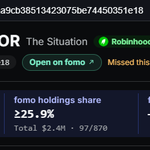
2️⃣ Check the FOMO holdings share. I usually look for >20%.
Why? FOMO holders are mostly diamond hands 💎🙌, which logically creates a much stronger price floor.
⚠️ Note: This play works best for established midcap tokens.
You can also check the holders' thesis summaries on there for extra DD and confluence. Happy trading! 🤝


Dary retweeted

We bonded. The bounty board is open.
WANTED: your best post about $kakacoin.
REWARD: 3,000,000 $kakacoin.
Tag @kakacoindotcom and reply here with your link. 72 hours. Top 3 take 60%, every other valid entry splits the rest.

Study the long eco

I keep seeing the @LaunchOnSF vs @longdotxyz model over and over, so let's just knock this out as simply as possible.
I understand the appeal of reflection tokens. You hold a coin, and tokens land in your wallet. I’ve seen those near six-figure reward screenshots too. Nice!
But follow where those rewards come from.
$STONK’s reward model taxes buys/sells of the launched token, sells the collected tokens for the paired asset, and distributes it to holders. Those payouts are funded by activity and token sales.
Now there might be concerns about the feedback loop when volume slows down:
Early rewards attract buyers. Buyers accumulate supply to capture more payouts. But if the cost of buying a position rises faster than its rewards, the proposition becomes less attractive.
In other words, if activity then slows, the reward pool shrinks. If rewards were the main reason people bought, then smaller payouts could further weaken demand.
That doesn't mean tokens can't survive, but it’s a dependency worth understanding.
Now on the other side, this is why LONG is in the position you see today.
LONG automatically recycles launch fees into locked liquidity. Instead of landing in your wallet, those fees deepen the market for the coin you hold.
Why does that matter? Because when someone sells, the available liquidity determines how much that sale moves the price. More liquidity around the trading price generally means less slippage for the seller and less price impact for everyone still holding.
For example, $AI alone holds $20M in total liquidity and has withstood multiple $1M and $2M sells without breaking the chart. This is important.
Wait for the first real pullback on the STONK ecosystem, then you’ll get why that matters.
Not because LONG tokens can’t dump. They can. But you want trading activity during the good days to build liquidity that can absorb selling on the bad days.
Both models depend on activity. If volume slows, STONK’s reward generation slows, and LONG’s liquidity accumulation slows. The difference is that liquidity already added doesn’t vanish just because fewer people traded today. Its value and composition can change, but the previous activity helped build a deeper market.
So I understand preferring rewards you can receive today. But “I don’t get reflections, therefore I get nothing” misses the whole point.
I’d rather fees help build the liquidity holders eventually need than judge an ecosystem's value purely by the reflections.
Hope this helps.
Dary retweeted

latest $ORCL news, just last two days:
• $ORCL just secured another $30 billion
• Jim Cramer hard shill $ORCL on X
• Oracle (ORCL) supplies data-center capacity for AI clients including OpenAI
• $250 by 2026 evaluation by Seeking Alpha (well -known investment site)
new headliners and news every day. everyone looking at OpenAI and Anthropic pairs, but $ORCL is the tech infrastructure behind all AI (AMD, ByteDance, NVIDIA, OpenAI, Meta).
behind $ORCL are all the salary slaves in the cages, clocking in every day, task by task.
CLOCK IN - anything for our shareholders


Dary retweeted

gLONG
Even now. The market is still extremely underpricing the LONG eco.
Keeping the underdog mindset is important we don’t get comfy at any point we keep pushing against all resistance.
Reminds me of how at the end of last year I pitched stock pairs to plenty of crypto VCs and got 0 follow ups. But we kept moving.
Understand this: the Long community owns one of the most powerful ideas in crypto’s history(arguably in finance) we have the conviction to push higher and stronger.
We will win.
LONG.