





Pinned Tweet
My PhD supervisor told me give the reader just four numbers to remember; doesn't matter however elaborate and complicated your empirical analysis. Those from whom I learnt public speaking said, Make three points – no one remembers anything beyond that.

It has long been a legitimate concern that multilateralism would fragment into a confusing spaghetti bowl of overlapping domains and groupings.
But what's driving these different groups?
Put pasta to work. Make multilateralism a competitive sport.
bruegel.org/podcast/brics-25 – at Singapore

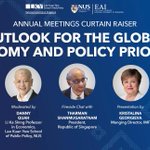
Wednesday 07 Oct 2026 2pm UTC+8
In 1hr at the Lee Kuan Yew School of Public Policy, IMF Managing Director Kristalina Georgieva speaks with President Tharman Shanmugaratnam on the global economy and policy priorities.
Livestream imf.org/en/news/articles/202…

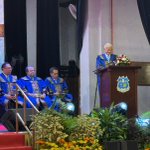
For its 210th anniversary my secondary school had me give a speech to alumni and students.
Calling Headmaster "Headmaster" makes everything Harry Potter-y.


Everyday now I walk into Lee Kuan Yew School buildings on the Bukit Timah Campus that look exactly like these buildings everyday I walked into for secondary school.
English colonial architecture FTW – at West Region, Singapore

Build cooperation worth joining. Stop waiting for the Great Powers to show up.
32-country median 61% back tackling global problems even without the US or China.
G-minus is in the data. Great Powers optional. Cooperation essential.
@RockefellerFDN rockefellerfoundation.org/re… – at Singapore

International order makes trade possible.
But what if the reverse causality also operates?
Trade builds order—not by forcing countries to agree, but by making cooperation inadvertent and ordinary.
thefreedomfrequency.org/p/tr… – at West Region, Singapore

Montek Ahluwalia's inspiring professional arc, wonderfully written up by Prakash Loungani, surfaces a story that is the best of East-West economic policymaking in Asia. imf.org/en/publications/fand… – at Singapore

In geoeconomics when confronting shocks that are not natural events but bear bad-actor intentionality, we need to respond using unconventional mixed strategies and without provoking unnecessary hostility. Call this economic diplomacy. – at Singapore


In geoeconomics you can ask, How can a Great Power get further ahead. Or you can instead ask, How can the rest of us respond better to the Great Power's actions.
Quah, Danny. 2026. "A Cooperative Advantage", IMF Finance and Development (Sep) pp. 24-27
imf.org/en/publications/fand… – at Brunei


Christoph Trebesch provides an intricate modern version of Kindleberger's Hegemonic Benefit. Hegemonic presence benefits those allied with it, through information or other frictions
thefreedomfrequency.org/p/gl…
In the model, bad-actor hegemons run the mechanism in reverse. – at Singapore

When the world was globalizing under rules-based multilateralism, individual states adopted straightforward strategies: be a price-taker; follow norms. Now that rules-based order is under attack, everyone proclaims instead geoeconomics.


In academic seminars, the behaviour of each generation of scholars is based on what that generation, as PhD candidates, observed of the previous generation. This is a surefire way of locking in either good codes of conduct or bad.
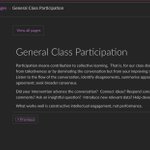
Be that as it may:
canvas.nus.edu.sg/courses/98… – at West Region, Singapore

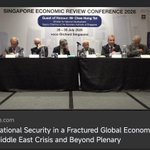
Talking International Security with my old friends Heng Chee, Tim Besley, and Jomo, and new ones made on the panel.
youtu.be/-OTHof4Q3Y8
Tue 28 July 2026. Singapore – at Hookwood, South East

In Economics research and teaching, policy evaluation and micro-intervention empower the student: "Fix poverty, do this." By contrast, more macro challenges don't provide that surface area quite as easily. Here's my attempt to change that impression.
canvas.nus.edu.sg/courses/98… – at Borehamwood, East


News can have all the same stresspoints as anywhere on Earth but hearing it in calm BBC tones while enjoying a tandoori chicken wrap is unexpectedly calming. – at London, England


What an amazing run of talent. For the rest of us it's the "CAG Shock". We can't keep up. – at Singapore

Over the past quarter, @CAG_LKYSPP underwent leadership changes and our team has also been busy with new research and events on regional security, economic security, and geopolitics.
Check it all out here: lkyspp.nus.edu.sg/docs/defau…

Debates about worldl order usually ask the question: who will lead next? The US? China? A concert of major powers?
All these entrust order to power. We need to stop asking who will rule. Instead start designing a system where states choose to remain.
thediplomat.com/2026/07/rede… – at Singapore

Danny Quah retweeted

Small states should resist one-dimensional narratives of an ideological struggle akin to that of the Cold War. Acknowledge a confluence of shocks.
Strategic space in shared incentives > universal consensus
By @DannyQuah channelnewsasia.com/commenta…

US lawmakers don't buy all that talk about US-China rivalry being the most consequential foreign policy challenge of our time.
youtube.com/watch?v=hyiVaABN…

Tue 28 Jul in Singapore I, Tim Besley, and other friends speaking at SERC 2026:
1130h-1250h Panel: International Security in a Fractured Global Economy
editorialexpress.com/confere…
1550h-1710h Papers: Political Economy
editorialexpress.com/confere…
DannyQuah.com/Storage/177641… – at West Region, Singapore

