

"He's kind of a strange dude, but in the best way possible." - student Detroiter; Philosophy Prof; OU Phil Camp advisor; Plato stan; musician; husband; dad.
Joined February 2017
- Tweets12.5K
- Following706
- Followers628
- Likes6.2K





In the early 2000s, GM made a faulty ignition switch that, over the course of two decades, killed over 100 people. The company only survived this debacle bc they lied about it until after a bailout. Public scrutiny was brutal.
Imagine they had announced those deaths in advance.


It never occurs to these people that knowledge and wisdom are intrinsically valuable.

I'd have thought that one could promote great works of literature & philosophy without attacking academic freedom, but apparently not.
We can imagine a maximally classical college with no single required reading. Is that good? I dunno. But common experiences are not essential.

Guess how many books all Harvard undergraduates read in common?
15? 8? 3?
The answer is zero. Not one.
Meanwhile every single graduate of Thomas Aquinas College in California has read
1. The Holy Bible
2. The Iliad — Homer
3. The Odyssey — Homer
4. The Republic — Plato
5. The Apology — Plato
6. Nicomachean Ethics — Aristotle
7. Politics — Aristotle
8. The Aeneid — Virgil
9. Confessions — St. Augustine
10. City of God — St. Augustine
11. Consolation of Philosophy — Boethius
12. Summa Theologiae — St. Thomas Aquinas
13. The Divine Comedy — Dante
14. The Canterbury Tales — Geoffrey Chaucer
15. Don Quixote — Miguel de Cervantes
16. Hamlet — William Shakespeare
17. King Lear — William Shakespeare
18. Macbeth — William Shakespeare
19. The Prince — Niccolò Machiavelli
20. Paradise Lost — John Milton
21. The Social Contract — Jean-Jacques Rousseau
22. Democracy in America — Alexis de Tocqueville
23. The Brothers Karamazov — Fyodor Dostoevsky
24. War and Peace — Leo Tolstoy
25. The Waste Land — T. S. Eliot
And so many more
"What position in this world can be baser than that of one who thinks it honorable to renounce the truth which is accepted on authority, and then relapses into an acceptance of falsehood which is still a matter of blind faith, unaided by independent inquiry?" - Al Ghazali
Amazing objection. No one has ever thought of this. If only the world had provided us philosophers with names like, I dunno, Aristotle, Ibn Sina, Aquinas...

The existence of immoral philosophy implies the existence of applied antiethics.
This is what often passes for "applied ethics" in business schools.


There’s no evidence that White House press secretary Katie Zacharia practiced law in the U.S.
Several experts said that if a person is not a licensed lawyer but is identifying as one, that presents serious ethical and legal problems. wapo.st/4ikpoPi

ALT A person is speaking at a podium with the White House emblem in the background. The text on the image reads, "Katie Zacharia calls herself a lawyer. The Post found no evidence that she was admitted to practice law in the U.S." Several hands are raised in front.
I have a child who absolutely loves reading, always has her hands on a book.
Does anyone have a child who loves reading, but only reads texts on their phone or computer screen?
I doubt this is possible, but maybe it is.
Maximus the Confessor on AI sentience:
"The senses, in accordance with the divine principle that is appropriate to them, are ... elements for the faculties of the soul, since they gently activate these faculties through their own apprehension of the inner logoi of beings."
This is my experience with both sides of that argument. When I'm reading doomers, I become less convinced of doom. When I'm reading those who downplay risk, I become more convinced of serious danger (if not doom).
In order to be maximally persuasive, both sides should shut up.

Imagine Europeans in 1650 debating about what circumstances it is permissible to lie to slaves, all the while assuming slavery itself is moral.
This is what AI ethics is like these days: endless disputes about how to treat AI, next to nothing on the immorality of AI development.
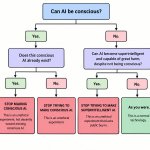
The more I think about it, the more I'm unsure about the moral relevance of *mere* consciousness.
If a being is conscious but permanently incapable of pleasure, pain, happiness, or unhappiness, do they have rights? I don't see why they would.


This is the Platonic form of AI accelerationism: wow, guys, so amazing, it'll totally destroy you!
But, I mean, in a good way.


"I don't think our consciousness controls our brain."
Tell me you know nothing about the free will debate without telling me you know nothing about the free will debate.

I don't believe we have free will.
I don't think our consciousness controls our brain or body, or makes decisions.
I think our brain undergoes (extremely complex) deterministic neurological processes that make decisions, and then we merely feel and experience those decisions.
Human consciousness is just the experience that arises from an extremely complex, self-referential, informational processing algorithm via evolved neurons and a brain.
And this has all been evolved as a biocomputational autopilot (our minds) for intelligently navigating a supercivilisation of cells (our bodies) through an extremely complex survival landscape.
This is complete with an evolved ego, sense of self, and deep inclination to self-preserve, maximise positioning in social pack dynamics, find mates, protect family and community etc.