


Daily Python Tips retweeted
Python is the #1 programming language in the world: bit.ly/2eNNcO9 - Proud to be part of this wonderful community. #positivepython
zip(zero or more) function allows you to iterate over number of iterables. #Python


filter (function,iterable) - evaulate given iterable against a condition and creates new iterable with items passing that condition. #Python

map() creates a new iterable by applying a given function to every element of the source iterable. #Python


Try using strftime function to convert python date-time object to string. #Python

Generators are iterators where the values are generated at the time of need without creating or saving all items. #Python


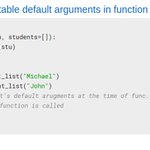
Python treats mutable default arguments in function definitions differently #Python
Here comes both good and bad practice.


Try using two leading underscores ( __x ), to define private class variables. #Python

If there is no any exceptions at TRY clause, the ELSE clause will be executed. #Python


Empty list ([ ]), zero (0), float zero ( 0.0 ), None and Empty String ( "") always evaluate to False. #Python


Checking whether two objects (lists, dictionaries, custom objects) you created are equal or not is called a test of identity in #Python.

Use get() method in #Python's dictionary to return a default value if key is not found. #programming

Comparisons can be chained arbitrarily in #python.
x < y <= z
is equivalent to
x < y and y <= z