

Founder & engineer, Lifted Holdings. Guides on payments, merchant fees & building fintech with AI. DM "STATEMENT" for a free statement markup.
Belvidere, TN
Joined November 2021
- Tweets846
- Following362
- Followers4.8K
- Likes807








Pinned Tweet
Most business owners have never had someone walk them through their card processing statement line by line.
I'll do it free. DM me the word STATEMENT, send a photo of your latest one, and I'll mark up every fee: what it is, whether it's normal, and what's padding.
No call. No obligation. Just a clear read on what you're paying.
Sezzle applied to the OCC for a national bank charter this week.
Most fintechs learn it eventually: the partner bank makes the hardest calls. Freezes, limits, what you're allowed to launch.
A charter is how you stop asking.
Anthropic just handed Agent Skills to the Linux Foundation's Agentic AI Foundation. A million skills published, nearly 280 million installs.
A skill is a file your agent follows with your permissions.
Read one before you install it, the same way you'd read a script.
Switching card processors? Moving the money is the easy part. These are the parts that bite.
1. Stored cards. If you bill customers on file, ask whether the old processor will transfer your saved cards to the new one. Some will, some won't, and re-collecting cards from every customer is painful.
2. Recurring billing. Subscriptions and payment plans live in the old system. List every one before you move.
3. The overlap. Keep the old account open until the last deposit lands and the refunds and chargebacks you expect have cleared.
4. Terminals. Some won't work with a new processor. Check before you sign, not after.
5. The old contract. Find the term, the early termination fee and the cancellation steps first. Cancel in writing.
6. Your statement name. Set it up on the new account so customers still recognize you.
Go slow and boring. Boring switches are the good ones.
Look up how your business shows on a customer's card statement.
If they see something like "PAY*JMS HLDGS 8885551212" instead of the name on your sign, some will dispute a charge they really made.
Your processor can usually change that name. Ask.

Claude Code 2.1.307: when a connection drops mid tool call, it no longer sends the call again. Only read-only or idempotent tools get retried.
That's the oldest rule in payments. If you don't know whether it happened, you don't get to do it again. Find out first.
Same week, two stories.
Banks are blocking AI agents that log in with a customer's shared password.
Visa, BILL and Billtrust are running a live pilot where an agent pays approved invoices with its own token and its own identity.
The AI isn't the difference. The credential is.

Owners: how did you end up with your card processor?
Your bank, a rep who walked in, a referral, or it just came with the POS?
Would you pick the same way again?
Walmart's new Agent Profiles are the cleanest agent setup I've seen from a big retailer.
Each AI agent gets its own profile. You approve every order or set a limit like $50 or $100. The agent never gets your card and can't change it.
Own identity, own limit, an off switch.
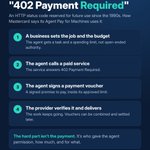
Builders: when your agent needs a paid API mid-task, how do you want it to pay?
A) An API key and prepaid credits per service
B) One budget, a signed payment per call (the x402 idea)
C) It stops and a human pays
Same sale, same price. A rewards card usually costs the shop more than a basic card.
Rewards cards carry higher interchange fees, and the business pays them.
Example rates on screen: basic card 1.5%, rewards card 2.1%.
🤖 Made with AI
Claude Code 2.1.306 fixed an API error that showed up as "prompt is too long."
A wrong error message is worse than none. You stop looking for the real problem and start fixing the one it named.
Same in payments. Log the processor's raw response, not just your summary of it.
US debit cards are required to support at least two unaffiliated networks, online too. That's the Fed's Regulation II.
Which network a debit sale runs on can change what you pay for it.
Worth asking your processor: do you route my debit for the lower cost, or for yours?
Before you sign a card processing agreement, read these five parts. They're where most of the surprises live.
1. Term and auto-renewal. Many run for years and renew on their own unless you cancel inside a short window.
2. The early termination fee. Some are a flat fee. Some are "liquidated damages," an estimate of what they'd have earned for the rest of the term.
3. The terminal. A lease is often a separate contract, sometimes with a different company, and it can keep billing after you switch processors.
4. Rate changes. Look for how much notice they give before raising rates, and whether a raise lets you leave without a fee.
5. Monthly and annual fees. PCI, statement, minimum-volume and annual fees add up before you run a single card.
If something was promised out loud, ask for it in writing. If it isn't on paper, it isn't in the deal.

Owners: what do your regulars actually pay with now? Cash, card, tap, phone, something else?
And did that change this year?
VS Code 1.143 can run one task through several models at once and have a judge model pick the winner.
Generating three answers got cheap. Reading three diffs didn't.
A judge can rank them. It can't tell you which one matches what your customer meant.
New Wildfire Systems survey: 71% of US consumers use AI services. Only 5% would trust an AI platform to process their agent's payment.
The shopping part is mostly solved. The paying part still has to earn trust, one boring safeguard at a time.
Agentic commerce: the AI finds the perfect product in four seconds, then spends three minutes waiting on a "verify it's you" text.