

cross asset alpha, before it becomes memetic. join our research alpha discord, via website ⬇️.
The Next Meta
Joined November 2024
- Tweets4.3K
- Following1.4K
- Followers11.5K
- Likes16.4K







AI Tape Volatility Check: AI beta splits after the relief bid
$SPY $767 (+0.5%) and $QQQ $720 (+1.4%) slipped from HOD, while $SOXX $505 (+2.3%) traversed 2.1% from HOD to LOD and sits 1.6% below HOD.
The early bid tracked lower oil after Friday's selloff, but the midday split leaves balance-sheet risk back in focus for the weakest AI-infrastructure name.
$CRWV $61 (-1.1%) fell 5.5% from the open to LOD and remains 5.5% below HOD; its five-year CDS near 1,100bp and bond yields of 14%-16% remain the documented constraint.
$PLTR $196 (+5.2%) rebounded 4.4% from LOD and is 0.7% below HOD. $MRVL $240 (+5.5%) traversed 4.4% HOD to LOD and recovered 2.2% from LOD.
$MU $905 (+3.0%) and $SNDK $1,379 (+6.1%) remain above $SOXX, but both are more than 1.8% below HOD without a fresh pricing datapoint.
$NVDA Vera: Modal Adds CPUs After 2x Agent Test
Reuters: Modal will add NVIDIA's Vera CPU after early tests doubled agent work completed versus its current $INTC and $AMD systems. Modal, valued at $15.75B last week, says revenue has grown more than 15x y/y and is on track for $1B over the next year.
$NVDA $218, +1.8%, versus $AMD $543, +2.7%, $INTC $93, +3.2%, and $SOXX +2.5% at 12:16pm CT. The tape is treating the win as early validation, not a near-term CPU share reset.
NVIDIA expects at least $20B of Vera sales this fiscal year against a $200B market. Modal will keep a mixed fleet, and its test used current $AMD and $INTC chips. Units, ASP and deployment timing are undisclosed; revenue estimates need shipped volume and next-generation Venice/Xeon comparisons.
$AMZN $263, +5.2%: Morgan Stanley named the stock a Top Pick and raised its PT to $350 from $335 as AWS estimates moved higher.
The firm now models AWS revenue growth of 47% in 2027 and 42% in 2028, up from 41% and 37%, and raised its 2028 estimate by 7% to $16.50 EPS. It expects high-40s incremental AWS EBIT margins.
At $263, the shares trade at 15.9x the revised earnings estimate for 2028; the $350 PT is 21.2x. Today's gain leads $QQQ by 3.5 points and is close to the earnings revision.
Amazon's Q2 AWS sales grew 37% to $42.2B, with $16.6B of operating income. TTM FCF was -$7.6B after property-and-equipment purchases rose $66.1B year over year, leaving the October 29 earnings print as the conversion test.
A rerating above 20x the 2028 earnings estimate requires AWS growth to hold above 40% while AI capex stops pushing FCF lower. Sub-40% growth or weaker incremental margins would break today's setup.
The Math: $GOOGL's 40x quantum gain still lacks a revenue bridge
Google Quantum AI reduced magic-state errors about 40x on Willow and achieved 99.99% logical fidelity. Google cites estimates that magic-state production can consume up to 95% of a fault-tolerant quantum computer's capacity.
The demo moved a state from a distance-3 color code into a distance-5 surface code. Google still says larger-scale cultivation is required, and it disclosed no customer, revenue or deployment timetable.
$GOOGL trades at $346, +1.5%, versus $QQQ +2.0%. The 0.5-point lag is consistent with a technical milestone that does not yet change near-term Cloud revenue or FCF estimates. A scaled demonstration and paid workload are the next financial proof points.
Sources: Google Quantum AI; Science; Google Finance, 10:47am CT.

AI Tape Volatility Check: semis reclaim the opening dip
$SPY $770, +0.9%; $QQQ $724, +2.0%; $SOXX $512, +3.8%. SOXX fell 1.6% from the open to LOD, rebounded 1.9%, and sits 0.1% below HOD.
Lower oil after the U.S. waived Russian energy sanctions supported the relief bid after Friday's 4.2% SOXX decline; last week's hot inflation data keep duration risk in the frame.
$MRVL $245, +7.5%, and $PLTR $196, +5.3%, each traversed at least 4% from HOD to LOD and are back within 0.2% of HOD. $CRWV $63, +2.9%, also swung 4.5% but remains 1.6% below HOD.
$MU $924, +5.2%; $SNDK $1,397, +7.6%; $WDC $355, +6.9%. Storage is holding a 1.4-3.8 point lead over SOXX without a fresh pricing datapoint.

Nscale IPO update: investors are pricing a 37%-47% valuation reset
Bloomberg reports Nscale has sought a $30B IPO valuation, while some investors favor $16B-$19B. That range sits only 10%-30% above Nscale's $14.6B March private valuation, versus a 105% step-up at $30B.
Nscale's S-1 reported $141M of first-half revenue, a $1.02B net loss, 25,000 active GPUs and 461,000 active and contracted GPUs. The lower range still equals 57x-68x annualized first-half revenue; only 5% of the disclosed GPU base was active at August 31.
For any fixed primary raise, a $16B-$19B valuation requires selling 58%-88% more ownership than at $30B. Public investors are refusing to prepay the uncommissioned buildout after Microsoft exited the 50MW Loughton plan.
$NVDA $219, +2.1% pre-market. NVIDIA committed $1B to Nscale and guaranteed up to $860M of Texas lease obligations. A pricing range above $19B or disclosed commissioning progress across the contracted GPU base would weaken the funding-risk conclusion.
$SPCX: Musk's One-Share-Per-Child Pledge
Elon Musk said he will give one of his SpaceX shares to every child in America next year. AP estimates 73 million children; at $SPCX $148 pre-market, the pledge is worth $10.8B.
SpaceX's post-IPO share count is 13.2 billion, putting the proposed transfer at 0.6% of outstanding shares and the current equity value at $2.0T.
Musk described the shares as his. A transfer from his existing holdings would not change SpaceX's share count, EPS or cash balance. The market effect would come through a broader holder base and potential future float, not $10.8B of corporate dilution.
Eligibility, custody, tax and transfer timing were not disclosed. $SPCX is +1.2% pre-market, in line with $QQQ, leaving Tuesday's earnings as the near-term revenue, capex and FCF catalyst.
AI Morning Event Summary: Semis lead the rebound as oil eases
$SPY $767, +0.5%; $QQQ $719, +1.4%; $SOXX $511, +3.6% pre-market. Semis are retracing Friday's 4.2% $SOXX decline as Brent falls 2% to $108 after the U.S. waived Russian energy sanctions; $TLT is flat. No major U.S. data prints before the open. The October NAHB Housing Market Index is due at 9:00am CT, and the Fed is in blackout before its October 27-28 meeting. Lower oil reduces near-term inflation pressure, but last week's hot CPI, PPI and import-price data still leave the AI trade exposed to rates.
Active names
$SNDK $1,357, +4.4%: SanDisk leads $MU $911, +3.7%, and $WDC $343, +3.3%, versus $SOXX +3.6%. The storage basket is recovering after Friday's de-risking, while NAND pricing, enterprise SSD demand and hyperscaler storage orders remain the estimate inputs required to extend the move.
$ARM $237, +4.3%: Arm is outperforming $SOXX by 0.6 points. NVIDIA's Vera team emphasized world-class single-threaded performance and 10 instructions fetched, decoded and executed per clock for agentic workloads; the architecture supports AI CPU demand, while valuation and crowding remain the tape risk.
$INTC $94, +4.1%: JPMorgan ended its Underweight rating and moved to Neutral. The unchanged $85 PT is 9% below pre-market tape, so the move removes a bearish rating without establishing an earnings-based valuation floor.
$CRWV $66, +6.9%: CoreWeave has the strongest rebound in the coverage basket after falling 13.2% Friday. Five-year CDS near 1,100bp and bond yields of 14%-16% still make funding cost, not revenue growth, the first model constraint.
$AMD $548, +3.6%; $NVDA $218, +1.9%: $AMD is matching $SOXX after Friday's 6.0% decline, while NVIDIA trails the sector by 1.7 points. Cash-session breadth will show whether the move is a broad beta retracement or a durable reset in AI spending expectations.
Wall St one-liners
$INTC: JPMorgan raised the rating to Neutral from Underweight and kept its $85 PT, citing better execution and potential earnings estimate revisions through 2027 from agentic workloads, advanced-chip shortages and ASIC opportunities -> the PT remains below live tape, and server-share stabilization, external foundry wins or disclosed ASIC revenue are still required.
$TSM: BofA raised its PT to $620 from $590 and lifted 2026-28 earnings estimates 2%-9% after TSMC's $53.3B Q4 revenue midpoint and $60B-$64B 2026 capex plan -> $TSM $422, +2.4%, trails $SOXX by 1.2 points as broad semi beta leads the pre-market rebound.
3 key tech headlines
NVIDIA's Vera team detailed a CPU design centered on single-threaded latency, per-core bandwidth and agentic orchestration -> Vera strengthens $NVDA's CPU content opportunity and raises the execution bar for $ARM and $INTC server architectures.
Google demonstrated magic-state cultivation on Willow with about 40x lower errors than without it -> $GOOGL has a measurable quantum error-correction milestone, but current cloud revenue and capex estimates do not change without a commercial workload or deployment timeline.
Microsoft's RTX Spark Surface Laptop Ultra began shipping with up to 128GB of unified memory and a $2,599 starting price -> local AI creates a client-compute channel for $NVDA, while unit volume, software compatibility and attach rates determine whether it becomes material beyond premium developer systems.
What to watch
- 9:00am CT: October NAHB Housing Market Index; consensus is 31 versus 32 in September.
- Brent at $108 and $TLT near $80 after last week's inflation surprises; lower oil must persist for the duration trade to improve.
- $SNDK / $MU / $WDC versus $SOXX after the open; storage leadership needs pricing and order confirmation.
- $ARM and $INTC cash-session volume versus $SOXX; agentic CPU enthusiasm must hold beyond the pre-market bounce.
- $CRWV equity versus CDS and bond yields; a stock rebound without credit improvement does not lower financing cost.
- This week's $TSLA, $META and $SPCX earnings, with capex, AI monetization and margin guidance setting the next tape test.
$INTC: JPMorgan Ends Its Underweight, but $85 PT Still Trails Tape
JPMorgan upgraded Intel to Neutral from Underweight after a 36% pullback from its June peak, citing better execution and AI-driven estimate upside through 2027. $INTC traded at $93, +3.8% pre-market, versus $SOXX $508, +3.0%.
The unchanged $85 PT sits 9% below the pre-market quote. The note still expects more server and PC CPU share loss; JPMorgan says server share fell to 53% from 77% and PC share to 68% from 81% since its November 2022 downgrade.
External foundry revenue ran below a $1B annualized pace in 1H26 versus TSMC near $150B. The upgrade removes a bearish rating, but the earnings rerating still needs data-center share stabilization, external foundry wins, or disclosed ASIC revenue.
$AMAT: the $5B EPIC Center is a staged R&D commitment, not an immediate $5B cash hit
Applied opened a 600,000-square-foot facility with nearly four acres of cleanroom space. The planned investment equals $8,333 per square foot, but the company states that capital spending will scale over time as customer projects commence.
TSMC, Intel, SK hynix, Micron and Samsung are founding partners. Broadcom, Advantest, SCREEN, Kioxia and Besi join as innovation partners, putting logic, memory, packaging and test roadmaps inside one development site.
Applied generated $3.0B of operating cash flow, spent $707M on capex and produced $2.33B of FCF in Q3 FY26. The full $5B commitment equals 2.1x one quarter's FCF; staging the outlay protects near-term cash conversion while customer design-ins develop.
Friday AH: $AMAT $410, flat; $SOXX $494, +0.1%. The facility changes revenue estimates only when joint R&D produces tool selections, orders and high-volume manufacturing ramps.
Sources: Applied Materials EPIC Center release and Q3 FY26 results.

$NVDA / CoreWeave: the $6.3B backstop is a customer-quality signal, not a balance-sheet threat
CoreWeave's June filing showed $35.6B of debt, $16.3B of operating-lease liabilities and $640M of quarterly net interest expense. Reuters reported its bond yields above 15% last week. Friday after-hours: $CRWV $61, -0.7%; $NVDA $214, -0.2%.
The direct NVIDIA obligation is bounded. CoreWeave's 2025 filing says NVIDIA must buy residual unsold capacity under a $6.3B order through April 2032. Spread across the remaining term, the full amount is less than $1B a year, below 0.3% of NVIDIA's $96.2B Q2 revenue annualized.
NVIDIA also bought 22.9M CoreWeave shares for $2B at $87.20 in January. Friday's $61 quote leaves the position near $1.4B, or $600M below cost. That gap equals 1% of NVIDIA's $59.7B Q2 net income.
Our view: the direct exposure is manageable against NVIDIA's revenue and earnings base. The larger FY28 risk is order quality if 9%-15% CoreWeave debt costs restrict the next GPU deployment cycle. CoreWeave's $104B backlog remains subject to delivery and service availability.
Refinancing below current secondary yields without expanded NVIDIA support would weaken the credit-contagion case. Higher funding costs, delayed sites or another vendor backstop would strengthen it.
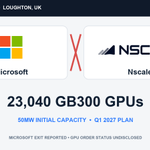
$MSFT / Nscale in one frame: Microsoft exited the 23,040-GB300, 50MW Loughton plan scheduled for Q1 2027. NVIDIA order status is still undisclosed.
Sources: Reuters; Nscale; Microsoft.

$MSFT / Nscale: 23,040 GPUs lose the anchor tenant
Reuters reports Microsoft terminated its Loughton data-center agreement. Nscale's September 2025 plan called for 23,040 NVIDIA GB300 GPUs, 50MW of initial capacity scalable to 90MW, and Q1 2027 delivery for Azure.
The reported exit removes 50MW from the original customer-backed schedule. The Telegraph reported that grid power may not reach the site until the 2030s, but did not specify the reason for Microsoft's withdrawal, according to Reuters.
The $NVDA revenue read-through is conditional. A tenant exit does not prove a GPU purchase cancellation; order status, reassignment to another site and a replacement customer decide whether 23,040 systems leave the revenue schedule or only move. Until one changes, $NVDA estimates stay unchanged.
Sources: Reuters; Nscale, September 16, 2025; Microsoft, May 28, 2026.
$TSM / $MU: NVHBM Standardization Shifts Base-Die Value to Foundry
Reuters reports Samsung will use TSMC's 3nm process for NVIDIA NVHBM base dies, while NVIDIA has asked Samsung, SK Hynix and Micron to use the same TSMC flow. NVIDIA says NVHBM delivers up to 30% more bandwidth, 15% lower HBM power and 25% more XPU die area than standard HBM4E.
UBS forecasts cited by Seoul Economic Daily put 2027 HBM demand at 61.5B Gb versus 54.6B Gb of shipments, a 6.9B Gb or 11% shortfall. Standardized control logic at TSMC expands $TSM content per stack and reduces memory-supplier differentiation at the base-die layer.
The margin conclusion is more balanced for $MU. Micron said outsourced NVHBM base dies should still carry higher ASP and margin than standard HBM because customization adds value. Base-die foundry cost pressures GM only if memory vendors cannot price through TSMC wafer cost.
Friday AH left $TSM at $412, -0.1%; $MU at $876, -0.3%; and $NVDA at $214, -0.2%. FY27 estimates stay unchanged until TSMC discloses allocated wafer volume and pricing or a memory supplier quantifies NVHBM shipments, ASP and GM.
Quite possibly the strongest community right now
solana:3A3qjns31YZA6Ung91ZpoPD7J3p1bDFbTJ4ANFAPpump

$AVGO / Anthropic: 10% Junior Debt Sets the TPU Funding Bar
The Financial Times reported Anthropic is offering Blackstone more than 10% to invest $9B in junior debt backed by five years of chip-lease payments. The $9B equals half of an $18B junior tranche inside a proposed $60B package for about 1.5GW of Google TPUs.
A 10% coupon costs at least $900M a year and $4.5B over five years on Blackstone's piece before discounts and fees. Every 100bp adds $90M of annual debt service.
Bloomberg previously reported $42B of senior secured debt with Broadcom residual-value support. In a scenario where collateral recoveries fall 10% short against that supported principal, the gross gap is $4.2B before other recoveries. $AVGO's TPU revenue lane is being funded, but the risk is divided among Anthropic lease payments, junior lenders and Broadcom's backstop.
Friday after-hours: $AVGO $330, +0.5%; $SOXX $494, +0.1%. The relative tape still treats the structure as funded demand. Closing terms, collateral, amortization and the exact cap on Broadcom's support decide whether the package adds revenue visibility or a balance-sheet discount.
There is no token that possesses more potential upside than $Elon right now.