
Dr Suri Lab Pvt Ltd is now CGHS Empanelled lab in Delhi
Joined October 2012
- Tweets17.5K
- Following5.1K
- Followers7.3K
- Likes10.7K





Pinned Tweet
Hello and welcome. I’m Dr J S Suri with Dr Apica Sharma the Host and the producer of the Podcast.
Today we discuss one of the biggest silent threats to healthcare in India — Antimicrobial Resistance (AMR).
The host of this Podcast oiis Dr Apica Sharma, a renowned economist from NITI Aayog ,
who brings vital insights into AMR’s economic and policy impact.
In India, antibiotics are often used without proper testing or prescription.
What seems like a quick fix is actually making infections stronger and treatments less effective.
AMR now affects not just health, but also our economy, healthcare access and national productivity.
In this episode, we’ll briefly explore:
Why antibiotics are losing effectiveness
How misuse, weak regulation and diagnostic gaps contribute
And, with Dr Apica Sharma, what AMR really costs India — and what actions are urgently needed
If you’ve ever wondered why some infections no longer respond to treatment — this conversation is for you.
I am extremely thankful to Dr Apica Sharma .
Let’s begin.
youtu.be/wgP118InxAc?si=Vpwu…
Healthcare Fragmentation vs Multiplicity
Many institutions. But do they make a healthcare system?
India has no shortage of healthcare providers, schemes, programmes or policies.
Public and private hospitals, CGHS, ESI, PM-JAY, state schemes, commercial insurers and numerous regulatory authorities.
But does multiplicity necessarily mean fragmentation?
Certainly not.
Multiplicity is the coexistence of several institutions, providers and financing arrangements. It can offer diversity, choice, competition and innovation.
Fragmentation occurs when these arrangements lack sufficient integration, coordination, common standards or continuity, compromising equity, efficiency and patient care.
The distinction is fundamental.
Consider Germany's Social Health Insurance, originating with Bismarck's legislation of 1883.
Germany has multiple sickness funds, public and private providers, and professional organisations. Yet these function within a statutory framework of common entitlements, solidarity-based financing, risk adjustment, negotiated payments and institutional accountability.
Not a fragmentation-free system, but an example of institutionalised multiplicity.
Where does India stand?
India's challenge is not merely the number of institutions, but how effectively they function together.
Three dimensions deserve attention:
1. Fragmentation of financing: Separate financial pools, unequal entitlements and inadequate protection against out-of-pocket expenditure.
2. Fragmentation of healthcare delivery: Disconnected primary, secondary and tertiary care, inadequate referral arrangements and poor continuity of care.
3. Fragmentation of governance: Divided responsibilities, inconsistent regulation and insufficient coordination between authorities and institutions.
But fragmentation does not arise in isolation.
Healthcare policies establish objectives and rules. Institutions translate them into organised arrangements. The healthcare system is how these arrangements actually function together.
Policies without effective institutions may remain promises. Institutions without coordination may become isolated islands of healthcare.
And patients are left to navigate the gaps.
The consequences include unmet healthcare needs, inequitable access, discontinuity of care and avoidable financial hardship.
Creating another scheme, hospital, insurance product or digital platform may expand services. It does not necessarily repair the system.
Nor would eliminating multiplicity automatically establish Universal Health Coverage.
The objective is not fewer institutions, but coherent policies, stronger institutions and a functioning healthcare system committed to equitable access and financial protection.
Perhaps we should ask less often who is providing healthcare and more often how healthcare is organised for those who need it.
A hundred institutions do not necessarily make a healthcare system. What connects them matters more than how many there are.
#HealthcareSystems #HealthcareFragmentation #UniversalHealthCoverage #HealthPolicy #HealthcareIndia – at New Delhi, India
Why blame MBAs alone? Are they setting the priorities, or implementing those of hospital owners, corporate boards and investors?
More importantly, who sets and enforces the rules governing healthcare?
India's deeper problem is fragmented governance, inadequate financial protection and weak institutional regulation.
Blaming MBAs is easier than reforming the healthcare system. Patients need the latter. – at Delhi, India

A welcome initiative by Tata Trusts, deserving appreciation.
But why does our healthcare discourse repeatedly celebrate more hospitals while overlooking the urgent need for comprehensive healthcare system reforms?
India's fundamental challenge is not merely inadequate hospitals. It is fragmented healthcare, inadequate financial protection, inequitable access, and the absence of effective institutional arrangements for UHC.
Philanthropy can build hospitals. Only systemic reform can ensure healthcare for all.
When will our healthcare intelligentsia shift its attention from individual initiatives to reforming the system itself? – at Delhi, India

INDIAN HEALTHCARE: IS THE MBA REALLY THE PROBLEM?
A 30-year-old MBA ordering a 60-year-old surgeon around may be disturbing. But is that why Indian healthcare is broken?
If only our problems were so simple! Replace the MBA, restore the surgeon's authority, and declare Indian healthcare repaired. Perhaps even hold an inauguration!
Meanwhile, millions face a rather different reality.
Healthcare they cannot access. Treatment they cannot afford. Illnesses that remain undiagnosed. Families exposed to catastrophic expenditure. Patients moving between fragmented institutions, often without continuity of care.
India has islands of excellent medical care, extraordinary professional talent and impressive technology. Yet excellence in individual institutions does not automatically produce an equitable, functioning healthcare system.
Our deeper deficiencies concern universal access, financial protection, effective pooling of resources, institutional accountability, regulation and coordination of care.
Doctors need clinical autonomy. Administrators need professional competence. Both need accountability.
But patients need something greater than either: a healthcare system that works for them.
We have spent decades debating who controls healthcare. Perhaps it is time to ask who remains outside its protection.
A broken hierarchy may inconvenience a surgeon. A broken healthcare system can devastate a family.
The real fault lines lie in inadequate public financing, fragmented healthcare delivery, weak regulation and governance, insufficient risk pooling, inequitable access, unaffordable out-of-pocket expenditure, and the largely invisible burden of unmet healthcare needs.
#HealthcareIndia #UniversalHealthCoverage #HealthSystems #PatientCentredCare – at Delhi, India

An important reminder from the United Nations.
Poverty denies people healthcare; unaffordable healthcare can deepen poverty.
Universal Health Coverage must mean accessible care, financial protection and dignity—not merely insurance coverage.
Ending poverty and achieving UHC must advance together.
#EndPoverty #UHC #SDG1 #SDG3 – at Delhi, India

Everyone has the right to live free from poverty and the chance to thrive.
Every efforts must be made to eradicate poverty so all people, everywhere, can live with dignity and prosperity.
Saturday is #EndPoverty Day.
un.org/en/observances/day-fo…


Healthcare Across Nations: What We Spend, What We Deliver, and Who Bears the Burden
1/5
Dr Soumya Swaminathan's discussion of looking beyond GDP raises an important question for healthcare.
If GDP growth and health expenditure as a percentage of GDP are insufficient measures, what should we compare?
I suggest three indicators:
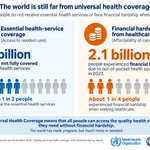
• Healthcare expenditure per capita, adjusted for purchasing power (PPP).
• UHC Service Coverage Index (SCI), SDG 3.8.1.
• Financial hardship (FH) from healthcare payments, SDG 3.8.2. – at New Delhi, India
4/5
India, Thailand, Germany, Japan, the UK and USA offer an instructive international spectrum.
Higher expenditure does not automatically guarantee better coverage or financial protection.
Equally, lower expenditure does not necessarily indicate efficiency. It may reflect inadequate investment, unmet needs or both.
We must examine what healthcare systems actually deliver for their populations. – at New Delhi, India
5/5
There is another patient whom expenditure statistics may overlook: the person who never receives needed healthcare and therefore spends nothing.
The objective should not merely be to raise healthcare expenditure, but to build institutions that translate adequate resources into accessible, quality healthcare without financial hardship.
Are we measuring what nations spend, or what their people actually receive?
#UniversalHealthCoverage #HealthSystems #HealthFinancing #SDG3 – at New Delhi, India
When Doctors Gained a Collective Voice — Germany’s SHI, 1913–1931
By the early twentieth century, Germany's sickness funds were well-established institutions financing healthcare.
But there was an interesting imbalance.
The sickness funds were organised. The doctors were largely independent practitioners.
The funds contracted with doctors to treat insured patients. This allowed them to expand healthcare access without having to build and staff their own medical facilities.
A practical arrangement. But not without friction.
Who would decide which doctors could treat insured patients, what they would be paid, and under what conditions?
After all, even in 1913, doctors and those paying their bills did not always see eye to eye!
Doctors had begun organising themselves, notably through the Hartmannbund, founded by Dr Hermann Hartmann in 1900.
Disputes over contracts, remuneration, choice of doctors and professional independence grew increasingly serious.
The Berlin Agreement of 1913 marked a turning point.
It strengthened collective representation of doctors and established more structured arrangements for resolving disagreements with sickness funds.
But agreements alone do not necessarily make enduring institutions.
In 1931, statutory Associations of SHI Physicians (Kassenärztliche Vereinigungen, or KVs) were established.
Over time, these associations became central to organising outpatient medical care, negotiating remuneration and distributing payments to participating doctors.
Something important was emerging.
Doctors could remain independent practitioners while providing care within an organised, collectively financed healthcare system.
The significance went beyond doctors' earnings.
It was about balancing the interests of those financing healthcare with those providing it, while maintaining services for insured patients.
Disagreements did not disappear. They probably never will.
But Germany progressively created institutions through which such disagreements could be negotiated rather than left entirely to individual bargaining.
The enduring lesson: A healthcare system need not eliminate conflicting interests. It must develop institutions capable of reconciling them.
And now comes an even more interesting question.
When sickness funds and doctors sit across the negotiating table, where does the patient sit?
That question takes us towards another fascinating chapter of German SHI: the patient's voice, entitlements and place in healthcare decisions. – at Delhi, India

A welcome step towards transparency in healthcare billing.
But transparency is not affordability, price is not quality, and issuing directives is not implementation.
Patients need more than displayed rates. They deserve assured quality, appropriate care, itemised billing, effective grievance redressal and protection against unaffordable expenditure.
The Clinical Establishments Act is not uniformly applicable across India. State-level enforcement remains crucial.
From a UHC perspective, the real test is whether this measure improves financial protection under SDG 3.8.2 and reduces out-of-pocket expenditure.
A useful administrative reform, certainly. But displaying the price of healthcare is not the same as ensuring access to healthcare.
Let transparency be a step towards systemic reform, not mistaken for its achievement.
#UHC #PatientRights #HealthcareQuality #FinancialProtection – at Delhi, India

In a push to make healthcare billing more transparent, the Centre has asked states and union territories to ensure that hospitals and other clinical establishments prominently display the rates they charge for services and facilities.
m.economictimes.com/industry…

An excellent observation by Nour H. Othman.
“Pay according to means, use according to needs” captures the spirit of solidarity.
My ongoing study of Germany's 143-year-old Social Health Insurance system explores how Sickness Funds institutionalised this principle, combining solidarity, choice and financial protection.
I have shared three reflections on SHI, Sickness Funds and their multiple responsibilities.
#SocialHealthInsurance #SicknessFunds
xitter.cf/DRJSSURI/status/210659…
xitter.cf/DRJSSURI/status/210706…
xitter.cf/DRJSSURI/status/210555… – at New Delhi, India

Dr J S Suri retweeted

The govt had many officers to ILO to learn about SHI. So much money has been spent. At least implement the most suitable system for the country. Many countries took the concept of SHI to implement NHI. Pay according to means use according to needs.
Bismarck and a Healthcare Idea That Refused to Grow Old
Otto von Bismarck is remembered primarily as the statesman who unified Germany.
But there is another Bismarck story that I have recently found fascinating.
In 1883, Germany introduced compulsory sickness insurance for sections of its working population. It covered only a small fraction of the country. It was nowhere near universal healthcare.
Yet it did something remarkable.
The system did not remain frozen in 1883. It expanded, adapted, encountered resistance, survived political upheavals and wars, faced rising medical costs, and repeatedly changed its machinery without abandoning its basic commitment.
Over time, limited sickness insurance grew into what we now call a Bismarck-type Social Health Insurance system.
What fascinates me is not merely where Germany eventually reached.
It is the journey.
How does a healthcare system begin with a small section of society and keep expanding its protection across generations?
How does it survive when healthcare becomes increasingly sophisticated—and increasingly expensive?
And why did an institution created almost a century and a half ago prove so adaptable?
I have been slowly following this journey.
It is turning out to be much more than the history of healthcare financing.
It is a story of continuity, adaptation and the long road towards universal coverage.
Should we not salute Bismarck.
Should we not talk about SHI, Social Health Insurance of Germany of 143 years old.
Should we not talk about many hats of Sickness Funds of SHI of Germany as a model which is a success story of UHC. – at Delhi, India

🌍 The World Health Summit 2026 has officially begun in Berlin
“To strengthen cooperation, resilience, and new approaches to health, the World Health Summit stimulates new solutions and partnerships between science, politics, civil society, and the private sector,” said Axel R. Pries, President of the World Health Summit.
At WHS Opening Night 2026, participants and partners gathered under this year's theme, “From Crisis to Resilience: Innovating for Health.”
WHO Director-General Tedros Adhanom Ghebreyesus and Georg Kippels, Parliamentary State Secretary to the Federal Minister of Health of Germany, marked five years of the WHO Hub for Pandemic and Epidemic Intelligence in Berlin.
“Five years on, the Hub has gone from strength to strength, helping countries detect and respond to threats faster, strengthening preparedness, and making the world safer from pathogens that know no borders,” noted Tedros Adhanom Ghebreyesus.
“Germany is proud to host the Hub. It strengthens our ability to detect and respond to health threats early and stands for our continued commitment to international cooperation and a strong, effective and science-based WHO,” emphasized Georg Kippels.
The evening also marked the handover of the WHS International Presidency from Lukoye Atwoli, host of the WHS Regional Meeting 2026 in Nairobi, to Chak-sing Lau, host of the WHS Regional Meeting 2027 in Hong Kong, China.
👉 Watch the full WHS Opening Night: youtube.com/live/SA503xhm4Gk
#WHS2026 #GlobalHealth