

exec coach, entrepreneur, community steward, farmhand, school builder, dad x3 || cultivating high consciousness x high agency
Boston, MA
Joined December 2008
- Tweets4.2K
- Following1.4K
- Followers1.4K
- Likes5.8K





Very bullish on the Ultra team. $62M (!!!!) is huge.
I've had the pleasure of seeing Jon go to work on this problem space, from when it was a twinkle in his eye to what it is now -- an industry-leading AI robotics company. He and his co-founders make a formidable team, and I'm excited to see what this next chapter brings.
Congrats to the team! 🔥🔥🔥

There cannot be a ChatGPT moment for robotics without robots. That's why at Ultra, we're focused on the industry's biggest bottleneck: deployment.
Since the very beginning, we've chosen to deploy before it was comfortable, learning lessons that only customers and the chaos of the real world could teach us.
Those lessons became the foundation for OP1, a robot designed from the ground up for the realities of scaled deployment. Through repetition, we've built the operational muscle and knowledge needed to scale the installation, operation, and servicing of our robots. And most importantly, we've learned how to enable our customers to succeed with them.
It's easy in robotics to become completely engrossed with the robot itself. But technology only matters when it's useful to someone. The best robot is the one people can rely on every day to build, do, and achieve more.
It's time to deploy more robots.
🙋♂️ If you’re optimizing for highest quality of life by cost, cities aren’t the best place to look.


Surprises me this is even a debate, so will try to say this plainly.
Happier people create happier people. This is a good thing. And they tend to be more integrated. Work. Relationships. Emotions. etc. They see a bigger picture.
Psychedelics are one way to help people become more integrated. There are many others. Progress isn’t always up and to the right. Sometimes it gets messy. Teachers & elders are essential.
What people’s lives look like on the other side of the integration is varied. Some leave their companies to become surf instructors. Some become even more ambitious. Some are parents. Some are artists.
Whether you agree or not with this particular modality, more integration is of civilizational importance.
Developing certain technologies is of civilizational importance too.
But this is a “both, and” not “either, or”.

Ari Emanuel says @pmarca is wrong that psychedelics make founders work less hard:
“That’s complete bulls**t. I had this argument with Marc.”
“5-MeO-DMT, that’s the best psychedelic in the world.”
“With 5-MeO, you smoke it. You’re tripping for about 30 minutes, and you realize how small we are in the world, and how meaningless in a weird way. Not in a bad way that you don’t want to work or anything, that you’re not aggressive or any of that. You just realize... you want a meaningful life.”
“I’m not half-assing things. Zero. There’s still plenty of calls. I’m up at 5:00 this morning, worked out, in the office, did another podcast. I got you. I’m going to Montecito for something. I’m working my tail off.”
Take away the *need* to rely on each other, and this naturally follows.
Reminds me of one of my favorite ideas: a community is a group of people who are, at least a little, indebted to one another.
This is downstream of choosing a life that, without your effort, puts you into the debt of others.

New newsletter: THE DEATH OF THE AMERICAN HOST
The share of Americans who say they host friends or family at their home at least monthly has declined by 70 percent in the last 50 years.
derekthompson.org/p/the-deat…

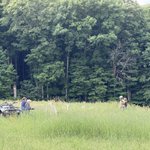
Borrowed the neighbor’s tractor.
Got the job done.
At the end, noticed the tire was flat. Valve stem was gone. Tire no longer sealed. Crap.
An apology. Then: YouTube, phone calls, trip to the hardware store. Lots of fumbling around.
Finally: F*cking fixed it! What a feeling.
Hard agree

There's a crucial distinction missing from this.
Getting what we want, without clarifying our desires, is a path to suffering and destruction. That's true for us as individuals and as a culture.
Clarified desire is where a good world begins.
intimatemirror.substack.com/…
With so much content slop moving around that’s laced with fear, it’s lovely to see something AI generated that’s born out of love.

Whoa. 🦉

Duncan Trussell recorded this conversation with his mother while she was facing terminal cancer.
What you’re hearing isn’t scripted. It isn’t performed. It’s a son sitting with his dying mother trying to hold onto every word before the words run out.
And she, the one facing the end, is the one doing the comforting.
That is what makes these conversations so extraordinary. Not the wisdom itself, as profound as it is. But who it’s coming from. A woman who had every reason to be consumed by her own fear choosing instead to spend what little time remained helping her son understand how to live without her.
These recordings became the heart of The Midnight Gospel. And I always go back to watch it again.
They remain some of the most honest conversations about death, love and what it means to be human ever put on screen…
Clarifying our desire is the work of our lives.
Once people catch the scent of what they really really want, things move…
One of the things I appreciate the most about master teachers, coaches, therapists, et al. is that they can smoothly turn confusing or paradoxical perspectives into something tractable for the person in front of them.
I got more work done in four hours last night than I could have done in a week before.
But I still feel like I’m behind…
🤔
Something here needs my attention.
What a great message for… everyone.

Steve Kerr says Roger Federer taught his Warriors team the secret to sustained success wasn’t outworking everyone, it was building a life around your craft you never want to escape from
“I’ll tell you a great story about Roger Federer. We were playing in China with the Warriors in 2017. Roger was in Shanghai for the Masters tournament, so we invited him to come speak to the team.”
“Draymond Green asked him, ‘How do you sustain success? How have you managed to win majors 20 years after you first won one?’ Everyone was expecting him to say, ‘I work harder than everybody,’ the will, all the clichés.”
“Roger Federer says, ‘I get up every morning and I make breakfast for my kids. Then I take them to school and drop them off. Then I go practice tennis for about two hours, and I’ve figured out a really good routine where I don’t destroy my body, but I can get all the work in I need.”
“‘Then I go have lunch with my wife. In the evening, we cook dinner together. The kids are all home from school. We ask them about school. There’s so much joy in the house. We put them to bed, and then I put my head on the pillow and go, “Man, that was just a great day.” And I’ve been doing that for 20 years.’”
“And it was like, yes. That’s it. That’s the formula. That’s what leads to sustained success. He loves tennis. He loves his family. He loves life. It’s not outworking everybody and banging your head against the wall, ‘I’m going to be better than everybody.’ It’s allowing your natural talent to shine through with a work ethic, with a great family life, with perspective, with peace, with mindfulness.”
“It’s perspective. It’s joy. It’s passion. It’s mindfulness. It’s an awareness that we are truly lucky. To get the most out of ourselves, it’s our daily rituals and experiences and love and joy.”
Derek R. Haswell retweeted

Enrollment doors are officially open for cohort #10 of Nervous System Mastery 🚀
Apply here → nsmastery.com
~~
What exactly is it?
In a nutshell, it's a 5-week live training to help rewire your stress response and reclaim agency over your internal state.
What will I learn?
Over the past 6+ years, we've developed an experiential curriculum that teaches practices to rewire reactive states: mostly through building awareness, shifting your state and feeling through emotions.
How have others benefited?
The student testimonials are frankly the reason that I keep running these cohorts. Please read through these stories from our alumni → nsmastery.com/outcomes
Who is the training for?
Typically our students fall into one of three categories:
1. Execs, Team Leaders & Founders who have woken up to the non-negotiable work of taking responsibility for their emotional state.
2. Creatives & Freelancers who wish to share their gifts with the world but feel overstimulated and have been prone to burnout in the past.
3. Coaches & Clinical Practitioners who wish to understand the neuroscience of stress & add tools to their coaching toolkit.
What else is included?
You'll get access to our incredible masterclass vault with 35+ hours of content from world-class guest speakers including:
1. Dr Rick Hanson (@drrhanson) on overcoming negativity bias
2. Joe Hudson (@FU_joehudson) demonstrating his transformative rapid-fire coaching
3. Tristan de Montebello (@Montebello) on mastering public speaking anxiety
4. Alex Olshonsky (@oloal) on exploring modern addiction in a distracted world
5. Brett Kistler (@AirKistler) on self-regulating in high-stress situations
6. Stephen Zerfas (@stephen_zerfas) exploring blissful jhana states
7. Derek Haswell (@DRHaswell) on the life-changing magic of Internal Family Systems
8. Dom Francks (@DomFrancks) on optimizing your home environment for nervous system health
9. Franzi + Ted Gonder (@franziskagonder) on how to raise regulated kids
10. Salim Najjar (@thatHRVguy) sharing practical tools for improving your HRV
We live in increasingly wild times – where nervous system capacity is becoming the most important skill you can cultivate for yourself and those around you.
Previous cohorts have sold out & we've already received over 400 applications for the current cohort, so if you would like to join us this year, here's the link to apply → nsmastery.com

Derek R. Haswell retweeted

I’m building a new website for a project I’m announcing in September.
Looking or a copywriter for a 1-2 week sprint. Most of the content is drafted. What I need is another set of eyes, sharp instincts, and taste.
Want someone hands-on who’ll get in the mud with me.
DMs open.
Matches our experience to a T.
We’re ~2 years in, past the honeymoon phase but still in the (cash incinerating) infrastructure build.
And we’ve never been happier as a family. :)

Purchased a small farm during the lockdown era (w/o a rural background).
My 2¢ on the good/ the bad/ the surprises (long list):
The Good:
- Owning a farm is a forcing function that will increase your baseline activity (and thus health, fitness) by magnitudes of order.
- We don't go out to eat, at all, so the quality of the food is superior b/c it is local, non-industrial, non-processed by default.
- You will begin develop your senses and begin to read signs, see things you did not notice before. Cloud patterns will mean "rain" or "wind." You'll know the difference between fox and coyote sign. Etc.
- You'll also appreciate migrating birds you may not have noticed before; when fox kits litter in the Spring, why bucks are in one part of the acreage at a certain time of the year, etc. You'll be much more in tune with nature (for good and bad!)
- Seasons become operational calendars, not scenery. Spring is repair-and-planting season; summer is a race against heat, weeds, and trying to keep the pastures / fencelines relative trim; fall is fencing, winterization; winter is a break when you "catch up" on all the things you didn't get to that can be done in the house or garage between snow clearing, of course.
- You'll develop real, practical skills by necessity. You can't take every piece of equipment that breaks to someone else, so you'll begin to learn how to patch your own tires, repair small engines. You're going to get equipment stuck - so you'll learn how to tow and use a winch. You'll eventually develop some Macgyver-ish ways of doing tasks smarter, not harder (like using a t-post puller to extract the broken remnant of a fence post.)
- You'll also become biased toward self-sufficiency, which makes you and your home more resilient in the event of power outages, weather events, etc.
- Over time this compounds into confidence. You will solve problems you've never seen before with such regularity that don't intimidate or surprise you anymore.
- Your daily view is something many people would pay good money to vacation at. Your air and water is cleaner than anything within 100 miles of a major city. And if you want to blast off fireworks or use your back 5 for a rifle range or stock your own pond, for the most part, there's no one stopping you.
The Bad:
- You have no idea what you're doing and on the internet that's mostly embarrassing but harmless and in the real world, driving a tractor or wielding a chainsaw, it can be deadly. Go slow, practice a lot, assume you're an idiot and drive accordingly - and get outside training if you can.
- IT IS MORE EXPENSIVE, not less, than living in an average suburban home. Esp in years 0-5.
-- Infrastructure eats the budget before the fun projects begin. Fencing, electrical work, outbuildings, maintaining or creating road access is not IG worthy but where you're going to spend most of your first dollars.
- Nothing is ever “done.” Everything has a maintenance obligation: fences need to be painted, barns need to be cleaned, garden beds need to be weeded, machinery needs fuel, fluids, batteries, tires etc x ꝏ
- This is a 24/7 lifestyle - much moreso than a startup. At the end of a day at your startup you can binge Netflix and order doordash. On a homestead you are turning animals in or out around sunrise and sunset every day of the year rain or shine and that comes before you feed yourself and certainly before TV. And you're going to make your own dinner.
- Everything is default inconvenient and manual.
- IG focuses on bucolic greenery, but you're going to be in muddy, dusty environments at least as often as you see beautiful landscapes.
- There are no days off. Seriously. Freezing rain in the dark? 20" of snow? Weekends, travel, illness, or holidays? Animals still need water, feed, and shelter. Grass (or whatever you're growing) still needs to be trimmed/ weeded/ managed.
Surprises:
- Owning chickens is in no way cheaper than just buying $12 eggs. They are a lot of fun though.
- You will spend an absurd amount of time mitigating pests and rodents, esp if you have feed. h/t @BowTiedBroke he's exactly right about this.
- Your local SPCA's spay and neuter program is probably cheaper and better (more practice!) than your vets by a wide margin.
- You're going to see a lot more death, and life!, than you ever would have imagined. Its fragility will go from being abstract to very real in a short time.
- Neighbors will either be a tremendous asset or a source of great frustration. Even with acres between you. Good neighbors are a force multiplier. Someone with a post-driver, bigger HP tractor, or 20 years of equipment repair knowledge will save you months of trial and error
- Buying the animal is the inexpensive part. Feed, bedding, shelter, fencing, veterinary care, replacements, processing, losses, and your time are the actual economics.
- You'll basically develop two wardrobes: "farm" clothes (which are beat to hell) and everything else. Over time the everything else wardrobe becomes smaller and smaller.
---------------------------------------------------
***TL;DR***
This life is for you if…
- You can tolerate repetitive, unglamorous work: hauling water, fixing fence, moving feed, cleaning mud.
- You find satisfaction in doing and maintaining things, not just acquiring them.
- You can afford for the farm to be a lifestyle investment rather than a profitable enterprise, esp at first.
- You value autonomy enough to accept responsibility at 5 a.m., during holidays, and in bad weather.
- You are willing to suck at a lot of things for a long time to practice them long enough to gain competence.
It is NOT for you if
- You need weekends, vacations, evenings, and holidays free.
- You dislike maintenance, mess, mud, insects, odors, rodents, and occasionally finding dead things.
- You want animals mainly for the aesthetic but not the daily care, feces, predators, and end-of-life realities.
- You can't afford it. This is much more expensive than you think it is; bare minimum maintenance costs alone will probably be >2X,XXX for anything over 10 acres with outbuildings and fencing.
- You'd rather outsource every repair, because rural labor and specialized service is scarce, slow, expensive or all 3.
Do I regret our farm purchase? No. I like the daily activity forcing function for practical fitness, to be a part of the world around me not merely a visitor to it, and I prefer uncomfortable, inconvenient self-sufficiency to convenient dependence.
But I'll be the first to say this is not for everyone, and even for someone reasonably aware of what they were getting into - the learning and adaptation curve was (is!) steep.
xitter.cf/i/trending/20896973666…


Loved this response from Paul.
Once I clearly connected the dots — how I treat my kids is a reflection of how I talk to myself (and vice versa — I realized how endlessly fascinating the parenting journey could be.
(That’s not counting the love that pours in.)

I think the thing I’ve learned as a parent is that
1. All kids are different
2. Different things work for different kids
3. Most parents are doing their best
4. Non parents cannot imagine how much increased capacity you have for absorbing your kids challenges and also how much love you have for them
5. Every parent has very challenging stretches
6. Parents with at least three seem to be the wisest. They’ve typically had at least one kids where certain approaches didn’t “work”
7. Most parents are learning on the go
8. If I listened to twitter parenting discourse or took ideas from popular ideas without thinking my life would be way harder.
9. Changing direction on parenting strategies can be very hard. Often the limiter is the parents personal growth capacity at that moment.
Love this.
In some ways it’s the same as it’s always been, but things are much more amplified now (which makes them more evident to those looking).
“Everything seems fake now.”
.@lulumeservey on companies paying for retweets on their product launches:
“Every launch uses the same slop cinematic video, same template.”
“Half of them, you go to the engagement—it's completely fake.”
“You can just start to tell that the amount of engagement this thing has is completely disproportionate to how interesting it actually is. And when you look through the people engaging with it, it's all some random account in a developing country that has no other tweets other than shilling products like this.”
“When that happens, I write off the entire company as fake.”
“I don't think, ‘This was a fake video or fake engagement.’ I think to myself, ‘It's a fake company with a fake founder. I will never buy their product or do business with them. I would never recommend somebody go work with them. The whole thing is fake.’”
“It's better to put out something that truly represents the best version of what you’re doing that might get lower engagement, but the people who are engaging are actually real people, and they care. It's better to get 50 people who feel like this is speaking to them than to get 4,700 retweets that seem obviously fake.”
👀
A deep dive conversation with @danshipper on how AI can (actually) improve your life.
We explore the human side of AI: why producing good work still requires taste, how coordinating agents can fry your attention and why automation actually creates more work for humans.
Timestamps:
0:38 Annie Dillard, art + writing
4:14 Can AI deepen human craft?
5:43 The slot-machine effect of AI agents
6:55 Dan's “house phone” experiment
8:01 What AI can actually help us create
13:55 AI as a non-specific amplifier
17:23 Why AI companies mishandled the story
19:36 Will AI destroy jobs?
22:35 AI as “frozen competence”
26:11 Are human-AI centaurs temporary?
31:34 Career advice for the AI era
37:19 The skills that matter now
40:08 @every as an AI research lab
42:25 The coherence problem
45:25 Rapid-fire questions
48:00 Super-intelligence by 2030?
50:44 Life after superintelligence
52:07 The questions Dan is living
53:02 Give yourself permission
